
Image: AI Generated
The image is by now familiar, a fragile boat in the Mediterranean, young men packed shoulder to shoulder, somewhere between Libya and Italy. Increasingly and shockingly enough, many of them are Bangladeshi.
Over the past decade, Bangladesh has emerged as a significant source of irregular migration to Europe. This is not a sudden surge, nor a temporary crisis. It is rather a structured system that connects Bangladeshi villages to informal labour markets in Southern Europe through a chain of brokers, smugglers and traffickers.
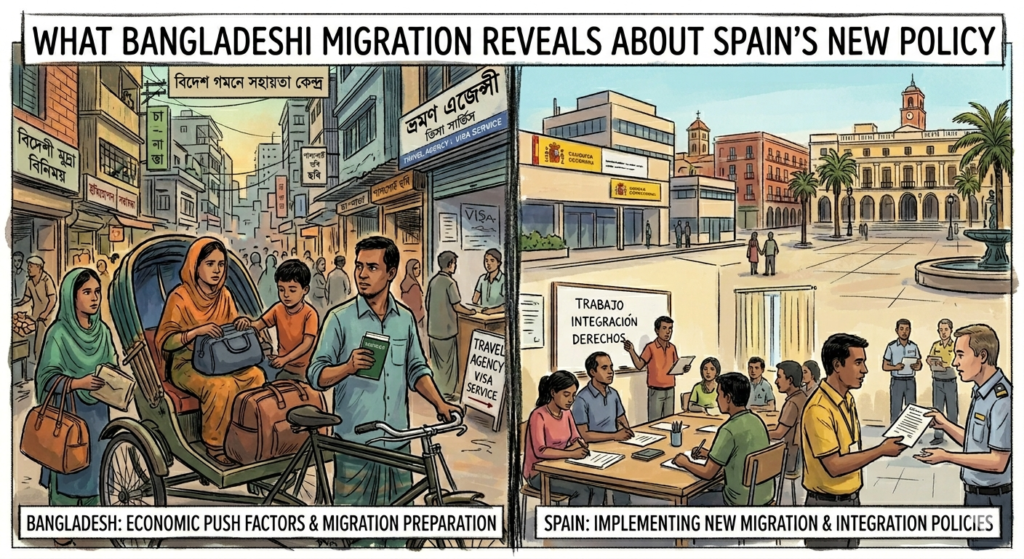
Spain has very recently moved to regularise hundreds of thousands of undocumented migrants. This step again has drawn attention to this system. But to understand what that decision means, we must first understand the irregular migration itself.
A crisis, made into a system
Bangladeshi migration to Europe is no longer marginal. Tens of thousands attempt the journey each year, with many entering through the Central Mediterranean route. Italy is the primary gateway, hosting a decent number of Bangladeshis, both documented and undocumented.
The journey typically begins legally, through flights to the Middle East or Turkey, before moving into irregular channels in North Africa, particularly Libya. From there, migrants are absorbed into a coercive system where movement is controlled by traffickers, and survival often depends on additional payments extracted through intimidation or violence.
The final leg is the most visible and the most dangerous, overcrowded boats crossing the Mediterranean. Deaths are frequent, and yet the flow continues.
This persistence reveals something important. These journeys are not undertaken blindly. They are calculated risks, shaped by economic realities, social pressures and the existence of established migration networks.
Why They Leave
The motivations aren’t simple, nor are they uniform.
Economic disparity plays the central role. Even low-paying jobs in Europe offer multiples of what many can earn at home. At the same time, traditional labour destinations, particularly in the Gulf, have become more restrictive and hence, less lucrative.
But economics alone does not explain the scale. Migration from Bangladesh is increasingly network-driven. In some districts, the entire communities are linked to European destinations through relatives, neighbours, and informal support systems. Success stories from them, however real or fake, create a powerful social logic behind this.
Crucially, legal pathways to Europe for low and semi-skilled workers remain extremely limited. In that vacuum, irregular routes become systematised.
Life in Europe’s Shadows
Arrival in Europe does not mark the end of hardship. For many Bangladeshi migrants, it marks a transition into a different kind of precarity.
Undocumented migrants typically work in agriculture, construction, and low-end services. Wages are modest, often below €1000 per month, and employment not secured. Legal vulnerability exposes them to exploitation, from unpaid wages to poor living conditions. And yet, they stay.
Because even within this precarious existence lies the possibility of stability. They send remittances back home, debts repaid, and eventually, the hope of regularisation.
Spain’s Policy Turn
It is within this context that Spain’s proposed regularisation of around 500,000 undocumented migrants must be understood.
The policy is not an act of open-door migration. It applies only to those already residing in Spain for a specified time and aims to bring them into the formal economy through temporary residency and work permits.
The rationale is straightforward. Spain faces an ageing population and labour shortages in key sectors such as agriculture, care work and services. At the same time, a large undocumented workforce is already embedded in these sectors, contributing economically while remaining outside formal systems.
Regularisation is therefore, less a departure from policy than an acknowledgement of reality. It seeks to convert an informal labour force into a regulated one. It will also result in improving tax collection, labour standards and administrative oversight.
Europe’s Quiet Contradiction
Spain’s decision also highlights a broader European dilemma. On one hand, the European Union continues to invest heavily in border enforcement, externalising migration control to countries such as Libya and Tunisia. On the other, member states periodically regularise undocumented migrants who have successfully entered and remained.
This dual approach reflects a structural tension among EU Member States.The result is a system that is restrictive at the border yet absorptive within.
What Changes and What Does Not
For Bangladeshi migrants already in Spain meeting the criteria, the benefits are immediate and tangible. Legal status reduces their vulnerability, enables formal employment and opens access to basic services.
Beyond Spain, however, the effects are more limited. The fundamental drivers of migration remain unchanged; economic disparity, constrained legal pathways and entrenched migration networks.
Spain’s policy does not make the journey safer. It does not dismantle smuggling networks. And it does not automatically alter the broader dynamics of migration from Bangladesh.
The Missing Response
If there is a gap in this story, it lies not in Europe, but in Bangladesh’s response.
Efforts to curb irregular migration have focused largely on awareness campaigns and reactive enforcement. These measures have had little to no impact against a system that is economically and socially embedded.
A more effective strategy would require:
- Stronger regulation of recruitment intermediaries, particularly the networks that blur the line between legal and illegal migration.
- Expansion of legal migration pathways through targeted bilateral agreements.
- Financial safeguards to prevent exploitative migration financing.
- Localised economic interventions in high-migration districts.
- Reintegration programs that reduce the pressure for repeated migration.
Without such measures, the underlying incentives behind irregular migration will persist.
A System That Endures
Bangladeshi migration to Europe is not sustained by a single policy decision, nor disrupted by one. It endures because each part of the system continues to function.
Spain’s regularisation is, in many ways, an admission of that reality. It recognises that those who have already arrived are not temporary anomalies, but part of a labour force that Europe consistently depends on.
Until that dependence is matched with coherent legal pathways and stronger governance at both ends, the boats will keep leaving, many will keep arriving, while many will be losing their lives chasing the European dream!
S M Saif Kader Rubab is a dedicated legal professional and the current Director of The Bangladesh Dialogue. An alumnus of both the University of Dhaka and the University of London, he is currently further honing his expertise through the BPTC LLM at BPP University, UK. Mr. Rubab is also a student member of The Honourable Society of Lincoln’s Inn, balancing his advanced legal training with impactful leadership in the legal and civic spheres.
Share it on :