
1. Background
I had the honor of participating as an expert panelist in the International Conference on “Strengthening BIMSTEC’s Role in Connectivity, Culture and Cooperation,” organized by Dr. Babasaheb Ambedkar Open University (BAOU) in association with the Ministry of External Affairs, Government of India, and the BIMSTEC Secretariat. The conference was held at Gift City Club, Gandhinagar, Gujarat, on 6-7 June 2026, corresponding with BIMSTEC Day, marking three decades of BIMSTEC’s contribution to regional partnership and development. It was a moment of both commemoration and forward-looking deliberation, bringing together a distinguished gathering of regional stakeholders to chart the grouping’s trajectory for the decades ahead.
The conference brought together delegates, diplomats, policymakers, academics, and practitioners from all seven BIMSTEC member countries – Bangladesh, Bhutan, India, Myanmar, Nepal, Sri Lanka, and Thailand. Structured around six thematic plenary sessions and a valedictory programme, the two-day event served as a significant platform for advancing regional dialogue on connectivity, trade, cultural diplomacy, peace, sustainability, and education.
Across every session, speakers returned to the idea that the Bay of Bengal is not merely a geographic or economic designation but a shared space of history, identity, and interdependence, and that the region’s full potential can only be realised through sustained, institutionalised cooperation anchored in mutual respect and shared aspirations.
2. Inaugural Session
The conference was formally inaugurated on BIMSTEC Day 2026. Prof. Ami Upadhyay, Vice-Chancellor of BAOU, delivered the welcome address, highlighting the University’s commitment to inclusive and technology-enabled education.
The keynote address was delivered by Dr. K.K. Khandelwal, Chief National Commissioner, Bharat Scouts & Guides, who identified connectivity, culture, and cooperation as the three foundational pillars of a stronger BIMSTEC. Amb. Sugandh Kumar Rajaram, Joint Secretary of the Ministry of External Affairs, India and National Coordinator for BIMSTEC, outlined India’s contributions under the 21-Point Action Plan, encompassing new Centres of Excellence, scholarships, youth exchange programmes, and digital public infrastructure projects that reflect India’s sustained investment in the grouping’s institutional development.
Amb. Akhilesh Mishra, former Ambassador and former Director General of the Indian Council for Cultural Relations (ICCR), underscored BIMSTEC’s demographic and economic potential alongside the civilizational ties binding member nations, and called for a renewed strategic vision for the grouping’s next three decades. He argued that BIMSTEC’s greatest unrealised asset is the depth of its civilizational connections, which predate the formal architecture of the organisation by centuries. Amb. Anil Trigunayat echoed these sentiments, advocating stronger intra-regional trade, people-to-people exchanges, and a more participatory approach involving academia and civil society in shaping the regional agenda. The inaugural session was anchored by Dr. Yesha Bhatt and concluded with a vote of thanks by Prof. Nilesh Modi, Director, School of Computer Science, BAOU.
3. Plenary Session I: Connectivity for Regional Integration
The first plenary session focused on the multi-dimensional nature of regional connectivity, with panellists drawing clear distinctions between physical, digital, and people-to-people dimensions of integration. Amb. Akhilesh Mishra emphasised that all three forms of connectivity are equally essential and mutually reinforcing, and stressed that digital trust and cybersecurity must be treated as foundational pillars of regional cooperation rather than technical afterthoughts. Without a secure and trustworthy digital environment, he argued, the region’s ambitions in e-commerce, data-sharing, and digital governance cannot be sustainably realised.
Representatives from Thailand shared advances in multimodal transport, green logistics, and infrastructure investment, and called for greater collaboration in transport digitalisation and border connectivity. They highlighted how smart border management and integrated logistics platforms can dramatically reduce transaction costs for intra-regional trade, particularly for small and medium enterprises. Delegates from Myanmar highlighted the critical importance of cybersecurity, digital governance, artificial intelligence, and skill development in building a resilient BIMSTEC digital economy, emphasising that capacity gaps between member states must be addressed through dedicated technical cooperation programmes rather than left to bilateral arrangements.
Amb. Anil Trigunayat framed digital connectivity as an enabler of the “3H agenda” – Health, Hunger, and Habitat – grounded in mutual respect and shared interests, arguing that connectivity investments are only meaningful if they translate into tangible improvements in the lives of ordinary citizens across the region. Other contributors underscored the roles of education, cultural exchange, and cross-border energy cooperation in ensuring sustainable regional growth.
4. Plenary Session II: Trade and Tourism
The second plenary examined the transformative potential of trade and tourism as drivers of regional integration and economic growth. Shri Siddhartha Dave set the tone by describing the Bay of Bengal not merely as an economic construct but as a civilizational space, a framing that resonated throughout the session. Ms. Farhana Ahmed Chowdhury, Deputy High Commissioner of Bangladesh, advocated strongly for regional solidarity and called on member states to approach trade relations with a spirit of mutual benefit rather than zero-sum competition, while Prof. Rajendra Kumar Anayath drew attention to shared spiritual values as a foundation for deeper regional understanding that can complement formal trade agreements.
Prof. Sandeep Kulshreshtha presented BIMSTEC tourism as a “Passport to Prosperity,” arguing that the region’s natural, cultural, and heritage assets remain significantly underutilised as drivers of cross-border visitor flows, and that coordinated visa regimes, joint tourism marketing, and regional circuit development could unlock substantial economic benefits. Prof. Lochan Rijal from Nepal spoke on the intersection of cultural conservation and sustainable tourism, emphasising that performing arts and heritage traditions must be treated as living assets to be preserved and developed rather than merely showcased for visitor entertainment. Amb. Anil Trigunayat highlighted the untapped potential of Indian cinema in promoting regional tourism and strengthening cultural connections across BIMSTEC nations, noting that soft power through popular culture often achieves what formal diplomacy cannot.
5. Plenary Session III: Cultural Diplomacy and Knowledge Exchange
Chaired by Prof. Ashok Mondal, the third plenary session explored how shared heritage, knowledge systems, and cultural traditions can deepen regional bonds and serve as a durable foundation for cooperation that outlasts the fluctuations of political relations. Prof. Mondal opened by arguing that cultural diplomacy serves as a powerful bridge for regional integration, with shared food habits, traditions, and practices creating enduring ties among societies that formal political and economic instruments alone cannot replicate. He called for a deliberate, institutionalised approach to cultural exchange that goes beyond festivals and performances to encompass research, archiving, and co-production of cultural knowledge.
Prof. Dr. Lochan Rijal from Nepal spoke about music as living cultural heritage, highlighting Nepal’s ongoing efforts to rebuild cultural assets damaged or disrupted by natural disasters and political transitions, and to channel performing arts into avenues for education and employment for young people. Mr. Karma Nidup from Bhutan emphasised the importance of folk traditions and oral literature in preserving the collective wisdom underpinning Bhutan’s Gross National Happiness philosophy, arguing that such traditions carry knowledge that cannot be captured in formal academic or scientific frameworks and must be actively protected from erosion by globalising forces.
Dr. Bhagyesh Jha reflected on the concept of Akhand Darshan and traced shared civilizational links, through ancient institutions like Nalanda, through manuscripts, festivals, and epics, that continue to unite societies across the Bay of Bengal. Invoking the principle of Vasudhaiva Kutumbakam, he argued that the region shares not only a past but a present and a future, and that recognising this civilizational continuity can provide both moral authority and practical motivation for deeper cooperation. Dr. Bhushan Patwardhan made a case for harnessing ancient knowledge systems, particularly Ayurveda, Yoga, and wellness diplomacy, as intellectual and cultural capital for the region’s development, noting their growing global recognition and the opportunity for BIMSTEC member states to collaborate on research, standardisation, and promotion.
6. Plenary Session IV: Peace and Regional Cooperation
6.1 Session Overview
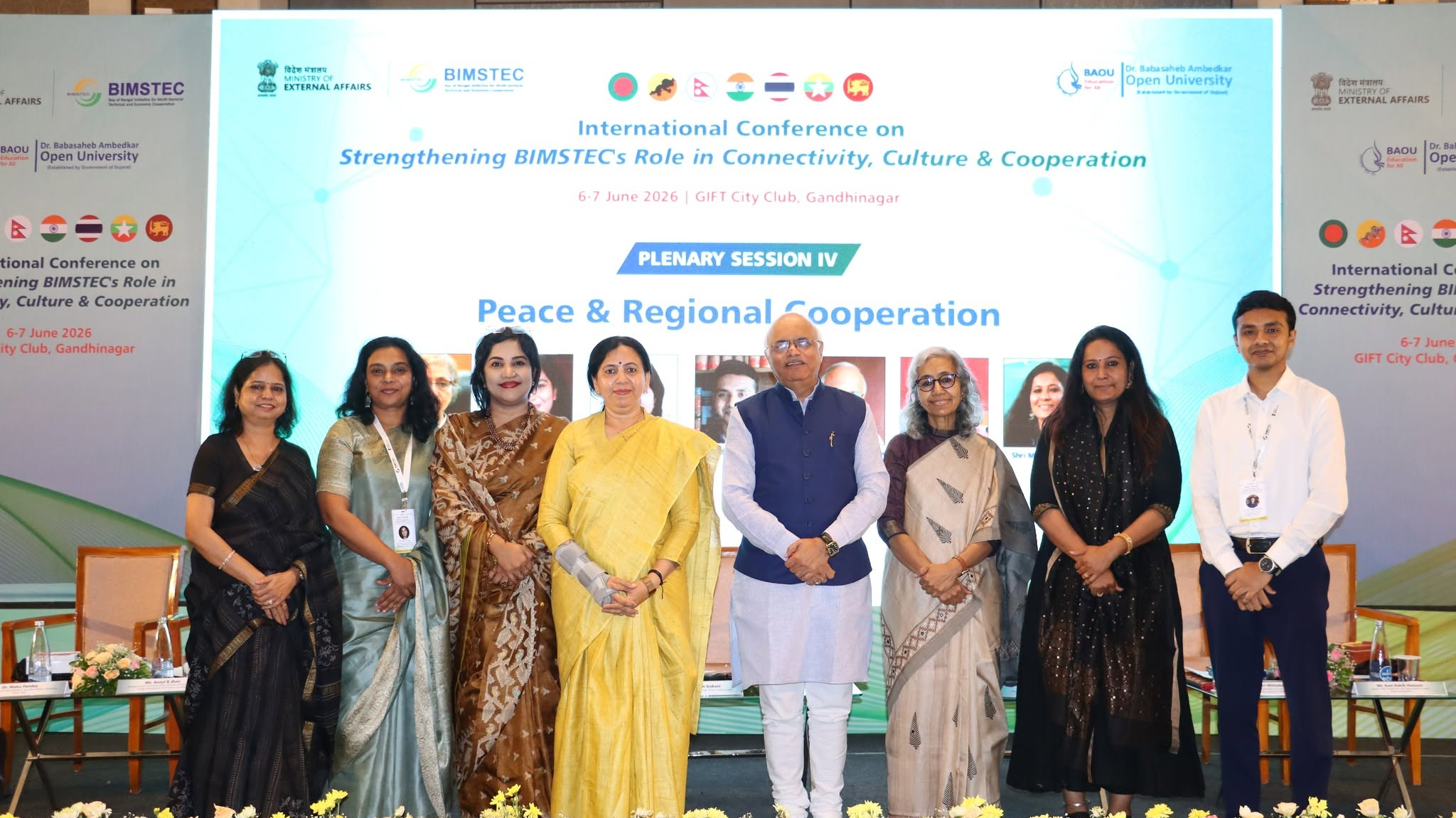
Plenary Session IV, on Peace and Regional Cooperation, was chaired by Hon. Justice Soniaben Gokani, former Chief Justice of the Gujarat High Court, notably the first woman to have held that distinguished office. The session brought together panellists from Bangladesh, Sri Lanka, and India to deliberate on peacebuilding, security cooperation, women’s leadership, and community-driven approaches to stability across the BIMSTEC region. In her opening remarks, Justice Gokani emphasised the indispensability of peace, inclusion, social justice, and women’s leadership in building resilient societies, drawing on Gandhian philosophy and the need for empathy and collective responsibility in addressing contemporary challenges. Her framing of peace not as the absence of conflict but as the presence of justice and inclusion set a thoughtful tone for the discussions that followed.
6.2 My Contribution as Expert Panellist
I presented on the theme of emerging regional challenges and the imperative of collective security frameworks within the BIMSTEC architecture. As the official State position of Bangladesh on conventional security issues had been presented in a written statement read by Ms. Farhana Ahmed Chowdhury, Deputy High Commissioner of Bangladesh to India, my remarks focused on non-conventional security dimensions, which I argued are increasingly central to the region’s stability and prosperity: cybersecurity, food security, water security, energy security, climate change, public health cooperation, and economic cooperation.
I began by acknowledging the tremendous honour it was, particularly as a lawyer, to speak in the presence of Justice Soniaben Gokani, a woman of extraordinary distinction who dedicated her career to the cause of justice and broke significant institutional barriers in doing so. I also, at the very outset, called on BIMSTEC nations to engage more actively and collectively in the peaceful resolution of the Rohingya refugee crisis, a humanitarian challenge that Bangladesh has been bearing with inadequate regional support and that demands a principled, multilateral response consistent with the values BIMSTEC espouses.
I opened the substantive portion of my remarks by articulating a people-centred definition of security: that security, in its truest sense, must mean ensuring a safe and prosperous present and future for the people of the region. This framing was deliberate; it shifts the reference point of security analysis from the state to the citizen, and from territorial integrity to human wellbeing, and provides the conceptual foundation for treating non-conventional security challenges with the same seriousness that has historically been reserved for military and political threats.
On cybersecurity, I argued that the rapid digitalisation of BIMSTEC economies has outpaced the development of coordinated regional safeguards. Member states operate largely in silos when it comes to cyber threat intelligence sharing, incident response, and digital governance frameworks. This fragmentation leaves the region collectively more vulnerable than any individual state’s domestic cybersecurity posture would suggest. I emphasised the need for a Cybersecurity Cooperation Mechanism that enables real-time information exchange and joint capacity building, particularly for smaller member states that lack the institutional infrastructure to address sophisticated cyber threats independently. Such a mechanism, I argued, should be anchored in clear data-sharing protocols, mutual legal assistance frameworks, and structured capacity-building commitments from more advanced member states.
On food security, I underscored that the Bay of Bengal region is highly prone to natural disasters and that any major disaster event translates rapidly into a crisis in agricultural production with cascading consequences for food prices, nutrition, and social stability. A critical feature of the regional geography, however, is that disasters rarely strike all member states simultaneously; different parts of the region are at different phases of their agricultural cycles at any given time. A coordinated regional supply chain and food reserves mechanism could therefore deliver better prices for farmers in surplus areas while ensuring food security in deficit regions, constituting a genuine win-win arrangement that the current absence of regional agricultural cooperation leaves entirely unrealised.
On water security, I drew attention to the shared river systems and transboundary water resources that simultaneously bind and create tension among BIMSTEC nations. The major river basins of the region, including the Brahmaputra, and the Ganges, traverse multiple national borders and sustain hundreds of millions of people whose livelihoods depend on predictable, adequate water flows. With climate change intensifying hydrological variability through more extreme droughts, floods, and glacial melt, equitable and cooperative management of these resources is no longer merely a development question but a peace and security imperative. I called for a regional water governance framework anchored in the principles of equitable use, transparency, data-sharing, and mutual benefit, noting that unilateral approaches to upstream water management have historically generated significant downstream tension and that the region cannot afford to allow water to become a driver of conflict.
On energy security, I drew reference to the earlier session’s discussion of the immense renewable energy potential of Nepal and Bhutan, particularly in hydropower, and the opportunity to share this clean energy across the region through cross-border grid integration. I observed that most BIMSTEC member states are heavily dependent on imported fossil fuels despite possessing no significant domestic reserves, making them structurally vulnerable to global commodity price volatility and supply chain disruptions, a vulnerability that has been painfully demonstrated by recent global energy shocks. The transition to regionally integrated renewable energy systems is therefore not merely an environmental aspiration but a strategic economic and security imperative. Regional energy cooperation, I argued, can reduce import dependence, lower costs for consumers and industries, and create new avenues for economic interdependence that deepen the regional peace dividend.
On climate change, I underscored that the Bay of Bengal littoral states are among the most climate-vulnerable in the world, and that this vulnerability is not a future risk but a present reality. Bangladesh, in particular, faces existential threats from sea-level rise, increased cyclonic intensity, and salinity intrusion into agricultural land and freshwater systems; threats that will displace millions of people and erode decades of development gains if not addressed through both domestic adaptation and regional cooperation. I argued that climate resilience must be formally recognised as a security issue within the BIMSTEC framework, and that regional responses, including jointly operated early warning systems, shared disaster response protocols, coordinated climate finance advocacy, and mutual support for adaptation investment, must be institutionalised rather than left to ad hoc bilateral arrangements that are inherently less reliable and less efficient.
On public health cooperation, I noted that there is a substantial and growing flow of health tourism from Bangladesh to India and Thailand in particular, driven by quality disparities in specialist medical care. While this serves patients with complex or terminal conditions, it also reflects an underlying gap in regional health infrastructure that must be addressed at the primary and secondary care levels within each member state. Drawing on the lessons of the COVID-19 pandemic, which exposed the region’s inadequate mechanisms for disease surveillance, pharmaceutical cooperation, and rapid-response health coordination, I argued that BIMSTEC urgently requires a robust Regional Health Security Network capable of coordinating pandemic preparedness, expertise sharing, joint pharmaceutical research, and supply chain resilience for essential medicines. The pandemic demonstrated with devastating clarity that no country can fully protect the health of its citizens in isolation, and that regional solidarity in public health is both a moral and a practical necessity.
On economic cooperation as a dimension of security, I highlighted that economic growth and opportunity on both sides of national borders are essential prerequisites for preventing the conditions- poverty, inequality, and the absence of legitimate economic options- that drive trafficking, smuggling, and irregular migration, challenges that consistently strain bilateral relations and impose significant human costs within the BIMSTEC region. In the broader context of an escalating global trade war and the growing fragmentation of the international trading system, I argued that a more economically integrated BIMSTEC, with deeper supply chain linkages, harmonised trade facilitation, and a stronger collective voice in international economic forums, would be far better positioned to weather external shocks and to avoid being drawn into the crossfire of superpower rivalries that increasingly threaten to polarise the global order.
I concluded my remarks by emphasising the importance of developing trust and fostering meaningful connections among the 1.8 billion people residing within the seven member nations of BIMSTEC, highlighting how strengthening these ties can pave the way for greater regional cooperation, shared prosperity, and mutual understanding. I also took a moment to express my sincere gratitude to the organisers for their exemplary efforts in facilitating this gathering, and to my fellow panellists for their insightful contributions and engaging perspectives throughout the discussion.
6.3 Other Panellists’ Contributions
Ms. Anzul B. Jhan from Sri Lanka spoke on peacebuilding and stability in the Bay of Bengal, describing it as a shared civilizational space and underscoring trust as the bedrock of regional cooperation. She emphasised that durable peace is not simply the absence of armed conflict but is built through the patient accumulation of collaborative experience, mutual respect, and people-to-people engagement at every level of society. Ms. Farhana Ahmed Chowdhury from Bangladesh addressed the deep interconnection between security and development, arguing that poverty, inequality, and the exclusion of marginalised groups are themselves drivers of instability and that the region’s security architecture must be designed to address these structural causes rather than only their symptoms. She emphasised the need for collaborative efforts to address terrorism, cyber threats, trafficking, and other transnational challenges through a genuinely people-centric security lens.
Dr. Vinay Sahasrabuddhe spoke on women in culture and community leadership, arguing that culture is a unifying force and that gender justice and equality of opportunity are not peripheral but integral to social harmony and regional cooperation. Societies that exclude or marginalise women from positions of leadership and cultural production, he argued, are systematically depriving themselves of half their creative and intellectual potential. Dr. Nisha Pandey presented women as leaders, innovators, cultural custodians, and architects of sustainable civilisations, highlighting their foundational contributions to heritage preservation, entrepreneurship, and regional development, and calling for institutional frameworks that actively create space for women’s leadership rather than simply waiting for it to emerge.
Shri Mittalben Patel offered powerful grassroots perspectives on community leadership for peacebuilding, emphasising dialogue, inclusion, and citizen-led initiatives as the most durable foundations for lasting peace. Drawing on direct experience with community-based conflict resolution, she argued that peace is ultimately built at the level of neighbourhoods, villages, and local institutions, and that formal peace processes are only sustainable when they are anchored in the trust and ownership of ordinary citizens. In her concluding remarks, Justice Gokani connected the session’s deliberations on peace, security, culture, and women’s leadership, drawing on Gandhian values, the Bhagavad Gita, and civilizational wisdom to remind participants that meaningful regional cooperation begins with inner transformation, empathy, and a commitment to embodying the change one wishes to see in the world.
7. Plenary Session V: Sustainability, Climate Resilience and the Blue Economy
The fifth plenary session addressed sustainability, climate resilience, food security, and the potential of the Blue Economy as interconnected pathways for regional development, reflecting a growing consensus that environmental and economic agendas cannot be addressed in isolation from one another. Ms. Dezome from Bhutan discussed climate change adaptation strategies, emphasising nature-based solutions and community-centred approaches to environmental management, and the need for coordinated regional responses to challenges, such as glacial lake outburst floods and changing monsoon patterns, that do not respect national boundaries. Ms. Thi Thi Myinth from Myanmar spoke on food security through cross-border agricultural innovation, stressing the importance of integrating indigenous knowledge systems with modern agro-technology to build food systems that are simultaneously productive, resilient, and ecologically sustainable.
Prof. Ashok Mondal presented a community-centred approach to development inspired by Rabindranath Tagore’s vision of self-reliance and grassroots empowerment, arguing that the most durable path to sustainability runs through the agency of local communities rather than top-down technocratic interventions. Mr. Binay Kumar Singh explored Blue Economy opportunities for joint development across the Bay of Bengal, with a particular focus on maritime connectivity, fisheries management, and the sustainable use of marine resources. He argued that the Bay of Bengal’s extraordinary biological and mineral richness remains largely unexploited in a coordinated regional sense, and that a shared framework for Blue Economy development could generate substantial economic benefits while protecting the ecological foundations on which those benefits depend.
Ms. Priti Saran, IFS (Retd.), addressed marine resources governance with particular urgency, underlining the dangers of uncoordinated resource extraction, the threats to marine biodiversity from pollution and warming seas, and the need for effective regional ocean governance supported by strong policy coordination and enforcement capacity.
8. Plenary Session VI: Education, Human Development and the Future Workforce
Chaired by Prof. Nageshwar Rao, the final plenary explored how education, skills, innovation, and academic mobility can shape the BIMSTEC region’s future and ensure that its young and growing population is equipped to participate in, and lead, the knowledge economy of the twenty-first century. Dr. Soontharee Namliwal from Thailand called for stronger industry-linked education, lifelong learning frameworks, and structured cooperation on human capital development, arguing that the pace of technological change is outstripping the capacity of existing educational institutions to prepare graduates for the labour markets they will enter. Dr. Kamlesh Upadhyaya highlighted the need for regional health security through disease surveillance networks, pharmaceutical cooperation, and climate-health initiatives – themes that resonated closely with the discussions in Plenary Session IV and reinforced the cross-cutting nature of health as a development and security challenge.
Prof. Rajat Moona focused on digital workforce transformation, advocating AI literacy, curriculum reforms, and targeted upskilling programmes to ensure that the region’s workforce is prepared for an economy increasingly shaped by artificial intelligence and automation. He argued that countries that fail to invest now in AI-readiness risk structural economic marginalisation, while those that act decisively can position themselves as regional leaders in the emerging digital economy. Dr. B. Shadrach called for enhanced educational exchanges through university alliances, scholarship programmes, credit transfer systems, and mutual recognition of qualifications across BIMSTEC nations; a set of reforms that would increase academic mobility within the region and help build the networks of shared intellectual experience that underpin lasting regional cohesion.
Prof. S.O. Junare underscored the importance of joint degree programmes and collaborative research initiatives in emerging areas such as cybersecurity, artificial intelligence, and forensic sciences, where the convergence of technical and policy expertise is particularly critical and where no individual member state has a monopoly on knowledge or capacity.
9. Valedictory Session
The valedictory session was graced by an assembly of distinguished guests: Dr. Pradyuman Vaja, the Hon’ble Education Minister of Gujarat; Dr. Hemang Joshi, Member of Parliament; Ambassador Preeti Saran; Dr. K.K. Khandelwal; Shri Sugandh Kumar Rajaram; Prof. Ami Upadhyay; and Dr. Bhavin Trivedi, Registrar of BAOU. The session served as both a summation of the conference’s deliberations and a forward-looking statement of intent, with speakers collectively articulating a vision for BIMSTEC’s next phase that is more ambitious, more institutionalised, and more oriented toward tangible outcomes.
Dr. Vaja emphasised education as the most powerful instrument of social transformation available to the region and unveiled BAOU’s new course, “India and BIMSTEC: Strategy, Diplomacy & Regional Cooperation (CCIB),” describing it as a reflection of the institution’s deepening commitment to BIMSTEC scholarship and its recognition that regional cooperation requires a well-informed and analytically equipped generation of future leaders and practitioners. Dr. Hemang Joshi described the Bay of Bengal as a bridge of civilisations and issued a compelling call to BIMSTEC nations to move from dialogue to delivery, from connectivity to community, and from shared geography to a shared destiny, powered by youth-driven regional development that harnesses the energy, creativity, and ambition of the region’s largest demographic.
Ambassador Preeti Saran highlighted BIMSTEC’s growing role as a bridge between South and Southeast Asia, with tangible progress in connectivity, trade, energy, disaster management, and digital cooperation, and described it as an increasingly credible model for inclusive development and collective security in a multipolar world. Prof. Ami Upadhyay presented the conference report and proposed the establishment of a BIMSTEC Research Centre and a Knowledge Lab at BAOU — initiatives that would provide institutional infrastructure for the kind of sustained, evidence-based regional scholarship that the grouping needs to translate aspiration into policy. She described BIMSTEC as a civilizational partnership that transcends the category of an economic grouping and expressed the University’s firm intention to position itself as a key knowledge partner for the region’s shared aspirations.
10. Conclusion
Participating in this conference as an expert panellist was a highly productive and enriching experience. The opportunity to engage substantively with senior policymakers, former diplomats, academics, and civil society leaders from across the BIMSTEC region, and to contribute to the discourse on peace, non-conventional security, and regional cooperation from a Bangladeshi perspective, was both professionally rewarding and personally significant.
The deliberations across all six plenary sessions and the valedictory programme collectively reaffirmed that BIMSTEC, at thirty, stands at a genuine inflexion point. The foundations of trust, shared identity, and institutional architecture that have been built over three decades provide a platform on which a far more ambitious and effective programme of regional cooperation can now be constructed, if member states summon the political will to move from dialogue to delivery. The proposals that emerged from this conference, spanning cybersecurity, water and food security, energy cooperation, climate resilience, public health, the Blue Economy, education, and economic integration, constitute a forward-looking agenda that is both comprehensive and actionable.
Bangladesh has a central, indispensable, and multifaceted role to play in this next phase of BIMSTEC’s development. Our geographic position, our development trajectory, our demographic dividend, and our experience of managing complex transboundary challenges all equip us to be not merely a participant in the regional conversation but a genuine leader and agenda-setter.
About Author:
Kazi Rakib Hossain is a lawyer based in Dhaka, and he currently serves as the Chief Operations Officer of The Bangladesh Dialogue Foundation.
Disclaimer: AI assistance was used in the preparation of this report. The substantive content has been derived from the post-program reports published by BAOU, as well as from the author’s personal notes.