
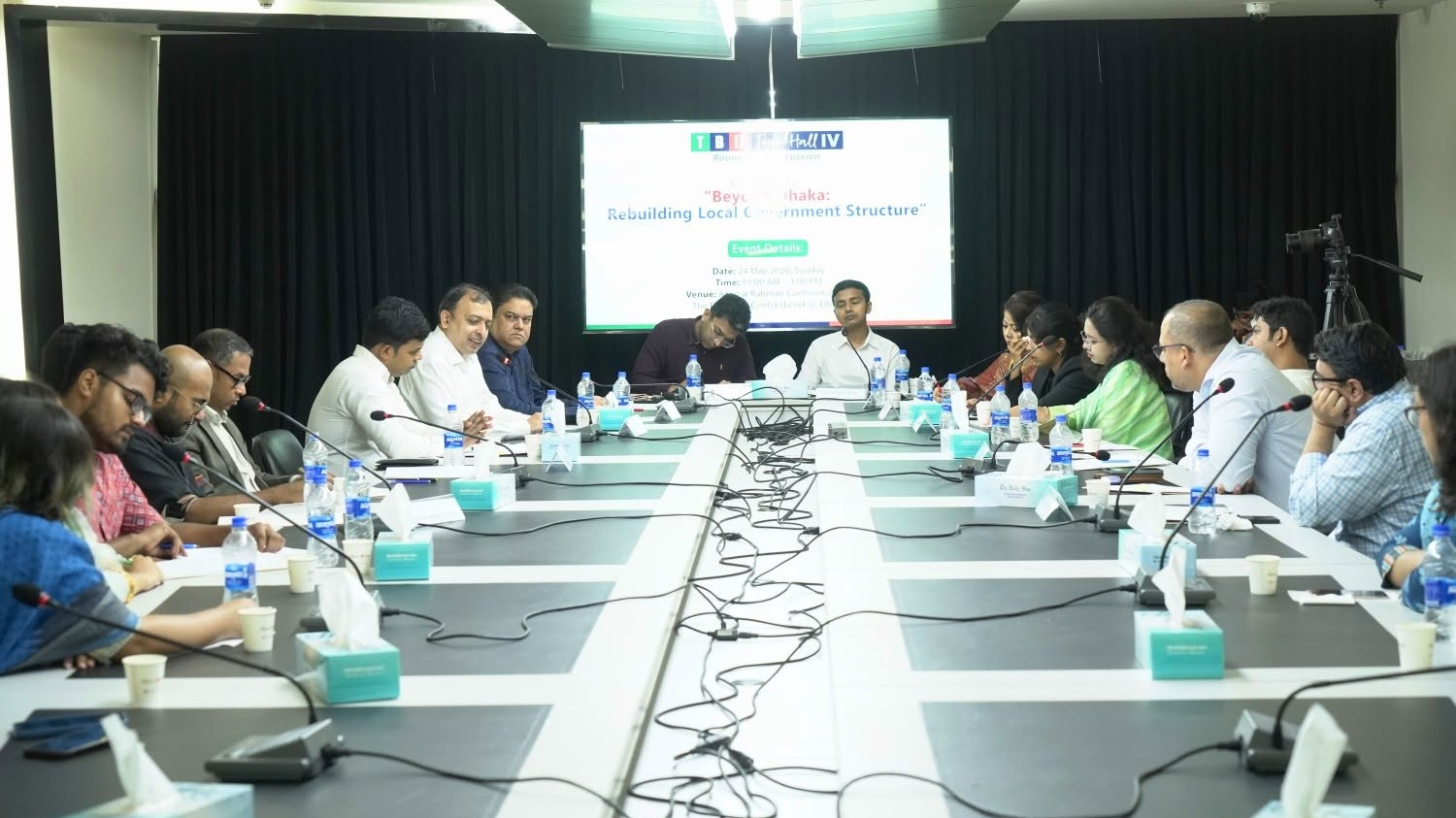
The fourth Town Hall discussion organized by The Bangladesh Dialogue (TBD) was held on Thursday at the Azimur Rahman Conference Hall of The Daily Star Centre under the theme “Beyond Dhaka : Rebuilding Local Government Structure”
The event brought together representatives from various sectors of civil society, including Members of Parliament, politicians, academics, and journalists.
The session was chaired by Mr. Aslam Beg Sayem, Director of The Bangladesh Dialogue. The discussion was moderated by Kazi Rakib Hossain, Chief Operations Officer of The Bangladesh Dialogue, while S.M. Saif Kader Rubab, Director of The Bangladesh Dialogue, delivered the keynote address.
Among the distinguished participants were Members of Parliament Bithika Binte Hossain MP and Dr. Sansila Zebrin Priyanka MP; Mr. Alauddin Mohammad, Joint Member Secretary of the National Citizens Party (NCP); Mr. Manabendra Dev, Central Committee Member of the Communist Party of Bangladesh (CPB); Oliur San, Member of the Network for People’s Action (NPA); Adv. Fayazuddin Ahmed, Policy and Advocacy Lead at WaterAid; Aaqib Md. Shatil, Special Correspondent at Netra News; Dr. Bulbul Siddiqi, Professor of Political Science and Sociology and Director of the Confucius Institute at North South University; Dr. Nurul Huda Sakib, Chairman of the Department of Government and Politics at Jahangirnagar University; Dr. Tanvir Ahmed, Professor of Civil Engineering at BUET; Sumaiya Binte Sazzad, Executive of The Bangladesh Dialogue; and Sakib Ahmed Siam, Jahangirnagar University Correspondent for The Daily Star.
Throughout the discussion, speakers emphasized several key issues related to local government reform. Participants stressed the need for greater autonomy for local government institutions, particularly in terms of taxation and revenue collection powers. They also discussed strategies for reducing the pressure on Dhaka by strengthening and utilizing other major cities more effectively.
The role of village courts received significant attention, with speakers advocating reforms to improve their effectiveness and accessibility. Participants also highlighted the importance of media decentralization, arguing that a more decentralized media landscape would help facilitate the decentralization of local governance. The discussion further addressed the issue of interference by Members of Parliament (MPs) in the activities of locally elected representatives. In addition, special emphasis was placed on increasing women’s participation in local government institutions.
In his closing remarks, Mr. Aslam Beg Sayem stated that many political leaders around the world have emerged from local government institutions. He explained that local government can sometimes be a source of comfort for the central government, while at other times it may become a source of concern, because when local governments function effectively, they often operate parallel to the party-led government. If the ruling government is democratic, it will welcome such a system; however, if it is authoritarian, it will view strong local governments with suspicion.
He further noted that there had long been significant shortcomings in ensuring accountability in the country, and emphasized that accountability must now be ensured, with the most important requirement being a credible election.
Additionally, he spoke about the current government’s electoral promise of the “One Village, One Product” initiative, stressing the need to better coordinate and expand the program in ways that could further diversify regional economies across the country.
In his keynote speech, S.M. Saif Kader Rubab stated:
“When we discuss the future of Bangladesh, we usually focus on national elections, the economy, investment, foreign relations, or broader Dhaka-centric and capital-centric issues. However, we rarely ask a fundamental question or often avoid it altogether: How is Bangladesh beyond Dhaka actually governed? And to what extent do people outside Dhaka feel that the state truly belongs to them?
The political reality that has emerged after 2024 has created a new opportunity before us. The reform commissions established during the previous government, renewed discussions on decentralization, and national political debates on institutional reform have collectively made this a particularly important moment.
But the question remains: Are we genuinely prepared, politically, for the decentralization of power? Not merely in rhetoric, but in terms of institutional structures and governance mechanisms as well?”