
Image: AI Generated
Standfirst: Within just two decades, Vietnam transformed from a colonial battleground into one of the central theatres of the Cold War. The war gave rise to one of the most devastating military campaigns in US history.
On the very first day of the joint assault on Iran, Israel launched more than 1,200 munitions, missiles and bombs, according to a statement issued by the Israeli Defence Forces (IDF) the following day. The initial wave of attacks reportedly claimed the life of Iran’s Supreme Leader, Ayatollah Ali Khamenei.
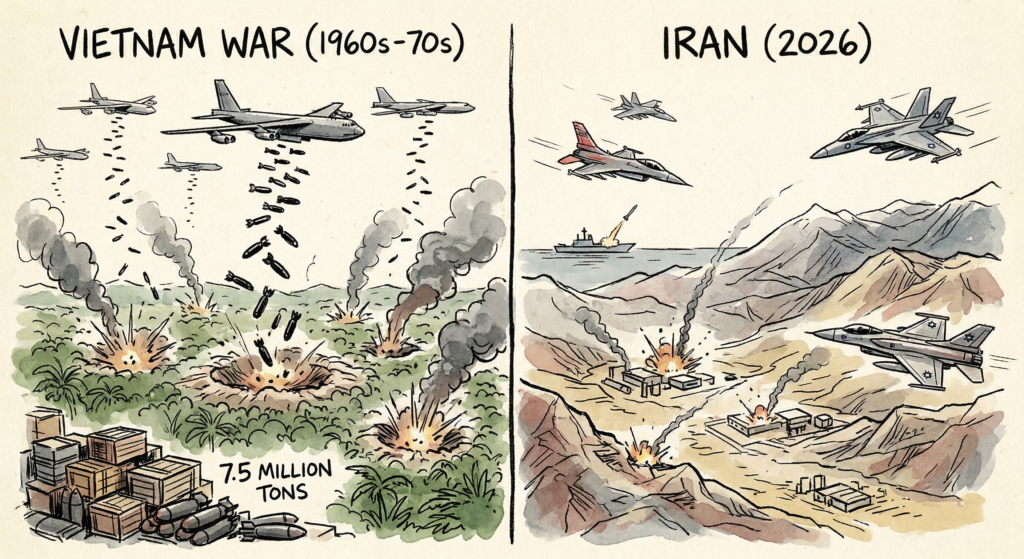
Reports from various international media outlets suggest that the United States and Israel have already deployed more weaponry against Iran than was used during the 12-day conflict in June. The scale and intensity of the attacks have been immense.
In just the first week, Israel dropped around 6,500 bombs on Iran, excluding missiles. In comparison, during the 12-day war in June 2025, Israel deployed approximately 4,500 bombs. This information was reported by Israel’s own media outlet, “The Jerusalem Post”.
A few days ago, massive airstrikes targeted oil refineries in Tehran. Fuel storage tanks were destroyed, unleashing vast quantities of burning petroleum that spread flames across parts of the city. The full extent of the humanitarian damage caused by this catastrophe has yet to emerge.
However, a report by “The Guardian” indicates that Iran’s environmental authorities and the Red Crescent fear severe ecological consequences. Toxic chemicals released from the burning fuel are a major concern, raising the possibility of acid rain in urban areas, which could harm residents’ skin and lungs.
The Director-General of the World Health Organization (WHO), Tedros Adhanom Ghebreyesus, warned: “Damage to petroleum facilities in Iran is raising the risk of toxic contamination of food, water, and air. These disasters will have particularly severe health impacts on children, the elderly, and those with pre-existing conditions.”
The full extent of US bombing in Iran has not yet been disclosed. However, it is widely assumed to exceed the scale of the June conflict. Even statements from former US President Donald Trump’s Defence Secretary, Pete Hegseth, reflect the severity of the assault.
He recently stated, “Death and destruction are raining down from the skies all day in Iran. This was never intended to be a fair fight, and it is not a fair fight. When the enemy is weakened and lying on the ground, that is when we strike, and that is exactly how this fight should be.”
The intensity of US aggression in Iran evokes memories of another war, one in which the Pentagon showcased overwhelming air power with devastating brutality.
The fire of US imperialism in Vietnam
Within just two decades, Vietnam evolved from a colonial battleground into a central conflict of the Cold War. This war produced one of the most destructive military campaigns in US history. What began as a nationalist struggle against French colonial rule gradually escalated into a catastrophic war, one that left Vietnam devastated by bombs, chemicals, and foreign military occupation.
The US did not enter Vietnam to protect the country, but rather to reshape its political structure according to its own ideological fears. Influenced by the “Domino Theory”, US policymakers believed that if Vietnam embraced communism, the rest of Southeast Asia would follow. This fear drove Washington into a total war, not merely against an opposing force, but effectively against a nation and its people.
After the First Indochina War ended in 1954, Vietnam was divided along the 17th parallel. The north came under the leadership of Ho Chi Minh’s communist government, while the south was governed by a regime backed by the United States and its Western allies. Although nationwide elections had been promised, they never materialised. Instead, the US deepened the division, rapidly transforming internal conflict into a full-scale international war.
US military strategy relied on overwhelming force. Strategic bombing campaigns devastated Vietnam’s infrastructure and rural areas. Approximately 7.5 million tonnes of bombs, more than three times the total used in the Second World War, were dropped on Vietnam. B-52 Stratofortress bombers alone delivered massive explosive payloads in each mission, contributing to around 1.6 million tonnes of munitions used during the war.
Operations such as Rolling Thunder led to relentless bombing that destroyed countless villages, ruined agricultural land, and killed vast numbers of civilians. In North Vietnam alone, physical damage was estimated at around $600 million, while the United States spent nearly $6 billion on the bombing campaign, an illustration of devastating asymmetry.
Beyond explosives, the US also waged chemical warfare. Over 19 million gallons of defoliants, including the infamous Agent Orange, were sprayed across 3.5 million acres of land. This environmental assault not only destroyed agriculture but also poisoned ecosystems and human bodies. The long-term effects of dioxin contamination persist in many parts of Vietnam today, causing birth defects, cancer, and chronic illnesses across generations.
Between 1965 and 1975, the United States spent approximately $176 billion on the Vietnam War, equivalent to over $1 trillion today.
Although 58,193 American soldiers were killed, the broader conflict claimed around 1.35 million lives, the majority of them Vietnamese. Indiscriminate bombing, military operations, and massacres killed countless civilians. The My Lai Massacre, in which US troops killed more than 500 unarmed villagers, became a symbol of the war’s brutality.
The scale of injury and disability deepened the tragedy. Around 75,000 US veterans were left severely disabled, but the devastation in Vietnam was far greater; millions were left crippled, orphaned, or psychologically scarred. Entire communities were displaced, and multiple generations were lost to the war’s impact.
US military planners adhered to a strategy of attrition, seeking to kill as many enemy fighters as possible to weaken their capacity to regroup. However, this approach failed to account for Vietnamese resilience and the unpopularity of the US-backed South Vietnamese government. By the time of the Tet Offensive in 1968, it had become clear that victory was beyond US reach.
As the war dragged on, public opinion within the United States shifted dramatically. The release of the Pentagon Papers in 1971 revealed that officials had misled the public about the war’s progress. Anti-war protests intensified nationwide, and the policy of “Vietnamisation” was introduced, aimed at transferring combat responsibilities to South Vietnamese forces. By then, however, it was too late.
In April 1975, the US-backed South Vietnamese government collapsed. Saigon fell to North Vietnamese forces, and the final American helicopters evacuated people from rooftops. The war ended not in victory, but in a humiliating withdrawal for the United States.
Vietnam was left physically, economically, and psychologically shattered. Across Vietnam, Laos, and Cambodia, between 2.5 and 4 million people were displaced. Around 1.6 million Vietnamese fled the country by sea or other means, many later becoming known as the “boat people”.
Cambodia and Laos also suffered immense destruction due to US covert bombing and military operations. Over time, both countries experienced political upheaval and the rise of communist regimes, the very outcomes the United States had sought to prevent.
The war transformed Vietnam’s lush landscape into scorched terrain. Entire provinces were reduced to rubble. Rivers and waterways were polluted, forests decimated, and soil rendered infertile by chemical exposure. Even today, unexploded ordnance continues to injure civilians, while the legacy of Agent Orange still afflicts many families.
The demographic composition of US forces was young and racially diverse, yet marked by inequality. While 88.4% of troops were white, Black soldiers accounted for 12.5% of deaths, disproportionately high relative to their representation. Hispanic soldiers also suffered significant losses, though they were not consistently recorded as a separate category.
Women bore the burden of war as well, particularly the approximately 6,250 nurses who witnessed its horrors firsthand. Upon returning home, many faced silence and neglect, carrying psychological trauma.
Despite this immense devastation, Vietnam endured. The country was reunified, though at an enormous cost. In the decades that followed, it struggled with poverty, international isolation, and the long-term consequences of war.
Yet gradually, Vietnam rebuilt—step by step, from villages to cities. Today, it stands as a nation that has transformed its painful past into resilience and strength.
Still, the question remains: what price was paid for this transformation?
The Vietnam War remains one of the most tragic chapters of the twentieth century, not only for its destruction, but for the lessons it left behind. It was a war waged not for Vietnam, but against it, by a superpower that sought to subordinate a nation to its will, only to ultimately retreat, proving the enduring strength of a people determined to resist.