
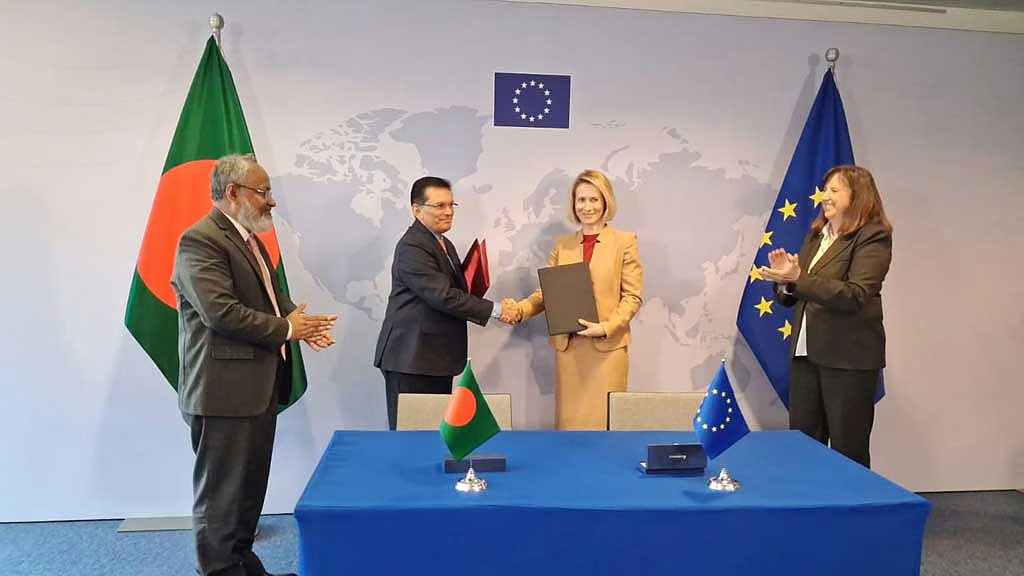
Bangladesh’s initialling of the new European Union–Bangladesh Partnership and Cooperation Agreement (PCA) in last April 2026 received far less public attention than it deserved. Overshadowed by domestic political noise and treated in many quarters as another routine diplomatic exercise, the agreement has the potential to, in fact, represent one of the most consequential shifts in Bangladesh’s foreign relations architecture since the country’s integration into the global trading system.
At the very first glance, the PCA appears technical pretty technical, as it’s supposed to be, an 82-article framework agreement covering areas like trade, migration, climate, security, governance, technology and political dialogue. But its real significance lies elsewhere. The agreement signals that relations between Bangladesh and the European Union are set to evolve beyond the traditional donor-recipient model that shaped much of the last three decades.
Bangladesh is no longer being engaged merely as a development case or a low-cost manufacturing hub. Increasingly, Europe is treating Bangladesh as a strategic partner.
This distinction matters because, for years, Bangladesh’s relationship with Europe rested on two pillars: development assistance and preferential market access. The garment industry’s extraordinary rise under the EU’s “Everything But Arms”-scheme transformed the European market into Bangladesh’s largest export destination. But the logic underpinning that relationship is changing rapidly. Bangladesh is approaching graduation from Least Developed Country (LDC) status, Europe itself is becoming more geopolitical in its external outlook, and global supply chains are being reorganized amid intensifying strategic competition. The PCA emerges precisely at this intersection.
Contrary to some public assumptions, the agreement is not a free trade agreement. Nor is it simply an aid framework. It is better understood as a long-term political and strategic infrastructure for managing relations between the two sides in a post-LDC future. That future will demand far more than only tariff preferences. It will require institutional cooperation, regulatory alignment, investment frameworks, security dialogue and diplomatic coordination.
For Bangladesh, this transition carries both opportunity and pressure.
The most immediate strategic importance of the PCA lies in what it may mean for Bangladesh’s economic positioning after LDC graduation. While the agreement itself does not guarantee trade concessions, it creates a structured political environment that could facilitate future discussions around GSP+ arrangements, investment expansion and eventually even deeper trade negotiations.
In an increasingly standards-driven global economy, sustained access to European markets will depend not only on competitive labour costs but also on governance capacity, labour compliance, environmental standards and institutional credibility. This is also where the PCA becomes politically significant domestically. Modern European agreements rarely operate in purely economic terms. They increasingly integrate questions of democracy, rule of law, human rights, migration governance and sustainability into broader partnership structures. Supporters of this approach argue that such provisions create more stable and accountable relationships. Critics, however, often interpret them as forms of political conditionality embedded within economic cooperation. In Bangladesh, this debate deserves greater seriousness than it has so far received.
Neither reflexive celebration nor instinctive suspicion is sufficient. The real question is whether Bangladesh possesses the strategic confidence and institutional maturity to engage Europe pragmatically while protecting its own policy autonomy. That balance will determine whether the PCA becomes transformative or merely symbolic.
The security dimension of the agreement is also being underestimated. The reported cooperation areas including cybersecurity, counterterrorism, anti-money laundering, maritime governance and organized crime prevention, indicate that the EU increasingly views Bangladesh through a strategic lens tied to the wider Indo-Pacific and Bay of Bengal region. This reflects a broader European shift. Brussels is no longer engaging Asia solely through trade; it is increasingly thinking in terms of resilience, connectivity, strategic access and geopolitical stability.
Bangladesh’s geographic location makes it central to many of those calculations.
For Dhaka, deeper engagement with Europe also offers an important geopolitical benefit; “Diversification”. Much of South Asia’s diplomatic space is shaped by the gravitational pull of larger powers like India, China and increasingly the United States. Expanding strategic relations with the EU does not place Bangladesh directly into any geopolitical bloc. Rather, it potentially strengthens Bangladesh’s ability to maintain strategic flexibility in a more polarized international system. In contemporary diplomacy, optionality itself is a form of leverage.
Yet agreements alone do not create strategic success. Bangladesh has often demonstrated impressive diplomatic ambition while struggling with institutional follow-through. The risk with the PCA is not necessarily that it imposes excessive obligations, but that Bangladesh fails to develop a coherent national strategy around it. If treated merely as a ceremonial foreign policy achievement, the agreement’s long-term value could dissipate quickly.
What is required now is a broader national conversation. The full text of the PCA should eventually be made publicly available and debated seriously by policymakers, economists, legal scholars, civil society actors and strategic analysts. Bangladesh needs to decide what it actually wants from this partnership. Is the priority trade continuity after LDC graduation? Investment attraction? Technology cooperation? Green financing? Maritime strategy? Skilled migration pathways? Without clear national objectives, even the most promising agreements risk becoming bureaucratic exercises.
Europe, for its part, also faces a test. The credibility of the EU’s engagement with Bangladesh will depend on whether it approaches the relationship as a genuine partnership or primarily through the language of compliance and conditionality. If Brussels seeks long-term influence in strategically important middle powers like Bangladesh, it will need to demonstrate that its partnerships produce mutual political and economic value rather than asymmetrical expectations.
The PCA therefore represents more than a diplomatic document. It reflects a changing international reality in which Bangladesh is gradually moving from the margins of global politics toward a more strategically relevant position. The question is, whether Dhaka is institutionally prepared for that transition!
The significance of the agreement ultimately lies in one simple fact: Bangladesh is no longer negotiating only how Europe can support it, but how Europe will partner with it. That is a fundamentally different era of diplomacy.