
Remembering Mustafa Monwar, the artist who taught a nation to play
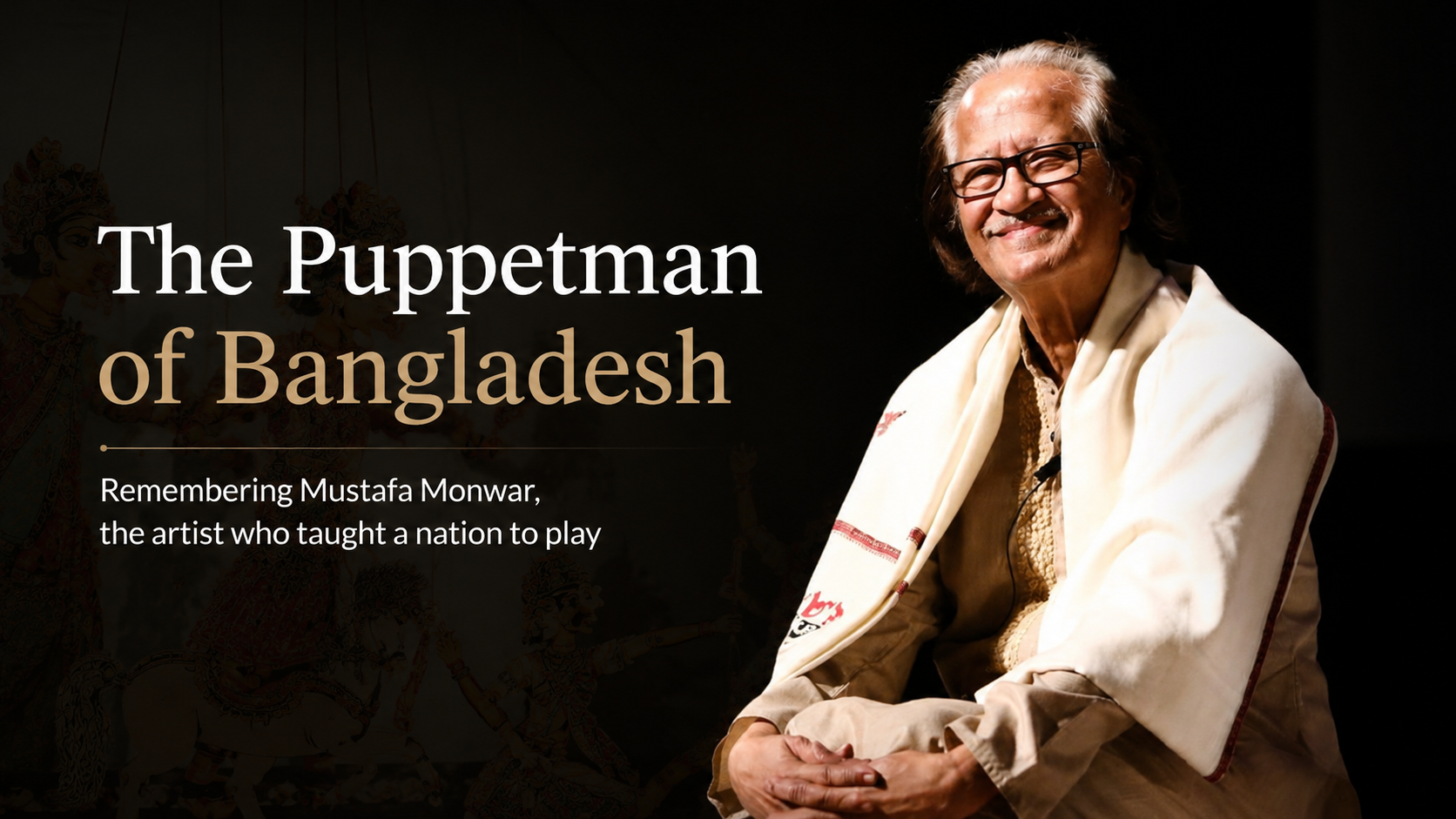
On the morning of June 29, 2026, the news moved through Dhaka the way bad news about an old, familiar face always does, quietly at first, then everywhere at once. Mustafa Monwar died at Square Hospital at around 8:30 a.m., three months short of turning 91. His nephew was the first person to confirm this news through a Facebook post. Within hours, tributes were pouring in from artists, television channels, government offices, and most tellingly, from ordinary people who had never met him but had a place in their heart fo r his puppets.
He had been unwell for a long period of time pneumonia layered on top of cancer.. He was admitted to Square Hospital on May 20, sent home on June 5, and then brought back on June 14 after his oxygen levels and blood pressure dropped. He spent his final two weeks in intensive care. His wife, Mary Monwar, told reporters just days before his death that he had been fighting several complications for a long time. But in the end his body finally gave out after nine decades of constant motion.
Bangladesh knew him by a nickname that had stuck for over fifty years: the Puppetman of Bangladesh. Before Mustafa Monwar, puppetry in this part of the world lived mostly in rural fairs and folk performances. By the time he was done, it was television, it was wartime comfort, and a small but permanent piece of how an entire generation understood childhood.
A childhood shaped by loss and language
Monwar was born on September 1, 1935, in Magura, then part of Bengal Presidency under British rule. He lost his mother when he was only five, an early wound that people close to him would later say never fully closed, and that perhaps explains why comforting children became the thread running through almost everything he built afterward. He studied at Narayanganj Government High School and later at Dhaka Collegiate School. When he was still a ninth grader, politics first collided with his pencil. He was briefly jailed that year for drawing cartoons in support of the Bengali Language Movement. It is a detail that tends to get lost next to his puppets, but it matters. He primarily enrolled at Scottish Church College under the University of Calcutta to study science. It was he writer Syed Mujtaba Ali who advised him to follow what was his real talent. Monwar transferred to the Government College of Art & Craft in Kolkata and graduated at the top of his class.
From lecture halls to the newsroom of Bangladeshi television
His working life did not begin with puppets .It began with teaching as a lecturer at the East Pakistan College of Arts and Crafts. From there he moved into broadcasting, joining the East Pakistan wing of Pakistan Television Corporation, which after 1971 became Bangladesh Television, commonly known as BTV.
His institutional resume over the following decades looks almost like a map of Bangladesh’s cultural infrastructure being built from scratch: director general of the Bangladesh Shilpakala Academy, director general of what is now the National Institute of Mass Communication, and managing director of the Bangladesh Film Development Corporation (FDC). He was evidently one of the people who quietly shaped the machinery through which Bangladeshi art and media would be produced for generations.
War, and the puppets that carried a nation’s children through it
The story that defines Mustafa Monwar’s place in Bangladesh’s history did not happen on a stage. It happened in the refugee camps of West Bengal in 1971, during the nine-month war that created our nation. Millions of Bengalis had fled across the border, and among them were children who had seen things no child should see. Monwar could not fight in the war the way others did. What he carried into those camps instead was cloth, wood, paint and improvised uppet figures. He staged plays with names like Agachha (Weed), Rakkhash (The Monster) and Ekjon Sahosi Krishok (A Brave Farmer). The American documentary filmmaker Lear Levin was in Bangladesh at the time and filmed some of these performances. That footage later found its way into Tareque masud’s celebrated 1995 documentary Muktir Gaan.