
Five decades after independence, local government remains fiscally starved and politically subordinated. The post-uprising BNP-rule is a chance to change that — if an elected Parliament chooses to use it.
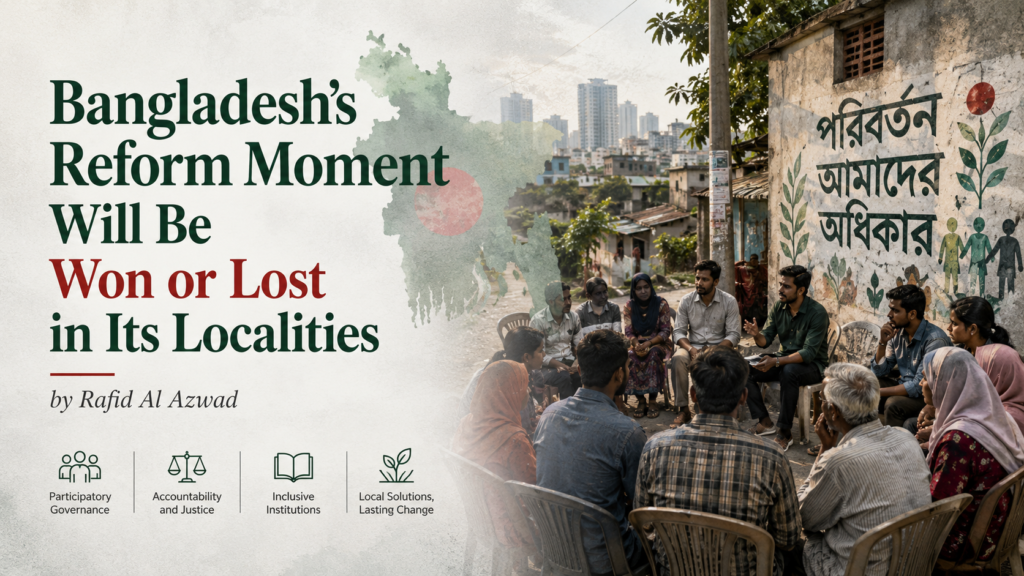
Image: AI Generated
Local government in Bangladesh occupies a paradox at the heart of the country’s political life. The Constitution could not be clearer: Articles 9, 11 and 59 mandate elected bodies at every administrative tier. Yet more than five decades after independence, these institutions remain among the most centrally controlled, fiscally starved and politically subordinated in South Asia. Five tiers of elected bodies — Union Parishad, Upazila Parishad, Zila Parishad, Pourashava and City Corporation — sit alongside a deconcentrated field administration of Deputy Commissioners and Upazila Nirbahi Officers whose authority routinely overrides that of elected representatives. What looks on paper like devolution functions in practice as recentralisation.
For the first time in a generation, this settlement is genuinely contestable. The student-led July uprising of 2024 swept aside the old order and produced an interim government under Chief Adviser Muhammad Yunus, which established eleven reform commissions. Among them was a Local Government Reform Commission, chaired by Professor Tofail Ahmed, whose 500-page final report — 51 recommendations in all — was submitted on 20 April 2025. The July National Charter of 2025, endorsed by thirty political parties, went further still, codifying four consensus commitments (Statements 44 to 47) to autonomous, financially empowered and locally accountable government. Then, in February 2026, the Bangladesh Nationalist Party under Tarique Rahman won a decisive parliamentary majority — and with it, the responsibility for turning these promises into law.
The question is no longer whether reform is needed. It is whether this rare political opening will be converted into durable institutional change, or quietly absorbed into the same centralising habits that have defeated every previous attempt.
A system designed to be overridden
Begin with the bureaucracy. The Deputy Commissioner and the Upazila Nirbahi Officer continue to exercise de facto control over budgets, project selection and personnel, while elected chairs operate without the secretariat or the financial discretion to lead. This is not an accident of implementation. Successive scholars — Ahmed, Panday, Aminuzzaman and Khan, and more recently Lewis and Hossain — have converged over three decades on a single judgement: that regime after regime has used decentralisation as rhetoric while recentralising in substance, treating local institutions as instruments of regime consolidation rather than as sites of democratic devolution.
The clearest instrument of that subordination is Article 25 of the Upazila Parishad Act 2009, which made the local Member of Parliament a mandatory “adviser” to the Upazila Parishad. In practice, that advisory role has operated as an executive veto, with line-ministry circulars explicitly requiring MPs to be consulted on local development projects. Lewis and Hossain, writing in Development and Change in 2022, documented four mechanisms by which the post-2009 ruling party hollowed out local bodies: circumventing them, capturing their standing committees and selection processes, governing through party-affiliated brokers, and spinning up parallel organisations to absorb their functions. Yilmaz and Ahsan, in 2024 work for the World Bank, put it most bluntly — weak local democracy was not a flaw in the system but a feature of it, a deliberately weakened component of an authoritarian governance architecture. The civil service, and the Deputy Commissioners in particular, became instruments of regime consolidation, a pattern most visible in the manipulated elections of 2014, 2018 and January 2024.
Starved of money
No reform survives contact with the budget. Local government expenditure in Bangladesh hovers near one percent of GDP — against roughly eleven percent in China, twenty-three percent in South Korea, ten percent in South Africa, and an industrial-country average close to twenty-eight percent. The World Bank’s own assessment found that local spending rose from 0.67 percent of GDP in 2001 to just 1.1 percent in 2013, still about five times below the developing-country average; local institutions accounted for only seven percent of total public expenditure, against a developing-country mean of nineteen. Starved of own-source revenue and dependent on central grants, local bodies cannot plan beyond a single year.
The Commission’s proposal to hand one-third of total VAT revenue to local governments, and the July Charter’s Statement 45 guaranteeing “functional autonomy in financial management,” would be watersheds if enacted. But scepticism is warranted. In a September 2025 feature pointedly titled “Whither are the reforms?”, Professor Tofail Ahmed himself conceded that the local government, media, health and women’s commissions remained in the “weakest state,” and that the work had “not moved beyond report writing.”
What real reform would require
The Commission’s boldest proposals concern the architecture of local elections themselves. It recommends abolishing direct elections for the chairmen and mayors of all five tiers, replacing them with indirect election by directly elected members and councillors — a deliberately “parliamentary” logic intended to dilute the dominance of single executives and the personalisation of power. It proposes holding elections for all five tiers on a single day, a change projected to cut costs from around Tk 23,000 crore over 2021–24 to roughly Tk 600 crore. It would strip party symbols from local ballots and hold local elections before national ones. Not everyone is convinced: the jurist Shahdeen Malik has warned that a single-day, five-tier ballot places an excessive cognitive burden on voters. But the underlying intent — to insulate grassroots democracy from the winner-takes-all partisanship that has penetrated every tier of the state — speaks directly to the system’s deepest pathology.
Reform must also reach the citizens it claims to serve. When the Commission, working with the Bangladesh Bureau of Statistics, consulted 46,080 respondents, it found a striking divide: the urban political class in Dhaka prioritised national polls, while respondents across the rest of the country overwhelmingly wanted local elections held first. With Union and Upazila seats filled by appointed administrators since the August 2024 transition, citizens outside the capital reported a “service vacuum” and saw local elections as the most direct route back to democratic life. The Commission’s proposals to reserve three Union Parishad wards exclusively for women, and to introduce no-vote provisions and re-election thresholds, are at once participatory and integrity measures — a partial answer to the systemic exclusion of reserved-seat women councillors from real decision-making that ADB, UNDP and BIGD studies have documented for years.
And reform can no longer treat the city as an afterthought. Nearly forty percent of Bangladeshis now live in urban areas, more than a third of them in Greater Dhaka, yet urban institutions are often weaker than the rural Union Parishads. The approval of the National Urban Policy 2025 has pushed this question to the centre of debate. The real task is not the perennial distraction of relocating the capital, but empowering secondary divisional cities — Khulna, Rajshahi, Rangpur, Sylhet — and shoring up the more than 330 chronically underfunded Pourashavas. Proposals to fold the Chittagong Hill Tracts’ Headman and Karbari system into the national framework, meanwhile, signal a welcome recognition that plural legal orders exist within the unitary state.
Technology alone will not rescue any of this. Bangladesh climbed to 100th in the UN E-Government Development Index by 2024 and runs more than 5,000 Union Digital Centres, but of over 700 online government services, not one is fully digitised end-to-end; ministries operate in non-interoperable silos, and the digital divide reproduces existing inequalities. So far, digitalisation has mostly extended central administrative reach rather than empowered Union and Upazila bodies to deliver on their own. Empirical work from BIGD makes a parallel point about participation: where forums such as ward shovas exist on paper, they tend to lie dormant unless an outside actor activates them. Statutory provision is not the same as living practice.
The real test
The diagnosis, in the end, is not in dispute. Scholarship and journalism alike describe a system whose formal architecture is unusually elaborate and whose substantive autonomy is unusually shallow — five tiers of elected bodies shadowed at every step by appointed officials. Three pathologies recur: bureaucratic dominance, partisan and parliamentary interference, and fiscal starvation. The convergent prescription is just as clear: a single, unified local government law to replace the tangle of sectoral statutes; rules-based fiscal transfers and real own-source revenue powers; non-partisan, simultaneous local elections held before national ones; the legal removal of the MP’s advisory role; and citizen participation embedded through ward shovas and social-accountability mechanisms that are actually used.
The July Charter’s Statements 44 to 47 have written several of these commitments into the country’s constitutional conversation. But charters do not implement themselves. Their durability now rests with a BNP government whose 2030 vision and 2026 manifesto endorse local empowerment in principle while leaving the fiscal and electoral specifics to later negotiation. Bangladesh has promised its localities autonomy for fifty years and delivered centralisation instead. The post-uprising moment has reopened that promise with rare force. Whether it becomes law — or becomes another report that never moved beyond report-writing — is the real test of what 2024 was for.
About Author:
Rafid Al Azwad
Executive, TBD