
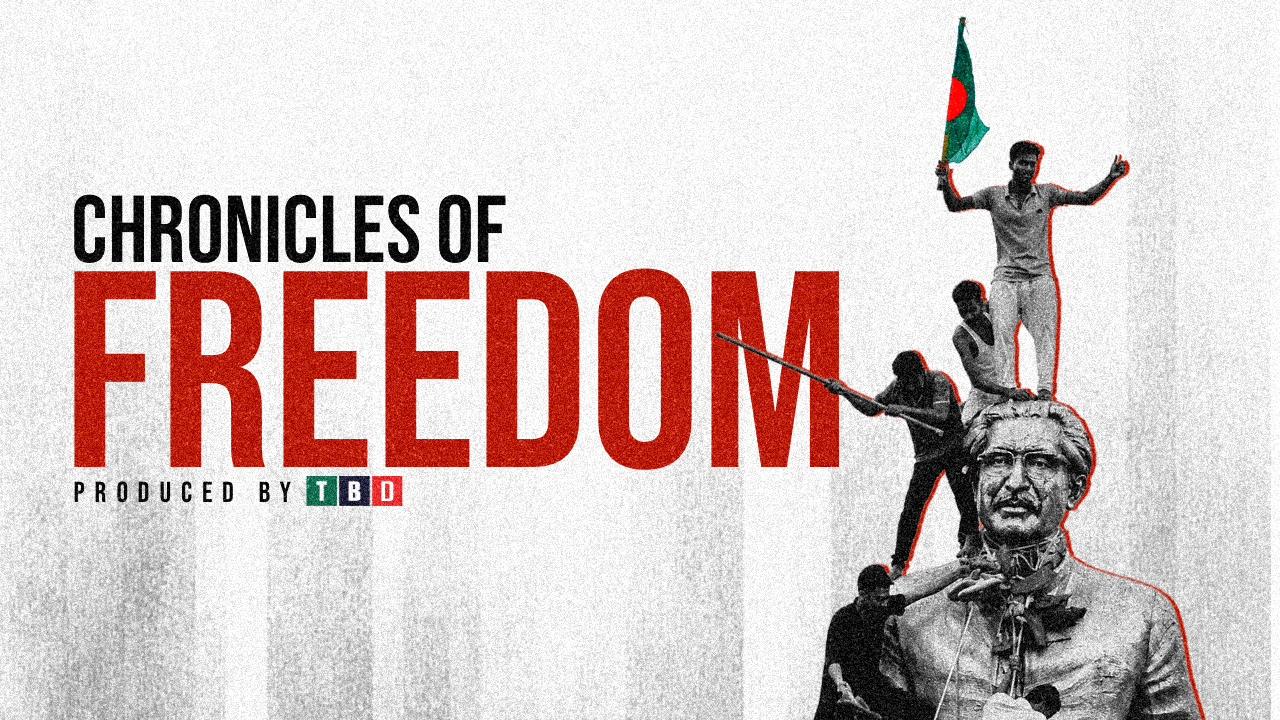
Opening
For two years, July has been written, spoken about, documented, debated, and remembered in countless ways. Its photographs have travelled from one screen to another; its slogans have become part of public memory; its prominent faces have been repeatedly placed at the centre of the narrative. Much has been said about those who stood in the front line, those who organised, those whose names became familiar during the movement, and those who came to represent July in the mainstream discourse. Yet, somewhere within this growing archive of July, a quieter question remains.
What about the people who stood just beside them?
What about the student who walked into the streets without knowing where the day would take them? The journalist who kept reporting while the city around them grew increasingly silent and violent? The teacher, the worker, the shopkeeper, the political activist, the ordinary citizen who watched the country change before their eyes? What did July mean to them? What did they see, what did they lose, what did they hope for, and what did they carry home when another day of protest finally came to an end?
History often remembers movements through their leaders, their slogans, their turning points, and their victories. But a movement is never made by a handful of names alone. It is made in the streets, in crowded rooms, behind closed doors, through whispered conversations, hurried phone calls, sleepless nights, unfinished meals, anxious families, and ordinary people making extraordinary choices. The July movement was not simply a series of events that unfolded before the eyes of the nation. For many, it became a lived reality a period measured not by dates on a calendar, but by fear, uncertainty, courage, hope, and the persistent desire for change.
So, if we truly want to understand July, perhaps we must look beyond the familiar faces and listen to the voices that have remained comparatively unheard.
We must ask how an ordinary person experienced those days. How did they become a part of a movement that was larger than themselves? What made them step outside their homes? What kept them on the streets when returning home might have been safer? How did they spend each day as the movement grew from protest into something far greater? And when the movement reached its decisive moment, what did victory mean in their personal lives? Did it change them? Did it change their families, their beliefs, their understanding of the country they lived in?
These questions remain difficult to answer in any single narrative. And perhaps that is precisely why they need to be asked.
To explore this forgotten or less-heard dimension of July, The Bangladesh Dialogue presents its documentary on the movement, Chronicles of Freedom (শেকল ভাঙার গান). It is an attempt to look at July not only through the lens of its most visible figures, but through the eyes of the people who lived through it. It is an attempt to move away from the familiar centre of the story and listen to the many voices that existed around it.
For this documentary, more than 70 people were interviewed, including ordinary citizens, students, journalists, teachers, politicians, economists, professionals, and individuals from diverse walks of life who participated in, witnessed, or were directly and indirectly affected by the July movement. Each carries a different memory of those days. Some remember the streets. Some remember the silence. Some remember the fear in their homes. Some remember the moment they decided that they could no longer remain spectators. And some remember the uncertainty of not knowing what the next morning would bring.
Together, these voices create something larger than a collection of individual testimonies. They form a mosaic of a country passing through one of the most defining moments of its recent history.
But Chronicles of Freedom (শেকল ভাঙার গান) does not look only at the weeks of July. Behind the movement lies a longer story, a story shaped by 17 years of political repression, fear, suppression, and the experiences of a generation that grew up under an increasingly authoritarian political order. The documentary therefore also gives space to the memories of that longer period: the experiences of those who witnessed repression, those who remained silent out of fear, those who challenged it, and those whose lives were altered by it.
Because July did not emerge from a vacuum.
It came after years of accumulated experiences, frustrations, silences, and unanswered questions. To understand the streets of July, one must also understand the years that preceded them. To understand why people came out, one must listen to what they had endured. And to understand the meaning of freedom, sometimes we must first listen to those who remember what it felt like to live without it.
Chronicles of Freedom (শেকল ভাঙার গান) is therefore not simply a documentary about a movement. It is a collection of memories a record of how ordinary people experienced an extraordinary time. It is an attempt to preserve voices before memories fade, before personal experiences become simplified into political narratives, and before the complexity of July is reduced to a handful of familiar images.
Because history is not only what happened.
History is also how people remember what happened.
And July belongs to all those who lived it.
Act I: Before the Storm
Before July, life moved forward, but often under the shadow of uncertainty. For many, ordinary routines: returning home, attending class, reporting the news, expressing a political opinion, calling a loved one; were never simply ordinary. They were acts carried out beneath a persistent question: would tomorrow arrive unchanged?
Mubashar Hasan, an enforced disappearance survivor, spoke of a fear that has not entirely left his eyes:
“In 2017, on November 7, I was taken away. The DGFI took me to Aynaghar. They kept me there for 44 days. There were all kinds of people in the nearby cells. I never got to see them. But I could hear them crying.”
His testimony evokes confinement beyond walls: the terror of hearing other human beings suffer without being able to see them, reach them, or know whether they would ever return.
For Prof. Dr. Chowdhury Saima Ferdous, memory is inseparable from loss; a daughter’s memory of political violence, and a family’s refusal to surrender hope completely:
“Because my father was involved in politics, everyday, we never knew whether he would make it home alive. A natural death, an unnatural death. But how do you accept a death like that? My father’s body was dumped in pieces. My brother’s body was dumped too. We still haven’t found my brother. Somewhere deep inside, we’re still waiting.”
In a country where truth could be buried with the disappeared, waiting itself became an act of resistance.
Zina Tasreen, a journalist who witnessed the machinery of power from inside one of the country’s leading newsrooms, reflected on the ethical unease embedded in her reporting:
“I’ve been a journalist for The Daily Star for fourteen years. Most of my time was spent in the business section. In my reporting, the corruption of the regime, what they were doing, it was not morally, ethically, in any way right.”
For Mirza Fakhrul Islam Alamgir MP, the years before July were measured in cases, arrests, and the systematic criminalization of political opposition:
“Among our leaders, the senior leaders, the top leaders, many had 114, 150, even 160 cases against them. There were 150,000 cases against six million party leaders and activists. This was the reality we were living through.”
Ashfaque Nipun described the transformation of public institutions and the moments that compelled him to turn artistic expression into testimony:
“At one point, we saw that the police in Bangladesh had become heavily politicized. That’s when I came up with the idea for my series, Mahanagar. There was a period when question paper leaks were happening one after another. Then there were the extrajudicial killings. When a councillor was killed in Cox’s Bazar, and that audio clip went viral, it shook me so deeply that I immediately decided since more people watch television during Eid, I would make something for Eid. That was when I first made something about enforced disappearances. Ferar Poth Nei.”
On campuses, political identity could determine whether a student was allowed the basic continuity of education. Shahriar Hoque Mozumdar Shimul recalled a university life narrowed by intimidation:
“Living in the hall, attending classes, I managed somehow through my first year. Up until my second year, I was still able to attend classes and sit for exams. Then I had to stop living in the hall. From my third year, I could no longer attend classes or sit for exams on campus. And it wasn’t just me. Probably everyone who was involved with Chhatra Dal politics at Jahangirnagar University, or with anti Awami League politics, went through the same thing. The only difference was, I was probably one of the few who wasn’t physically attacked. But if you count them, hundreds of leaders and activists were physically assaulted during that time. Some were attacked more than once. Cases were filed against them.”
Jahid Ahsan remembered the humiliation of early student life, when abuse was used as a warning and even parents were dragged into the violence:
“When I got admitted in my first year, I had to spend a few days in the guest room. When I was there, I saw them abusing me and my friends, dragging our parents into it. It was traumatizing for us.”
Dr. Shamaruh Mirza saw a country divided between possibility and fear:
“I’ve always seen Bangladesh as a country with incredible potential. At the same time, it had become a country where millions of people lived in fear. Lived in constant anxiety. So that’s how I viewed Bangladesh before July 2024.”
Azmeri Haque Badhon spoke with rare candour about privilege, compromise, and the moral turning point created by students who refused to remain silent:
“In 2014, I faced severe harassment because of my ex-husband’s political connections. Seeking protection, I became close to the previous government in 2018 and benefited from that relationship, including gaining custody of my daughter. I later realized the system had been manipulated, which left me deeply uncomfortable, though I remained silent. That changed when I saw SSC students protest for their imprisoned friends. Their courage made me ask myself: if children can stand up for what is right, why can’t I? Despite my privileges, I felt I had to raise my voice.”
For Md Rahat Rahman, the 2018 Road Safety Movement revealed the true nature of state power:
“The first time it really clicked for me that Hasina’s rule was a dictatorship was during the 2018 Road Safety Movement. I saw my brothers being beaten. We wanted to protest. Instead, they charged at us. That’s when we realized just how much it had become an autocracy.”
Sayedul Karim spoke of anger accumulated over years; not as a momentary emotion, but as a wound made deep by time:
“I wasn’t any different. I carried deep hatred inside me too. And this wasn’t hatred that grew in a day or two. It was the hatred of seventeen long years”
Mostofa Kamal Polash described exile as an extension of persecution, a distance measured not only in kilometres but in years away from home:
“To tell you the truth, from 2010 until today, it’s been sixteen years, and I still haven’t been back home. Sixteen, seventeen years, I haven’t been home. Because during Sheikh Hasina’s government, they tried in every possible way to persecute me. They pressured the administration to take action against me. They even filed complaints with my university in Canada.”
Ariful Islam captured the loss of dignity in a single, stark line:
“Before July 2024, life wasn’t a citizen’s life.”
Ehsaan Mahmud reflected on the role of media; not only as observer, but as an institution capable of lending legitimacy to repression:
“Personally, I believe the media in Bangladesh bears a huge responsibility for strengthening fascism by acting as a machine that manufactured consent. And I say this personally because I experienced it myself.”
Barrister SM Saif Kader Rubab described a kind of survival that became so routine it was mistaken for normal life:
“Every single day, every single moment, surviving was treated as something normal. You just kept surviving. You stayed alive. As long as nothing unexpected happened. But that sense of normalcy felt like a privilege to us. That was the real luxury. Just getting through an ordinary day without having to face something terrible.”
This was the world before the storm: a world in which survival was celebrated because safety could not be assumed, and silence often appeared less like consent than a strategy for staying alive.
Act II: The Spark
Every uprising has a moment when private grief becomes public recognition. In July, scattered frustrations held in homes, campuses, newsrooms, workplaces, and exile which began to find a shared language.
For Mansura Akter MP, July marked a defining generational rupture:
“For those of us who were born after the 1990s, July is the biggest event of our lives”
Aslam Beg Sayem described why the violence against students transformed a movement into an irreversible national moment:
“No matter what problems a country is facing, if students are attacked, if students are killed, people in Bangladesh see it differently. That is the boiling point. Beyond that, there’s nowhere left to go. That’s what July became. The moment the government started taking the lives of non-political, university going students, it reached the point of no return.”
Abdullah Al Amin located the beginning not in grand political spaces, but in neighbourhood conversations and tea stalls, where people who barely knew each other began to realize they were carrying the same disappointment:
“Think about it. The people you marched with, the people from your own neighborhood, maybe you only knew them from the local tea stall. Our generation, some were frustrated, some heartbroken, some in love, some had jobs, some were unemployed, some had just been scolded by their parents. They gathered at a tea stall, started talking, and that’s how the movement began. Most of them didn’t even know each other.”
Mirza Fakhrul Islam Alamgir MP recalled the strategic decision not to claim ownership over what students themselves had begun:
“At first, we didn’t join. Because we thought the government would once again try to dismiss it by saying the BNP was behind the student movement. Nahid himself has acknowledged that: “BNP Secretary General Mirza Fakhrul Islam Alamgir said, We have no connection to this movement. This is the students’ movement. What he said was absolutely right. That was the right strategy at that time. That was exactly what needed to be said.” Our communication with the student leaders was direct, all the way through.”
Dr. Shamaruh Mirza described the gradual collapse of a narrative that had long attempted to substitute visible development for accountability:
“People in Bangladesh could see what was happening. In the name of development, especially through visible infrastructure, bridges, buildings, schools, colleges, they tried to convince people that the country was moving forward. It was like masking what was really happening. Enforced disappearances. Money laundering. Looting. Banks being emptied. All of that was being covered up by so called development. But people aren’t fools. They had witnessed all of this for seventeen years.”
Dr. Saimum Parvez placed July within a longer history of democratic struggle and sacrifice:
“Every democratic movement, every democratic struggle, is the result of countless efforts coming together. Did the July Uprising happen all of a sudden? No. Behind it lies nearly a decade of sacrifice by countless people. We have to remember that. Again and again. At different times, there were movements. People were shot and killed.”
Prof. Dr. Samina Luthfa observed that resistance and repression both evolve but that authoritarian brutality reveals its own fragility:
“With every movement, the students, the resistance, learned. At the same time, those trying to suppress that resistance learned too. And they became more and more brutal. The biggest weakness of authoritarian regimes is that they believe they cannot survive without brutality. Many people are not with them. They’re only silent because they’re afraid. The regime reads that as the people’s weakness. Political scientists read it as the regime’s weakness. The Awami League, its repression, its oppression, its looting, its capture of every institution, its destruction of every institution, these are the things that accelerated July.”
For Prof. Dr. Chowdhury Saima Ferdous, the violence of July 15 was not distant political news. It came as screams through video messages, as the anguish of young people who could have been her own children:
“You remember the night of July 15. Those video messages kept coming. The screams of the boys. The screams of the girls. The violence inside the dormitories. In a nightmare like that, when you can’t even protect your own child, what does a parent go through? A teacher helps shape the conscience of a nation. So where was that conscience?”
Standing before the Shaheed Minar in solidarity with her students, she offered words that became both apology and promise:
“Forgive us. But don’t back down. Don’t be afraid. We’re your teachers. We are ashamed. We’ve learned from you. As long as you’re standing, we’re standing too.”
She later explained the force that brought her to the streets:
“There was only one reason to go out into the streets. To stop our students from being killed.”
From abroad, Jyoti Rahman carried a different but no less painful form of helplessness:
“I don’t have the audacity to speak for those who actually lived through it inside the country. The roller coaster of emotions of being abroad, unless you’ve lived through it, it’s impossible to understand how much emotional stress it builds up.”
Shakib Chowdhury of Cryptic Fate described the moment when social fear begins to fracture and the middle class recognizes its own power:
“The revolution always starts with students. You may think the whole army is in your pocket. All the money is in your pocket. All the banks are in your pocket. Literally, everything was in the Awami League’s pocket. Literally everything. But when the middle class rises up, the middle class is the thing. Not the poor. Not the rich. When the middle class rises up, no one can save you.”
Mawlana Jamil Siddiqui recalled how events of July 16 drew communities previously distant from the quota issue into the streets:
“At that time, our madrasas were largely uninvolved. Since the Qawmi madrasas had nothing to do with the quota system, the movement was seen as an issue about government jobs. But those of us who are always involved in movements and struggles, even inside the Qawmi madrasas, there were leaders from different student organizations. After what happened on July 16, they too came out onto the streets.”
The spark did not belong to one class, one profession, one political tradition, or one campus. It spread because people recognized themselves in one another’s fear and then in one another’s courage.
Act III: Fear
Fear is the emotional centre of this documentary because fear was not an interruption in the lives of those who spoke. It was the atmosphere in which they had learned to breathe. Yet July revealed something equally powerful: people can be afraid and still move forward.
Jyoti Rahman named that truth:
“Everyone was afraid. Under a fascist government, everyone was afraid. That’s the truth. Everyone has family. Everyone has relatives back home. Everyone has practical interests. You can’t expect everyone to become revolutionaries. There’s no point blaming people. Everyone has limitations.”
Others described the terror of a protest turning, within moments, into a trap:
“Then suddenly, the protests began. As soon as the protests started, they fired tear gas. Then suddenly, the shop shutters came down. I was inside one of the shops. It felt like I couldn’t breathe. At the same time, I couldn’t get outside. I didn’t even have the courage to run home. There were days when I thought, this is the last day of my life. Fear was there for everyone. No matter how brave someone is, fear exists inside everyone.”
Mehedi Hasan Zumman, a bullet-injured protester, remembered the particular terror of being taken away at night, toward an unknown destination:
“The first time I was really afraid was the day I was arrested. They arrested me in the evening. They took me to the police station. Then around 11:00, 11:30 at night, they took me out of the station. I asked the officer who was escorting me, Where are you taking me? He said, I don’t know. Or maybe, I really don’t know. That was the moment I was truly afraid. Because I’d seen what happened to the people around me. Many of my fellow activists had been taken away. And after that, there was no trace of them.”
Umma Uswatun Rafia, however, spoke from a place where fear had already been transformed by conviction:
“I never saw it that way. I kept thinking, what an opportunity it is to die for your country. Even if I died, it would be the greatest honor of my life. To be able to tell Allah, I died for my country. A martyr’s death.”
Between the fear of disappearance and the willingness to risk death for one’s country lies the moral intensity of July. It was not the absence of fear that brought people to the streets; it was the refusal to let fear decide the limits of their conscience.
Act IV: Convergence
In the final movement of the documentary, separate acts of courage begin to converge. Teachers, artists, students, doctors, expatriates, parents, and activists do not become identical, but they begin to stand in the same historical space. The streets become a meeting point for sorrow, responsibility, rage, and hope.
Prof. Dr. Saima Ferdous described the moment conscience overcame terror:
“It was my conscience that brought me to the streets that day. At that point, guns, rifles, nothing scared me anymore.”
Dr. Saimum Parvez pointed to the role of Bangladeshis abroad, whose participation took the form of sacrifice across borders:
“We saw that the amount of remittance being sent to Bangladesh by expatriates had dropped to an all time low. The sacrifices made by the diaspora community during the July Uprising, and their involvement in the movement, could clearly be seen through that remittance shutdown.”
Ashfaque Nipun recalled the growing certainty that artists and citizens were no longer standing apart from the movement:
“On August 1, we, the artists, joined the movement. On August 2, there was the Drohojatra. On August 3, people gathered at the Shaheed Minar, regardless of political affiliation. You could almost tell that day, that victory was no longer far away.”
Prof. Dr. Samina Luthfa identified a decisive shift: the movement could no longer be reduced to a narrow demand when private university students, who had no direct stake in the quota system, entered the struggle:
“Once bodies start falling during a movement, the floodgates open. When anger and frustration keep building, and people can no longer speak, there comes a point when they simply can’t accept it anymore. That’s why, from the 17th, or really, starting on the 16th, and then especially on the 18th, when private university students brought Dhaka to a standstill, everything changed. Because private university students had absolutely nothing to gain from the quota system. The attempt to frame them as selfish beneficiaries collapsed.”
The father of martyr Wasim Akram remembered a day of unanswered calls, ending in a video image no father should have to witness:
“On the day of 15th July, I kept trying to reach him. I must have called him at least a hundred times but he didn’t answer. Then I saw one of the footage of the protests, he was wearing Bangladesh Cricket Team’s jersey. At first, I saw two or three boys were massaging his leg. A little later, I saw them carrying him.”
Md Rahat Rahman and other students recalled confrontations in which the boundary between protest and survival vanished:
“After reaching BNS, we encountered police and RAB barricades near Uttara Police Station. They fired tear gas and rubber bullets, scattering us into nearby lanes. We regrouped and used metal sheets from a petrol station as makeshift shields, continuing to advance despite the attacks. Near the station, a RAB vehicle ran over a protester. In response, some students attacked the vehicle with iron rods, forcing it to retreat. The authorities then tried to negotiate, but soon BGB vehicles arrived and live ammunition was fired at us from the station and nearby rooftops. We realized we were facing real bullets, not rubber ones, and had to flee for our lives. At AIUB, we joined the movement on July 16. We had initially planned to gather at Jamuna Gate, but after seeing reports of police and Awami League members attacking students at BRAC University, we changed course and marched toward BRAC University instead. We started marching. The first attack came near Notun Bazar, at the intersection in front of the embassies. Chhatra League threw crude bombs at us there. That day, we realized the spirit of the students. They were no longer afraid of death. In the end, it became the Long March to Dhaka. The situation was anything but normal. It was either do or die.”
Tanzila Hossain Boishakhi described the attack that made retreat impossible:
“The students were still protesting peacefully. We were marching, chanting slogans in the streets. Before that, on July 14, at Jahangirnagar University, Chhatra League cadres were the first to attack us with weapons. Their first attack targeted the women. Many of them were brutally injured that day. Some of them still haven’t recovered, even after two years. That was the moment we realized, there is no turning back.”
Shamaruh Mirza remembered the individual images that condensed an entire uprising into a few indelible seconds:
“That video, the one with Mugdho, I still get emotional every time I think about it. He’s shouting, Water. anyone needs water.? He kept running. The tear gas had burned his eyes. He could barely keep them open. Just… looking for something. I think that moment will stay with me for the rest of my life. Yes. There was another image that shook me deeply. It was probably in front of the High Court. A young woman stood in front of a police van, refusing to let it pass. That was something incredible. It made me realize that people don’t always know how strong human beings really are. Or what they’re capable of, when pushed beyond their own imagination.”
Momee Ansary, a doctor, recalled entering Gonoshasthaya Hospital to find Nahid Islam after hearing of his arrival:
“I was staying at the house of a senior brother from Chhatra Dal, behind PG Hospital. That’s when I heard that Nahid Islam had been brought to Gonoshasthaya Hospital. The four or five of us said, Let’s go. Let’s go see Nahid Islam. But everyone said, Brother, you’re a doctor. You go first. See what the situation is, then we’ll come. So I left the house, wearing my apron, carrying my stethoscope, and entered Gonoshasthaya Hospital. The whole place was tense. From the ground floor to the top, everything felt unnaturally quiet. I didn’t even know which floor Nahid Islam had been admitted to. I went to the reception. They wouldn’t tell me. We faced obstacle after obstacle trying to get inside. Chhatra League had blocked the entire entrance to the hospital. I knew the admitted patients were on the third floor. I told the medical officer, I’m a doctor. Where is Nahid Islam admitted? After confirming I was a doctor, the medical officer gave me the cabin number. I went in and locked the door. As soon as I closed it, I asked Nahid Islam if he needed anything. How he was doing. He had injuries all over this side and this side. He was badly beaten. His body had turned dark, almost black from the bruises.”
The maternal aunt of martyr Farhan Faiyaz gave voice to the irreversibility of a single phone call:
“It was around 2:59 PM, I got a call and was said: ‘Faiyaz has been shot’. When I got to the emergency, my brother was sitting in a chair and my sister in law was standing there. I looked at my brother, he just shook his head and said ‘Farhan is no more’.”
Barrister SM Saif Kader Rubab reflected on how repeated deaths can become normalized in the midst of a crisis, even as they leave permanent scars on those who witness them:
“We were out on the streets every day. We’d come home late at night. In those first days of August, it felt like a decisive change was coming. Whether it would happen on August 5 or August 15, I couldn’t say. But every day, two or three new faces were added to the list of the dead. And somehow, that became normal. That leaves a permanent mark on a person.”
This documentary is not simply about an uprising. It is about the years that made an uprising possible: the disappearances that left families waiting, the campuses that became unsafe, the homes in which parents feared a phone call, the newsrooms that carried ethical burdens, and the ordinary citizens who learned to treat survival as privilege.
Its voices do not offer a single, uncomplicated account. They speak from different political positions, generations, professions, and wounds. But together, they form a record of a society moving from contained fear toward collective conscience.
July, as these testimonies reveal, was not born in a day. It rose from years of unfinished grief, anger, silence, and endurance. And when people finally converged despite bullets, tear gas, intimidation, and loss; they made visible a truth that had long existed beneath the surface: fear may shape a nation for years, but it cannot permanently silence its people.
Closing
Behind every story that reaches the screen, there are countless stories that remain unseen the sleepless nights, the unanswered calls, the hurried journeys, the endless hours of preparation, and the people who quietly give everything they have to bring a story to life. Chronicles of Freedom (শেকল ভাঙার গান) is no different.
What may appear on screen as a finished documentary was, in reality, an almost impossible task. The entire documentary was built upon more than 70 interviews, collected across only three weeks. In those fourteen days, the team travelled, coordinated, researched, recorded, listened, and returned again and again to capture the memories of people who had lived through one of the most turbulent periods in Bangladesh’s recent history. It was a race against time, but more importantly, it was a responsibility to preserve these voices while they were still vivid, personal, and alive.
At the centre of this enormous undertaking was the director, Yusuf Ibne Humayun. His relentless dedication, tireless effort, and extraordinary commitment shaped the documentary from its earliest stages to its final form. Guiding the team through an intense three-week interview process, his work became one of the driving forces behind Chronicles of Freedom (শেকল ভাঙার গান). The documentary stands as a reflection of the countless hours, difficult decisions, and immense labour that went into bringing these voices together.
Yet no story of this scale can ever belong to one person alone. It is the work of a collective a group of people working behind the camera, behind the research, behind the coordination, and behind the final frame.
Produced by: Rubayat Mannan Rafi
Executive Producer: SM Saif Kader Rubab
Line Producer: Abu Hasan Nahian
Production Manager: Md. Mainul Hoque Mojumder
Production Coordinator: Tanzila Hossain Boishakhi
The research team worked to trace the stories, contexts, and memories that form the foundation of the documentary.
Research: Kazi Rakib Hossain
Archival Research: Amimul Ihsan Samin
Behind every interview was another layer of work. Finding the right people, reaching them, coordinating their schedules, and creating the space for them to speak required patience and persistence.
Interview Coordination: Sabiha Zakir, Mahir Ibna Omar
Online Interview Coordination: Ridwan Kabir Beacon, KM Sabitul Islam
Then came the visual language of the documentary the images through which these memories would eventually reach the audience.
Director of Photography: Md. Ashiq Rahman & Al-Amin Nishad
And finally, hours of raw footage, voices, memories, archival material, and visual fragments had to be transformed into a coherent story.
Editor & Colourist: Tanjir Pallab
Graphics, Motion Design & Sound Design: Josub Bin Shoayb
Together, this team accomplished something that initially seemed almost impossible: gathering more than 70 voices and bringing them into one documentary within just two weeks of intensive production.
But perhaps the true achievement lies beyond the number of interviews or the speed of production. It lies in the fact that, for fourteen days, an entire team devoted itself to listening to people who had something to say, something to remember, and something they wanted the country to know.
The final film is therefore not only the story of those who stood before the camera. It is also, in many ways, the story of those who stood behind it.
Every interview carries their effort. Every frame carries their exhaustion. Every story carries their persistence.
And every voice preserved in Chronicles of Freedom (শেকল ভাঙার গান) is, ultimately, a testament to the team that refused to let those voices disappear.