
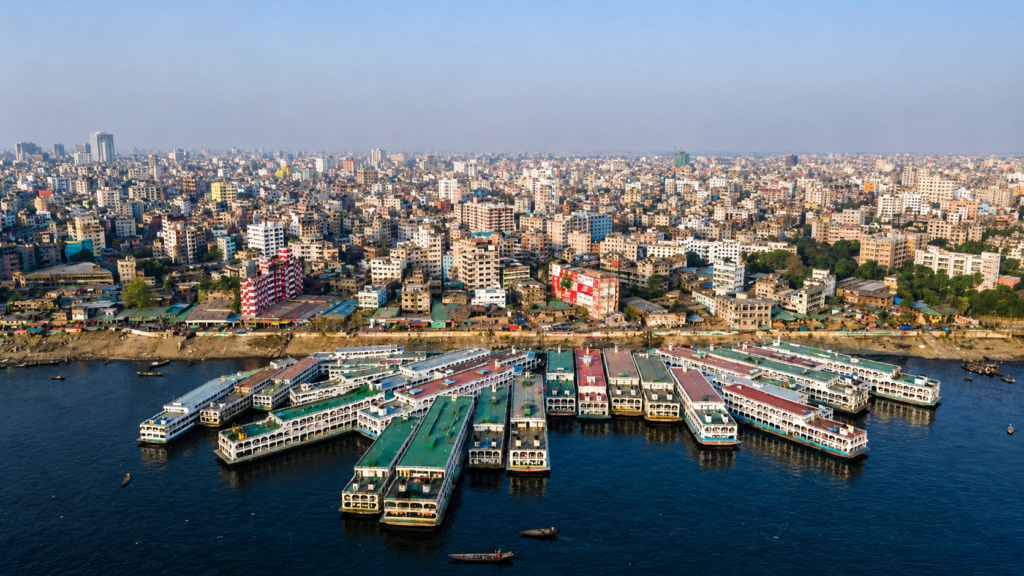
Photo Credit : MD MARUF HASSAN
In today’s world, Bangladesh stands at a very important turning point. Over the last few decades, the country has made quite some progress in economic growth, infrastructure, poverty reduction, and human development. But most of these progresses are only superficial. Almost like an eyewash. Beneath these achievements lies a deep structural imbalance that continues to hamper almost every aspect of national life. One of the most concerning aspect is the overwhelming concentration of power, opportunity, and development in Dhaka.
From employment and higher education to healthcare, administration, investment, and even justice delivery, nearly everything remains extremely Dhaka centric. As a result, thousands of people move toward the capital every single day. Some arrive carrying dreams of a better future, while others come simply because they have no other choice. But no country can move forward in a sustainable way when a singular city is forced to carry the burden of an entire nation.
At present, Dhaka is described as one of the world’s most unlivable cities. Nearly 36% of Bangladesh’s urban population lives in Greater Dhaka, which as a result places enormous pressure on an already burdened city. Traffic congestion, pollution, housing shortages, waterlogging, rising inequality, mental burnout, and overstretched public services have placed Dhaka in a position where it’s suffocating and choking with the lump of burden clogged in it’s throat.
And this crisis is not just urban. At its core, it is administrative, political, and deeply historical.
Bangladesh did not become centralized overnight. The root of this imbalance goes back to British colonial rule and later the Pakistani administrative structure, both of which were built on the idea of elitism and as a result the authority has always been concentrated at the very center. Colonial governance was designed to maintain control from above, not to empower local communities. Unfortunately, a hefty lot of that mindset still shapes governance today. And thus, power remains concentrated in the capital.
Ironically enough, Bangladesh’s Constitution originally envisioned something different. Articles 9, 11, 59, and 60 clearly emphasized local government, grassroots participation, and representative administration. The vision was there from the beginning. The implementation, however, was never truly followed.
Over the decades, different governments introduced different local government reforms. Democratic governments that followed also formed reform commissions and proposed changes. But many of these reforms suffered from one major problem- they were often shaped more by political interests than by a genuine commitment to empowering local governments.
Because local government institutions lack strong constitutional protection, successive governments have been able to restructure, weaken, manipulate, or abolish them according to their convenience. This constant instability has prevented local governance from developing continuity, trust, and institutional strength.
On paper, Bangladesh has an extensive local government structure:
- 8 Divisions
- 64 districts
- 492 upazilas
- 4,554 union parishads
- 328 pourashavas
- 12 city corporations
There is no lack of institutions. The real question is whether they actually hold enough authority to function effectively. This is the central problem of local governance in Bangladesh. The issue is not the absence of institutions. The issue is the absence of power, financial autonomy, continuity, and democratic trust within those institutions.
Local governments often cannot solve even small community problems without waiting for approval, funding, or direction from Dhaka. Decisions affecting remote regions are made by people sitting hundreds of kilometers away from the realities of those communities. They are unaffected by the problems that people from small communities suffer from. So they don’t feel the need to prioritize and solve those issues fast enough. Development becomes far more effective when decisions are made closer to the people affected by them.
The word ‘decentralization’ has lost its true meaning at this point because of the gap between how often it is discussed in political speeches and how often it is truly understood in its full sense. In reality, decentralization has several important dimensions. They can generally be divided into four sections.
- 1) Political Decentralization
- This means giving elected local representatives real decision making power instead of reducing them to symbolic figures with little authority.
- 2) Administrative Decentralization
- This includes:
- Deconcentration– where authority is spread across divisions and districts
- Delegation– where responsibilities are transferred to semi-autonomous institutions such as universities, development authorities, and boards
- This includes:
- 3) Fiscal Decentralization
- This involves giving local governments the ability to generate revenue, control budgets, and finance local development independently.
- 4) Economic Decentralization
- This allows NGOs, cooperatives, private sectors, and local institutions to actively participate in development and economic planning.
Bangladesh has made some progress in some of these areas even though they are not worth the mention. However, fiscal decentralization remains particularly weak.
One statistic alone explains the depth of the problem. Local government expenditure in Bangladesh accounts for only about 1% of GDP. In comparison, the figure stands at around 11% in China and 23% in South Korea. In simple words, Bangladesh continues to assign responsibilities to local governments without giving them adequate resources.
As a result, local institutions remain financially weak and overly dependent on Dhaka for even minor development activities. Many local bodies spend more time waiting for approval than actually solving problems. Fiscal decentralization is therefore not optional. It is a necessity.
When people can visibly see that their taxes and local fees are improving roads, drainage systems, healthcare facilities, or waste management in their own communities, public trust naturally increases. Citizens become more willing to contribute when they can directly see the results.
Another major obstacle is bureaucratic dominance. In many cases, government officials hold greater power than elected representatives. This weakens democratic accountability and often prevents local representatives from carrying out the responsibilities they were originally elected to perform.
Representation itself also remains uneven. Union parishads vary enormously in terms of population size and territorial jurisdiction, yet all of them have the same number of wards- 9 wards each union. This creates unequal and inadequate representation. Women’s participation also remains an important concern. Under the Union Parishad Act of 1997, three reserved female members are responsible for three wards simultaneously. In practice, this often overlaps with the responsibilities of male ward members, reducing both the effectiveness and visibility of women’s representation.
The local government election system also lacks uniformity. Different local bodies hold elections at different times under different arrangements. Discussions about synchronized elections and a unified legal framework can potentially reduce electoral expenditure to 1/4th of the current cost.
Recently, on 9 April 2026, Parliament removed provisions for holding local government elections under party symbols. Many people view this as an important step toward making local elections more nonpartisan and reducing excessive political polarization at the grassroots level.
However, reform cannot remain limited to elections alone. Bangladesh needs deeper structural reform. Development opportunities, healthcare, education, investment, and administrative authority cannot remain concentrated in one city if we truly want to develop. Decentralization must involve both fiscal and administrative autonomy.
Local governments need stronger revenue generation capacity so that they are not forced to depend on Dhaka for solving even minor local problems. Grassroots issues deserve more attention than mega projects. Development should not only be visible in flyovers and large urban infrastructure, but also in rural roads, schools, healthcare centers, drainage systems, and local economies.
One of the biggest reasons people migrate toward Dhaka is economic centralization. Most major industries, corporate investments, and employment opportunities remain concentrated in or around the capital. As a result, many district towns are gradually turning into mere labour suppliers for Dhaka instead of becoming economic centers themselves.
Bangladesh has enormous potential to create division-based specialized economic zones focused on sectors such as:
- • agriculture
- • fisheries
- • textiles
- • information technology
- • renewable energy
- • and local manufacturing
Universities and higher education institutions should also be connected directly with local industries so that students can build careers within their own regions instead of being forced to relocate to Dhaka. Young people should not have to leave their hometowns simply to access opportunity.
Capacity building matters a lot. Bangladesh does not necessarily lack institutions. In many cases, it lacks institutional support and long-term investment. Local governments need:
- trained personnel
- transparent financial systems
- performance monitoring
- regular audits
- stronger digital governance
- and professional administrative support.
Many regions that are currently neglected have huge potential. Often, they are held back by lack of attention despite having the capability to do so much more.
Climate change has also become an important driver of Dhaka centric migration. River erosion, floods, cyclones, salinity intrusion, and other climate related disasters continue to push people away from vulnerable regions and toward Dhaka. Reducing this pressure requires:
- climate resilient local economies
- local employment programs
- rehabilitation initiatives
- disaster preparedness,
- and green infrastructure.
Migration toward the capital will continue to intensify if these aspects are not taken into consideration.
According to UNDP, approximately 65% of Sustainable Development Goal targets require local level action. This means sustainable development is impossible without strong local government institutions. Localization is no longer just a policy discussion. It is essential for national development. Participatory budgeting, citizen complaint mechanisms, transparent audits, public oversight, and accountable leadership must become parts of governance at the local level.
Decentralization should also extend to justice delivery. Bangladesh currently faces a massive judicial backlog, including nearly 5.77 lac pending High Court cases. Keeping everything centered in Dhaka slows access to justice and increases inequality in legal services. Justice becomes more effective when it moves closer to the people.
‘Beyond Dhaka’ is not merely a slogan. It is a national necessity. The solution is not to weaken Dhaka, nor is relocating the capital realistically practical. Countries such as Indonesia have spent billions attempting capital relocation projects. Bangladesh’s challenge is different. The real solution lies in distributing opportunity, authority, development, and dignity more evenly across the country. A truly developed nation is not one where only the capital prospers while the rest struggle behind. True development begins when every district, every upazila, and every union becomes an active participant in progress.
Bangladesh must become a country where people are not forced to leave their hometowns in search of survival, where local governments are not merely symbolic institutions on paper, but effective and accountable democratic institutions closest to the people.
If Bangladesh truly wants a sustainable, inclusive, and resilient future, then the future of this country cannot remain trapped within Dhaka alone.
The future of Bangladesh must go ‘Beyond Dhaka’.
About Author:
Sumaiya Binte Sazzad
Executive, TBD
First-Year Law Student, University of Dhaka
The article presents a compelling case for decentralisation and local government empowerment in Bangladesh. Its strongest feature is connecting governance reform to broader issues such as migration, climate resilience, economic development, and justice. The improvement needed is stronger evidence for some claims such as, “Most of these progresses are only superficial. Almost like an eyewash.” Which is a very strong claim. Bangladesh has made measurable improvements in poverty reduction, life expectancy, infant mortality, female education, export growth. Calling these achievements ‘mostly superficial’ requires substantial evidence. Otherwise, critics may discuss the article as overly pessimistic.
This article has occasional emotional language. Some phrases sounds more rhetorical than analytical: “ Dhaka is suffocation and choking with the lump of burden clogged in its throat.” This creates imaginary but weakens academic credibility.
Fiscal comparison need context
The comparison Bangladesh 1% of GDP, China:11%, South Korea:23% is useful but incomplete. It creates a lot of questions like
“Are these figures measured the same way?”
“What fiscal powers do local government have in those countries?”
“What are the difference in governance systems?”
A brief exploration would make comparison more convincing.
Overall, it’s a thoughtful and policy-oriented piece that contributes meaningfully to discussions on Bangladesh’s future beyond Dhaka
Good read. Living in Japan has shown me how important regional development is. No city should have to carry the burden of an entire country. “Beyond Dhaka” is a conversation we need to have more often.
Excellent write-ups indeed.Without Decentralization and empowerment of local institutions the nation wouldn’t stand from seating on the floor.❤️🥰❤️