
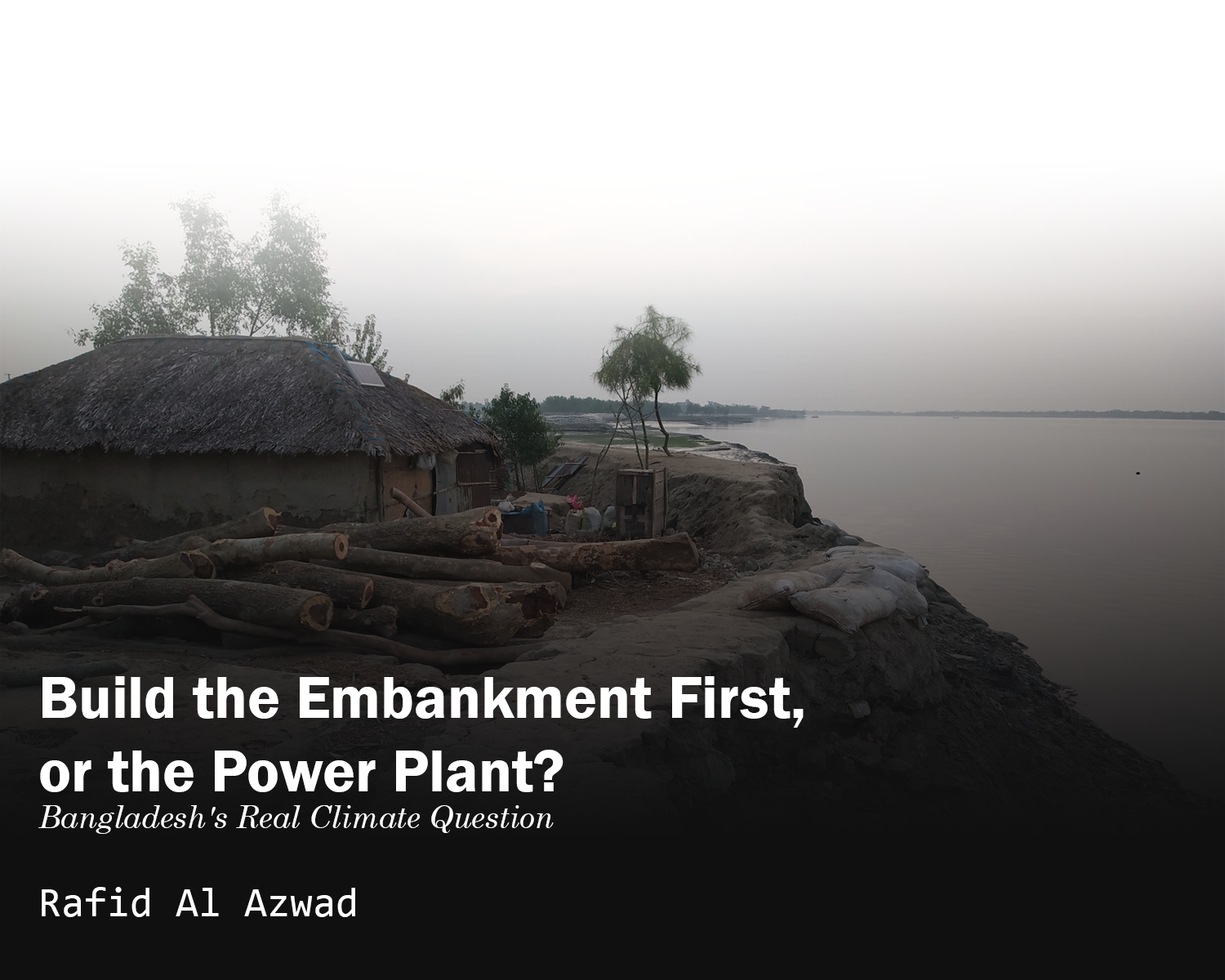
A farmer in Satkhira knows that saline water will creep back into his field next monsoon. What he does not know is whether that same field will be farmable at all in ten years. The first problem needs an answer today—a higher embankment, a salt-tolerant rice variety, a new irrigation scheme. The second depends on a question that reaches far beyond Bangladesh’s borders: how much warmer the planet will get, and how much Bangladesh itself is doing to slow that warming down. This tension between the two questions lies at the heart of a motion now being debated in policy circles—whether Bangladesh should give greater priority to climate mitigation than to adaptation. It sounds like a technical distinction. In truth, it will help decide the direction of millions of livelihoods, of public health, and of the country’s future security.
The difference between the two ideas is simple enough. Adaptation (জলবায়ু অভিযোজন) means adjusting to the impacts of climate change—cyclone shelters, early-warning systems, salinity management, climate-smart agriculture, urban drainage. Mitigation (প্রশমন) means reducing greenhouse-gas emissions or increasing carbon sinks—renewable energy, energy efficiency, public transport, forest protection. One asks how to limit the damage once it arrives; the other asks how to limit how much damage arrives in the first place.
Why the case for adaptation is so strong
The argument for prioritising adaptation in Bangladesh is far from weak. A World Bank assessment suggests that by 2050, climate variability and extreme events could put a substantial share of Bangladesh’s agricultural GDP at risk, and that over the next three decades several million people could be internally displaced by water stress and sea-level rise. These are not abstract figures. They describe a coastal family whose home floods every monsoon; a day labourer forced to work through ever-longer heatwaves; a fisherman whose waters are turning saline under him. For these people, climate change is not a future theory. It is a present condition.
There is also a question of fairness embedded here. Bangladesh is among the countries most exposed to climate impacts, yet its historical contribution to global emissions has been comparatively small. A foundational principle of the UN climate convention—Common but Differentiated Responsibilities and Respective Capabilities (CBDR-RC)—recognises exactly this asymmetry. The logic is straightforward: a country that did not create the crisis, but is paying one of its highest prices, has a reasonable claim to spend its limited resources protecting its own people first. And the returns on adaptation tend to be immediate—cyclone shelters and early-warning systems have already helped Bangladesh cut disaster mortality dramatically. This is not simply climate policy; it is poverty reduction, food security and public-health policy at once.
But adaptation indeed has a ceiling
Still, this argument has a soft spot, and it is the strongest counter-case for mitigation. How far can adaptation actually go? When the sea rises, embankments can be built higher—until the sea rises again, and they must be raised once more, until cost and engineering limits are reached and adjustment is no longer possible. This is what is known as an adaptation limit. The more the planet warms, the more places will find that adapting is no longer enough, and loss and damage begins—harm that can neither be prevented nor absorbed, only endured. That reality carries an uncomfortable implication: spending indefinitely to react to damage eventually becomes an open-ended bill, unless the underlying driver—emissions—is also addressed.
This is where Bangladesh’s uncomfortable position comes into focus. It is simultaneously a climate victim and a rapidly growing economy, with industrialisation, urbanisation and energy demand all rising fast. If Bangladesh builds fossil-fuel-heavy infrastructure today, it risks locking itself into a high-emissions pathway for the next three or four decades—a phenomenon known as lock-in. “Our emissions are small, so mitigation isn’t our responsibility” is not, in other words, an argument that holds up for the future. And mitigation carries practical benefits that go beyond ethics: cleaner energy reduces dependence on imported fuel, lowers air pollution and protects public health, and keeps export-driven industries—garments, leather, cement—competitive as global markets tighten their carbon standards. Seen this way, mitigation is not only climate morality; it is a development strategy.
What the policy record actually shows
Bangladesh’s legal and policy architecture suggests the country has, in effect, already accepted this dilemma, even if it has rarely said so explicitly. Article 18A of the Constitution places environmental protection and conservation of natural resources squarely among the state’s responsibilities—a foundation for both adaptation and mitigation, without privileging either. The Environment Conservation Act 1995 and the Climate Change Trust Act 2010 built the institutional scaffolding. The Bangladesh Delta Plan 2100 and the National Adaptation Plan 2023–2050 establish adaptation as a long-term development necessity in unambiguous terms. On the other side, Bangladesh’s Third Nationally Determined Contribution (NDC 3.0), submitted in 2025, sets a target of cutting emissions by 20.31 percent against business-as-usual by 2035—6.39 percentage points unconditional, and a further 13.92 percentage points contingent on international finance and technology support. In other words, the state has already answered the question of whether mitigation is necessary. Reading together, these documents describe not a rivalry but a coexistence: Bangladesh’s policy architecture has never treated adaptation and mitigation as competing alternatives, but as two pillars of the same structure. The Paris Agreement follows the same logic, treating mitigation and adaptation as equal pillars and establishing a Global Goal on Adaptation precisely to pull adaptation out from under mitigation’s shadow.
Where the real question lies
So where does the actual disagreement sit? Not in the budget line alone, but in marginal return—if the government spends one additional taka on adaptation, does it produce more benefit than the same taka spent on mitigation? There is no simple answer. Where climate risk is already severe—coastlines, agriculture, flood-prone cities—the marginal return on adaptation is probably very high. But where today’s infrastructure choices will determine emissions for decades—power, transport, industry—the long-term return on mitigation spending now may be just as high. A recent UNEP report notes that international public adaptation finance for developing countries has grown, yet the gap against actual need remains vast. That sharpens the question further: can Bangladesh, with its limited domestic resources, pursue large-scale adaptation and ambitious mitigation at the same time?
Mitigation’s own costs cannot be waved away either. Rapid decarbonisation—grid transformation, renewable infrastructure, industrial retrofitting—is expensive, and if electricity prices rise or industrial competitiveness suffers, the political legitimacy of climate policy itself comes under strain. This is why the idea of a just transition matters. Adaptation, too, has its weaknesses: repairing infrastructure after every flood can become a recurring expense rather than a genuine transformation, and poorly designed embankments or drainage systems can shift risk from one place to another—a pattern known as maladaptation.
Not a binary, but a blend
One way out of this bind is the idea of climate-resilient development, which treats adaptation and mitigation not as rivals but as two faces of the same decision. Solar-powered irrigation helps a farmer withstand drought while cutting fossil-fuel use. Mangrove restoration shields the coast from storm surges while sequestering carbon. Energy-efficient, elevated housing protects against both flood and heat while lowering emissions. In this kind of policy, the question stops being “adaptation or mitigation” and becomes: which investment delivers the most of both at once?
Even so, real trade-offs will remain, and thinking in terms of time horizons can help. In the near term, protecting today’s population is hard to deprioritise, particularly along the coast, in agriculture, and in disaster management. In the medium term, wherever it makes economic sense—energy efficiency, public transport, waste management—mitigation can advance without much additional burden. And in the long term, mitigation’s importance only grows, because today’s infrastructure decisions will decide how difficult a climate the next generation inherits.
The underlying question may therefore be framed wrongly to begin with. Bangladesh does not need to choose between adaptation and mitigation as a whole; it needs to ask, sector by sector, project by project, taka by taka, how much each choice protects people from today’s risks and how much it reduces tomorrow’s. For the farmer in Satkhira, both questions are equally real. The embankment saves him this year; but how warm the world becomes will decide whether his children can farm the same land at all. Adaptation determines how safely Bangladesh lives with the climate it already has; mitigation determines how difficult a climate it leaves behind for the next generation. Treating these not as rivals but as two fronts of the same struggle is probably the most realistic way forward.
Sources consulted: World Bank, Bangladesh Country Climate and Development Report (2022); UNEP, Adaptation Gap Report 2024; IPCC, Summary for Policymakers and related reports; UNFCCC, Bangladesh’s Third Nationally Determined Contribution (NDC 3.0), 2025; United Nations, UNFCCC legal texts on CBDR-RC; Bangladesh Ministry of Environment, Forest and Climate Change, National Adaptation Plan of Bangladesh 2023–2050; Bangladesh Delta Plan 2100 portal; Constitution of Bangladesh, Article 18A; Environment Conservation Act 1995; Climate Change Trust Act 2010; Bangladesh Climate Fiscal Framework.