
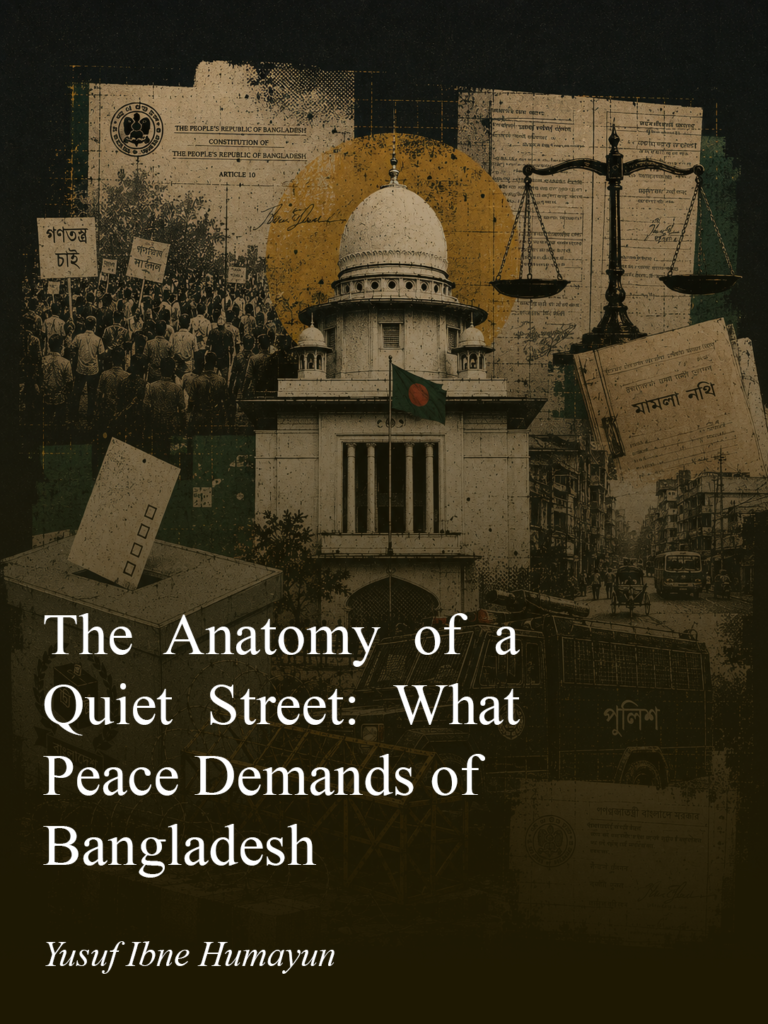
There is a deceptive calm in Bangladesh after every political imbroglio. Traffic flows steadily on Dhaka’s arteries, shopkeepers hoist open their shutters with renewed vigor, and the howl of public outrage that reverberated through the streets evaporates under the oppressive heat of the morning sun. To the untrained eye, it might seem like things have largely returned to normal. To those who have witnessed the country lurch from one crisis to another, however, this is the eerie silence before the next storm breaks.
Bangladesh has seen enough of political unrest to know the difference between peace and quiet. Our vocabulary of peace is, perhaps, too conveniently conflated with the absence of immediate political violence, and the same goes for democracy. Democracy, as a concept, is too often distilled to the ritualistic theatre of polling booths, and peace reduced to the restoration of order after anarchy. The two, in theory, should be inextricably linked, but in practice, their relationship is far more complicated in Bangladesh.
An election could make winners and losers of political parties, but unless it reshapes the very idea of how power operates in the country, it has little effect on the broader political landscape.
If power is positional, and losing out in a contest of power means ceasing to exist as a political entity, then every election campaign is a fight for survival. Perhaps the most crucial question for post-election Bangladesh should be whether the people actually want a state in which power is no longer an existential threat to those who do not possess it.
This, in turn, raises more basic questions about institutions. In an ideal democracy, institutions act as a buffer that allows citizens to co-exist despite their differences. They may dislike the government, or a particular minister, or be disappointed with the outcome of an election, but they can have faith in the institutions to deliver a measure of stability. In Bangladesh, that faith has largely been eroded. The institutions are not inherently undemocratic, but they have become so intensely polarising that people are prone to suspecting everybody else of having an agenda.
It is impossible to quantify how much the general mistrust of institutions has damaged democratic life in Bangladesh, but its effects are certainly tangible. Citizens have become so accustomed to navigating the minefield of partiality that it informs their dealings with the law, too. They factor in their risk assessment before approaching a police station or filing a case against someone. They may ask themselves, in good faith, if they will be served based on the rule of law or the perceived interests of the person on the other side of the counter. Once that mindset is normalised, it is extremely difficult to roll back. Trust, once lost, is infinitely harder to regain than it is to earn in the first place. This is why the question of accountability is so pertinent to Bangladesh.
It is understandable that people would demand retribution against those who have abused the system, especially in the wake of particularly egregious crackdowns. However, as Bangladesh tries to move on from years of repression, it must learn to differentiate between revenge and accountability. Justice should not, and cannot, exist in a democratic system in isolation from structural reform. If justice delivers short-term satisfaction but fails to serve the long-term interests of society, it is not really justice. The very fact that Bangladesh needs to have this discussion suggests that, as a country, it is dangerously close to crossing the threshold.
July 2024, then, was not merely a sobering lesson on Bangladesh’s democratic temperament; it was an opportunity to reflect on some of the deeper issues that have contributed to this state of affairs. While much of the commentary has focussed on the events of July, it is worth remembering why this crisis unfolded in the first place. The bigger question is precisely what the country is going to do differently in the future so that July is neither a foreboding prelude to renewed strife nor a permanent closed chapter for Bangladesh’s democracy.
It is in this context that the discussion on reform becomes more interesting. Bangladesh has had long and, at times, quite heated debates about reform in the wake of political violence. But reform is a broad concept, and the urgency of preventing the next crisis often overshadows other equally important measures. There is much to be gained from examining alternative mechanisms that could help prevent future crises. The most obvious example is prevention as opposed to cure. Prevention, while undoubtedly less headline-grabbing, has the potential to yield far richer long-term dividends.
The most recent round of the Bangladesh Dialogue brought together citizens and professionals from a variety of backgrounds to deliberate on the subject of reform. Its relevance was not in its existence per se but in asking what it could offer beyond immediate electioneering and crisis management. Reform is complicated, and its track record in Bangladesh has been inconsistent at best. The questions surrounding reform have to be more nuanced, not merely what to do but how and when to do it in order to mitigate political conflict. Some crucial areas stand out, namely policing, minority-majority relations, hate speech and disinformation, and long-term institutional trauma.
It is perhaps unsurprising that Bangladesh’s political parties have not spent much time considering how democracy really works. They are more preoccupied with staying in power or getting there at all costs. Democracy is an asset when it serves their interests and a liability when it does not. Theirs is not a system of checks and balances but one of entitlement; a sense of moral superiority that allows their members to disregard institutional norms when convenient. The root cause of Bangladesh’s recurring electoral violence lies in the ability of individual politicians to treat the state as an extension of their own authority. Every political party should be acutely aware that simply placing its candidates in state institutions is not good enough. Institutions must have the ability to withstand political interference. Otherwise, they serve no purpose beyond being a façade for those in power.
A new government, then, may well find itself in the same position as the one that preceded it. It may inherit many of the same structural weaknesses that made Bangladesh so susceptible to political violence in the first place. Democratic reforms require institutional independence, professional law enforcement, and reliable channels of accountability in order to be truly effective. Political parties must realise that their interests and their survival are inextricably linked to the institutions they purport to serve.
It is not enough that Bangladesh merely reiterates its democratic credentials once every few years through an election. Its democracy needs to be capable of fulfilling its potential as a mechanism of coexistence and compromise. This requires more basic elements: security and institutional reliability, so that citizens feel empowered to utilise the tools democracy gives them. Peacebuilding and democratic strengthening, for Bangladesh, must be viewed as intertwined processes that serve a common goal. Democracy is not an end in itself, but a means to an end, one that is significantly more attainable if democratic institutions are trusted to deliver on their promises. The next government must understand that winning, or losing, an election does not mean victory or defeat for the entire country.
It must be remembered that a society does not achieve peace solely because its streets have ceased to be battlegrounds. It only begins to approach peace when its citizens know that they can settle their differences through democratic means. It is not sufficient to merely end violence; justice must be done, and it must be seen to be done by institutions that are demonstrably fair. This is how democracy delivers its most vital function, by ensuring that disagreements do not devolve into uncompromising confrontations. It is not easy to turn citizens into responsible political actors, but it is essential if Bangladesh is to move beyond its perpetual cycles of unrest.
About Author:
Yusuf Ibne Humayun
Executive, TBD