
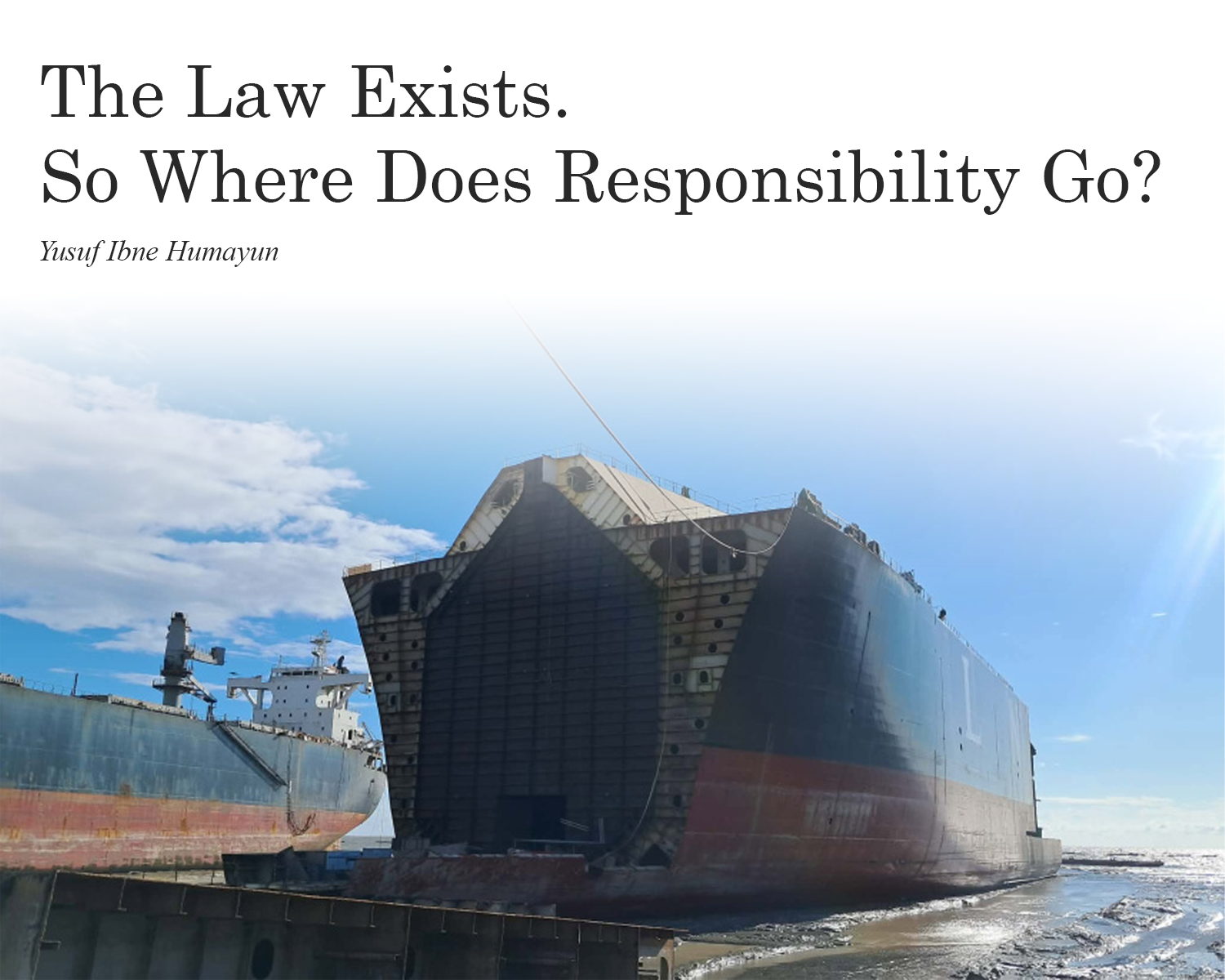
On 14 August, 2026, nine workers lost their lives inside an LNG carrier at a Sitakunda shipbreaking yard after being exposed to toxic gas. One survivor, Mohammad Selim, told The Daily Star that if he had stayed inside for just 20 seconds longer, he wouldn’t have made it out. Some workers had masks on; others had simply tied cloth over their faces. Even those who rushed in to rescue their colleagues fell victim to the fumes. While the coming investigation needs to pinpoint exactly how this happened, one question is impossible to ignore: how did workers end up stepping into a vessel filled with lethal gas in an industry where these exact risks have been documented for decades?
Shipbreaking is inherently dangerous. That is precisely why there are regulations in place. Issues like confined spaces, toxic gases, hazardous residues, and poor ventilation aren’t unexpected surprises, they are well-known occupational hazards. Research into Bangladesh’s ship recycling industry has repeatedly highlighted the same critical failures: inadequate gas freeing, lack of monitoring, poor ventilation, insufficient protective gear, and weak emergency responses.
And this is happening under a supposedly stronger regulatory regime. The Hong Kong Convention for the Safe and Environmentally Sound Recycling of Ships became mandatory in Bangladesh on 26 June 2025. Yet a Bangladesh Institute of Labour Studies report found 28 accidents at shipbreaking yards across the country between January and June this year, leaving three workers dead, while another BILS report recorded 32 accidents in Sitakunda yards during the second half of 2025, leaving three workers dead and 38 injured.
The history of the Sitakunda area makes it very difficult to view these latest deaths as a mere fluke. A 2023 investigation by The Daily Star found that 251 workers had died in the upazila’s shipbreaking yards over the last 18 years. That same investigation pointed to three massive industrial disasters within just nine months, including the BM Container Depot explosion that killed 51 people and the Sheema Oxygen Plant explosion that claimed at least seven lives. Experts had already been sounding the alarm about the lack of safety equipment and oversight.
The pattern is troubling because the legal framework isn’t actually missing. We have the Bangladesh Labour Act of 2006 to set safety obligations and the Bangladesh Labour Rules of 2015 to flesh them out. The Department of Inspection for Factories and Establishments is tasked with enforcement, and shipbreaking also falls under a web of environmental, fire, and industrial regulations. The government itself has now formed a high level committee to review the country’s ship industry laws, rules and policies and recommend reforms.
So, the real question isn’t what new laws Bangladesh needs. It is what happened to the rules that were already supposed to be protecting these people.
Before those workers ever stepped foot inside that vessel, a chain of responsibility was already in motion. Employers had duties. Management had duties. Safety officers had duties. And the relevant authorities had the duty to inspect and regulate. Whoever was tasked with assessing the vessel, confirming it was safe to enter, testing the air, providing gear, or halting work when conditions turned deadly, they all had responsibilities attached to their roles. Those duties existed long before anyone died.
This is why finding the immediate actor cannot be the end of the accountability chain. If an employer failed to provide the legally required safety measures, that is a failure. If management allowed work to proceed without precautions, that is a failure. If safety personnel missed a known hazard, they must answer for it. If an inspector failed to spot a violation, they deserve scrutiny. If a regulator had the power to step in and didn’t, that failure must be part of the investigation. The fact that these deaths happened inside a ship doesn’t erase the decisions made in offices and inspection bays that allowed the work to happen in the first place.
This brings us to the necessity of administrative accountability. Institutions don’t make decisions; people do. Inspections are conducted by people. Licenses are signed by people. Regulatory decisions are made by people in specific roles. When a position carries a legal responsibility, the person in that role cannot simply hide behind the “institution” when tragedy strikes. This doesn’t mean we should immediately label everyone involved a criminal. Criminal liability requires evidence and due process. However, there is more to responsibility than just criminal charges. If an official failed to carry out a statutory duty, that failure should be addressed, even if it doesn’t lead to a prison sentence. The same goes for failures in supervision, inspection, or enforcement.
Past disasters illustrate why this distinction is so vital. When the BM Container Depot explosion killed 51 people in 2022, a government probe offered 20 recommendations. Later, police released a report stating the eight officials named in the case weren’t responsible, calling the event an “accident.” Regardless of what that says about criminal liability, it doesn’t answer the bigger administrative question: did the safety system actually do its job before the blast, and did those 20 recommendations actually change anything?
The word “accident” becomes a dangerous convenience if it is used to end an inquiry. An accident describes an event, but it doesn’t prove that no one failed in their duties beforehand. A worker can die in an “accident” while an employer is violating safety laws, an inspector is looking the other way, or a regulatory system is breaking down at every level.
That is why this investigation must follow the trail of responsibility both up and down the chain. It needs to look at the employers and managers on the ground, but it must also look at the officials responsible for oversight. Was the vessel inspected? Was the air tested? What do the records say? Were past violations caught? If corrective measures were ordered, were they actually followed? If they weren’t, who knew about it, who should have known, and who allowed the work to go on anyway?
These aren’t questions of hindsight; they are questions of accountability. They go back to the very basics of how a regulatory system is supposed to work.
This is exactly why calling for even stricter laws risks missing the mark. Bangladesh isn’t lacking in legislation; it already has workplace safety laws, inspectors, regulators, and enforcement protocols in place. It also has a long history of industrial accidents, investigations, and post-mortem reports that clearly show what happens when these systems break down. The fact that the Hong Kong Convention became mandatory in Bangladesh last year has not ended the accidents. If a specific law isn’t strong enough to handle a particular hazard, then we need to identify and fix that specific gap. But when the law already mandates a certain duty, the real question we should be asking is why that duty wasn’t carried out and what the consequences were when it wasn’t.
A working regulatory system should leave a paper trail. Someone either inspected the site or they didn’t. Someone recorded a violation or they missed it. Someone ordered a fix or they didn’t. Someone was tasked with ensuring compliance or they failed to do so. If an order was ignored, someone had to make the call on whether to enforce it. If an unsafe operation kept running, someone had the power to step in. Responsibility shouldn’t become harder to pinpoint just because a failure stretched across multiple offices instead of just one.
Sitakunda has already been flagged repeatedly. In 2023, The Daily Star reported that even government agencies couldn’t agree on how many industrial units were actually operating in the upazila. DIFE officials provided one set of numbers, the local administration provided another, and the Chattogram deputy commissioner admitted that the data was outdated. That same report mentioned the DC promising surveys and enforcement drives to ensure fire safety and general compliance.
That might sound like a minor administrative hiccup, but it isn’t. You cannot regulate what you haven’t accounted for, and you cannot effectively inspect a sector you don’t actually understand. When the same region keeps seeing major industrial disasters, these gaps in basic oversight aren’t just background noise, they are central to the tragedy.
None of this implies that every accident is an act of criminal negligence. It doesn’t. Nor does every official error automatically equate to legal liability; those are matters for evidence. However, when failures repeat themselves in a regulated industry, a simple expression of concern isn’t enough. We need to examine every single duty and every person or institution tasked with carrying them out.
The current investigation shouldn’t just look at how workers were exposed to the gas; it needs to look at the conditions that allowed that exposure to happen in the first place. It must identify the safety requirements, figure out who was responsible for enforcing them, review inspection and compliance records, and pinpoint exactly where the chain broke. If the employer failed, that needs to be proven. If supervision failed, that needs to be proven. If inspections failed, or if regulatory oversight failed, that must be established as well. The goal isn’t to manufacture blame, but to make responsibility visible.
Nine workers are dead in an industry where the risks are well-known, the rules are written, and multiple institutions have clearly defined roles. We might identify the immediate cause quickly, but the much harder task is tracing the systemic failures that preceded it. This is the question of accountability that Bangladesh keeps pushing aside. It isn’t a question of whether the laws exist, whether the offices are open, or whether an investigation happens after people die. It is a question of whether the person assigned a duty is actually held to account when they fail to perform it.
The laws are there. The duties are defined. The institutions are in place. The seats are occupied. What needs to be determined every time the system fails is whether responsibility actually reaches the people sitting in those seats