
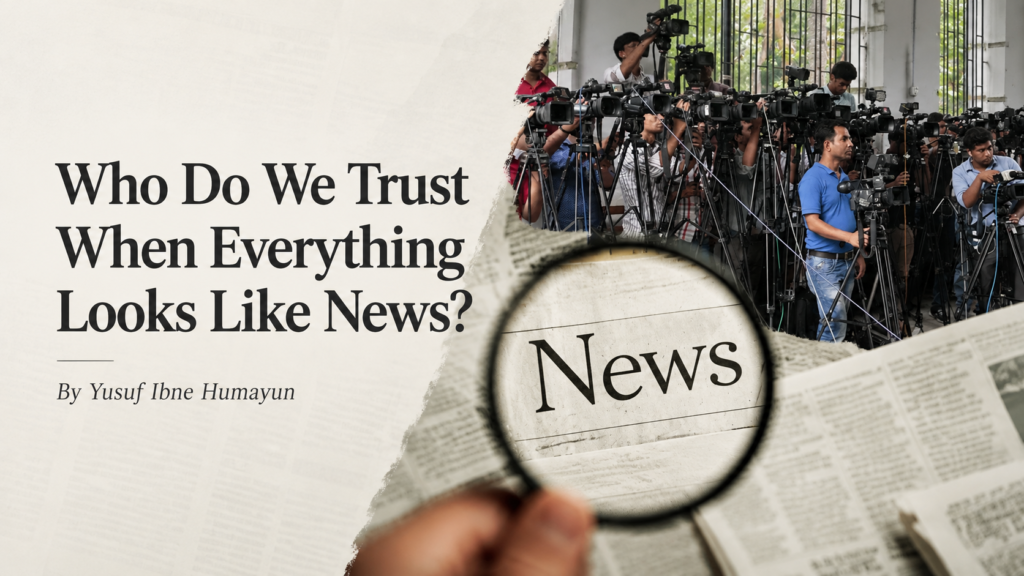
The injunction to “Choose Trusted Journalism” sounds perfectly reasonable, echoing the moral clarity of a public health campaign or a civic duty reminder. It implies that journalism exists on a clearly illuminated shelf, carefully inspected for quality, waiting patiently for the discerning citizen to reach out and select it. Yet, this well-meaning slogan feels increasingly detached from the brutal reality of the 2026 information ecosystem. When a person opens a screen today, they are not presented with a curated menu of verified facts. They are immediately submerged in a frictionless, algorithmic sludge where legacy news investigations, partisan newsletters, social media influencers, hyper-partisan video clips, state-sponsored propaganda, and synthetic AI-generated content all compete for the exact same fraction of human attention. The foundational boundaries that once distinguished professional reporting from the chaotic noise of the internet have entirely collapsed. Consequently, asking an audience to simply choose trusted journalism is a profound oversimplification of the crisis we face. The defining question of our time is no longer just whether we should trust the news, but how we can possibly identify what deserves our trust when everything we see has been engineered to look exactly like news.
To confront this crisis, we must first interrogate the unseen financial architecture that dictates what information is allowed to exist. The consolidation of corporate media ownership has fundamentally altered the local and national news environments across the globe. Consider the recent regulatory shifts in the United States, where the Federal Communications Commission voted in August 2026 to repeal the longstanding 39% national television multiple-ownership rule and replace it with case-by-case review of proposed transactions. The FCC said the new approach would assess individual deals against its public-interest standard, including the changed competitive environment created by digital platforms. This is not merely a dry regulatory adjustment; it is a significant change to a longstanding limit on how much of the national television audience a broadcaster can reach through ownership. It would be intellectually dishonest to claim that corporate ownership automatically guarantees bad journalism. In many cases, wealthy proprietors or large parent companies provide the only financial buffer capable of sustaining expensive, high-stakes investigative reporting. However, audiences are entirely justified in demanding to know what that ownership means for editorial independence. The broader concern is not hypothetical: the 2025 World Press Freedom Index found that in 92 of the 180 countries and territories it assessed, a majority of respondents said media owners “always” or “often” limited their outlet’s editorial independence. RSF also identified media concentration as a concern even in countries with relatively strong press-freedom environments. When local newsrooms become minor line items in a vast corporate portfolio, the crucial firewalls that separate commercial interests from editorial decisions inevitably face immense pressure. We must ask what stories are quietly ignored because they threaten corporate synergies, and what safeguards actually exist to protect reporters from the whims of their boardrooms. When citizens are deciding what to trust, the financial machinery behind the masthead is highly relevant context. Transparency regarding who pays the bills is just as important as the reporting itself.
Yet, the threat to independent journalism extends far beyond the boardrooms of corporate conglomerates; it is actively weaponized by political actors who recognize that a confused public is far easier to govern. Throughout 2025 and 2026, the global assault on editorial independence has grown remarkably sophisticated. The evidence of that pressure is visible across media systems: the 2025 World Press Freedom Index classified the global state of press freedom as “difficult” for the first time in the history of the index, while identifying economic and political pressure as major threats to independent journalism. Authoritarian and ostensibly democratic governments alike are no longer relying solely on the blunt, highly visible instruments of outright censorship or the physical imprisonment of reporters, though those horrors remain devastatingly common from Eastern Europe to South Asia. Instead, they are deploying a quieter, systemic form of intimidation. Governments routinely leverage administrative power to reward compliant outlets and financially suffocate critical ones. They utilize retaliatory tax audits, manipulate state advertising budgets, and deploy broad, ambiguous national security laws specifically designed to criminalize investigative reporting. These mechanisms are not merely theoretical. RSF has documented the use of opaque or unequal public aid and state advertising, as well as financial arrangements involving political or business interests, as sources of pressure on editorial independence in multiple countries. Furthermore, political figures have increasingly cultivated their own captive media ecosystems, bypassing independent scrutiny entirely to communicate directly with their bases through compliant broadcasters and social platforms. The Reuters Institute’s 2026 findings illustrate one dimension of this shift: politicians are increasingly going directly to audiences as online news creators, while established news media can be bypassed by large online video channels. This creates a deeply polluted environment where it becomes practically impossible for a citizen to distinguish between rigorous, independent journalism and state-aligned political communication. When political leaders relentlessly attack the very concept of objective truth, they are not just criticizing the press; they are contributing to an environment in which citizens can become increasingly cynical about the possibility of establishing reliable facts at all.
Even if a newsroom manages to navigate the treacherous waters of corporate consolidation and political intimidation, it remains tethered to the harsh, unforgiving economics of the digital attention economy. We demand that journalism serve a noble public-interest function, holding the powerful accountable and informing the electorate, yet we force it to survive within a commercial system that exclusively rewards immediate engagement. The total collapse of the traditional advertising model, the volatility of digital subscriptions, and the relentless, tragic shrinking of local newsrooms have placed immense pressure on publishers to capture and monetize fragmented audience attention. We should not romanticize a mythical past era when journalism was supposedly immune to commercial pressures, but the current digital environment is fundamentally distinct in its immediate, data-driven feedback loops. The scale of the economic pressure is measurable. RSF’s 2025 World Press Freedom Index found that in 160 of the 180 countries assessed, media outlets achieved financial stability “with difficulty” or “not at all”, while news outlets were shutting down because of economic hardship in nearly a third of countries. Clicks, engagement metrics, and algorithmic virality dictate editorial priorities with ruthless efficiency. This creates a profound structural incentive for speed over verification and for emotional outrage over careful nuance. The quiet, rigorous work of contextualizing complex civic events is placed at a massive disadvantage when forced to compete in a marketplace that financially rewards extreme polarization. When a publication’s economic survival relies on keeping its audience perpetually provoked, the fundamental journalistic practices of verification and measured context are inevitably sacrificed.
This economic desperation is heavily compounded by the fact that news organizations no longer control how their reporting actually reaches the public. The platform problem is the defining structural shift of the modern media landscape. A newsroom may invest months of labor into a vital investigation, but opaque, third-party recommendation systems largely determine whether anyone will actually see it. The 2026 Digital News Report published by the Reuters Institute for the Study of Journalism confirms a stark reality: across its 48 markets, social media and video networks were used by 54% of respondents to access news in the previous week, compared with 51% who used news organisations’ own websites or apps. For the first time globally, social media and video networks became the single most widely used way of accessing online news. These platforms are engineered around engagement and retention rather than the institutional responsibilities traditionally associated with journalism. Their algorithms flatten the visual and functional hierarchy of information, placing a deeply sourced, verified report right next to a highly emotive piece of partisan commentary or a fabricated conspiracy theory. The consequences are visible in the trust data: globally, only 22% of respondents say they trust news consumed through social media most of the time, compared with 37% for news overall. Consequently, journalism has become violently dependent on the very platforms that are driving audiences into isolated digital communities. This dynamic has accelerated the rise of influencers and content creators as the primary intermediaries of reality, individuals who frequently summarize, react to, or editorialize the news rather than undertake the difficult, expensive work of original reporting. The Reuters Institute’s 2026 report found that a quarter of audiences globally now get at least some news from creators who focus on news. Among younger audiences, the shift is even more pronounced: 52% of people aged 18–24 say that social media, video networks and AI chatbots are their main way of getting news. We have allowed the distribution of our civic reality to be governed by algorithms that are entirely indifferent to the truth.
Layered aggressively over this platform dominance is the rapid, highly disruptive integration of artificial intelligence into the global information ecosystem. As audiences increasingly turn to generative AI systems, conversational chatbots, and automated search summaries to discover and interpret current events, another massive, opaque barrier is erected between original reporting and the public. The 2026 Reuters Institute data indicates rapidly growing, though still minority, use of AI chatbots for news: weekly use increased from 7% to 10% globally. These systems frequently scrape complex, heavily researched journalism and compress it into a concise, seemingly authoritative paragraph. When reporting is metabolized by an AI system in this manner, the foundational markers of trustworthiness can become harder to see. The visibility of the original source can diminish. The crucial context surrounding the reporting can be compressed or omitted. The necessary caveats regarding uncertain or developing information can disappear in the process of summarisation. Most importantly, the human accountability of a bylined journalist can be obscured by the frictionless, disembodied certainty of algorithmic text. The risk is not that original reporting always disappears: 42% of people who use AI chatbots for news say they always or often click through to the original news source. But a majority do not report doing so regularly, leaving a substantial gap between the generated answer and the journalism behind it. If audiences consume journalism not as the transparent product of human inquiry, but as a generic answer generated by a machine, the very concept of trusting a newsroom becomes dangerously harder to sustain. We are effectively transferring part of our trust to black-box technologies that cannot be held to the same professional accountability as a newsroom, cannot protect a vulnerable whistleblower in the human sense, and possess no institutional obligation to tell the truth. The trust gap is already visible: only 20% of respondents globally say they trust answers from AI chatbots for news, compared with 37% who trust news overall.
However, we cannot lay the blame entirely at the feet of algorithmic platforms, corporate owners, and political operatives; we must also turn a harsh, critical eye toward the audiences themselves. Global research continues to document a severe, multi-year decline in public trust toward the news. The 2026 data reveals that trust in news has fallen to historic lows across a majority of surveyed markets. Trust fell in 29 of the 48 markets surveyed, bringing global trust in news down to 37%, the lowest level recorded by the Reuters Institute since it began measuring the figure in 2015. At the same time, 62% of respondents expressed concern about misinformation online. While it is tempting to frame this phenomenon solely as a failure of journalistic practice, doing so ignores the complex, uncomfortable reality of human behavior. Distrust can certainly be a rational, justified response to sensationalism or corporate bias. Yet, it is increasingly an expression of a much deeper, more destructive societal rupture. We are navigating an era of profound political polarization, leading to a dynamic where selective exposure heavily dictates media habits. If public distrust is directed indiscriminately at journalists, elected governments, academic institutions, scientific bodies, and technology platforms alike, it suggests a terrifying breakdown in how modern societies establish and agree upon basic empirical facts.
This brings us to the sharpest, most difficult question of all. If people trust journalism primarily when it confirms what they already believe, are they actually trusting journalism, or are they merely trusting their own worldview? In deeply polarized environments, the metric for trustworthiness often shifts violently away from the rigor of the reporting and toward the comfort of the conclusions. When fragmented media ecosystems offer an endless, algorithmic buffet of ideological validation, a citizen can easily reject a rigorously verified story simply because it challenges their political identity, reflexively dismissing the work as biased or fabricated. This is not intended to blame audiences for systemic failures, but rather to recognize that the structural conditions of the internet heavily encourage and reward this specific form of intellectual retreat. When digital platforms monetize tribalism, people are naturally conditioned to judge the credibility of a report based entirely on whether it signals allegiance to their preferred political or cultural tribe. Genuine journalism that challenges a reader’s preconceptions is inherently uncomfortable. But a functioning society requires citizens who possess the fortitude to experience that discomfort rather than retreating into the warm, algorithmic embrace of an echo chamber.
If we are to salvage the concept of trusted journalism, we must radically redefine what trust actually means. Trustworthiness cannot be treated as a static reputation, a legacy corporate logo, or a prestigious institutional status inherited from a bygone era. It must be understood as an active, observable, and continuous process. The practical features that allow audiences to assess the validity of journalism are not abstract mysteries; they are deeply grounded in rigorous professional methodology. Trust is built through the meticulous verification of facts, the presentation of clear evidence, and the unprompted disclosure of potential conflicts of interest. It requires a strict, visible distinction between factual reporting and editorial opinion. It demands the fierce protection of vulnerable sources, a commitment to seeking a right of response from those being scrutinized, and a willingness to clearly explain the limits of what is known during developing situations.
Most critically, trustworthy journalism demonstrates its integrity through accountability when errors inevitably occur. The standard is not flawless perfection, as no human enterprise operating under the intense pressure of time is immune to mistakes. Rather, trustworthy journalism demonstrates precisely how it attempts to get things right, and it is entirely transparent about the corrective actions it takes when it gets things wrong. A familiar corporate logo cannot substitute for that rigorous process. A prestigious institutional background cannot substitute for that process. Political agreement with the audience absolutely cannot substitute for that process. Furthermore, a reader’s personal disagreement with a well-reported story cannot, by itself, serve as proof that the report is untrustworthy. We must relearn how to evaluate the scaffolding of a story, actively looking for the presence of verifiable evidence and professional standards, rather than simply reacting to the headline.
After confronting the intense corporate pressures, the sophisticated political interference, the unforgiving commercial incentives, the algorithmic distortions, and the rise of AI intermediaries, it is remarkably easy to succumb to a deep, structural despair regarding the future of civic information. The system appears irreparably broken. Yet, moving away from this anxiety requires acknowledging the tangible, persistent reality on the ground. Despite every systemic force currently making the profession vastly more difficult, more legally dangerous, and less economically viable, there are still journalists, investigative teams, local correspondents, photojournalists and editors doing the work. Across South Asia, Europe, the Americas, Africa, and Southeast Asia, they continue to meticulously verify information before hitting publish. They actively pursue difficult, highly sensitive stories that require months of unglamorous, exhausting labor. They document exactly what powerful people and corrupt institutions would vastly prefer to remain undocumented, often operating in legally hostile or physically dangerous environments. They issue public corrections when they err, they fiercely protect the identities of whistleblowers, they ask deeply uncomfortable questions of those holding public office, and they maintain rigorous professional standards despite immense pressure to surrender.
These daily acts of professional resilience are exactly what gives actual weight to the concept of trusted journalism. We must stop treating these individuals as romantic heroes or mythical saviors; they are dedicated professionals attempting to hold the line in a collapsing ecosystem. Trust has to be earned, repeatedly and transparently, by media institutions, by newsroom leadership, and by the individual people performing the grinding labor inside those organizations. Trusted journalism cannot simply be passively chosen from a menu of digital options as if it were an inherent, guaranteed property of the internet. It has to be fiercely made trustworthy through deliberate, professional, and often deeply difficult practice. There are still people waking up every single day, staring down a fractured and hostile information environment, and choosing to do exactly that work. Recognizing that relentless human effort, and demanding the transparency that makes it visible, is the only meaningful way we can ensure that trusted journalism survives.
About Author:
Yusuf Ibne Humayun
Executive, TBD