
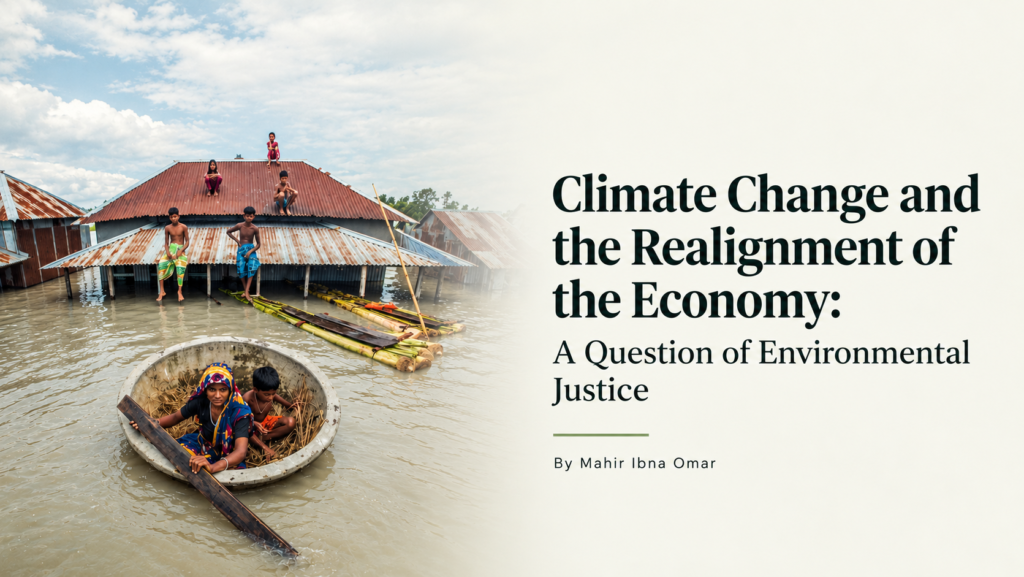
In August 2024, when the people of Bangladesh were dreaming of a new Bangladesh in the aftermath of the political upheaval, my home district of Feni was facing a devastating flood of unprecedented severity. The disaster, which struck suddenly in the final week of August, surpassed even the flood experiences familiar to the people of Feni. For the elderly people in my area, such a devastating flood was an extraordinary and unprecedented experience. In a region where flooding usually meant submerged field boundaries or inundated agricultural land, the height and force of the water this time threatened people’s homes, livelihoods and safety all at once.
I was at home with my family at the time. Within a single night, the water rose so rapidly that we had to take shelter in the attic beneath the roof of our single-storey house. The water had risen to almost the level of a second floor. I had never before seen my family members so helpless, frightenedand anxious. My family also had a dairy and poultry farm. Therefore, the damage caused by the flood was not merely a loss of our home or property; it was also a direct blow to our family’s livelihood and economic security.
The full extent of the disaster in Feni became clearer after the flood. According to the district administration’s preliminary report, 29 people died; and the damage exceeded BDT 238.4 crore. Some 319 kilometres of roads, at least 61 bridges and culvertsand more than 43 kilometres of embankments were damaged. Approximately 2,725 hectares of crops and seedbeds were destroyed, while 66,825 livestock and poultry died or were swept away. Numerous people were displaced, lost their jobsand were left destitute. It is reasonable to assume that the actual losses were several times greater than these figures suggest. Beyond the financial estimates, however, countless families faced long-term uncertainty. Their homes had been destroyed, their sources of income had disappearedand many no longer had the means to rebuild their lives.
A news report published a year after the flood also highlighted the gaps in rehabilitation. According to a report by Ajker Patrika published on 24 August 2025, citing district administration data, only 110 of the 1,718 damaged houses had been rebuilt with government assistance. This suggests that permanent rehabilitation had not been ensured for many displaced families even after the immediate damage had been addressed. The information raises an important question: rescuing people and providing emergency relief during a disaster are essential, but how effectively are we fulfilling our responsibility to help them rebuild their homes, livelihood sand economic capacity afterwards?
The experience of the Feni flood deepened my interest in the environment and climate change. I began to understand that the true scale of environmental disasters cannot be grasped if we view them merely as natural events or temporary emergencies. A single flood can displace thousands of people, deprive them of their livelihood sand leave others destitute after they lose years of savings and accumulated assets.
I realise that discussing my personal experience at such length in the introduction might seem somewhat excessive. However, I want to explain that my interest in the environment and climate change did not begin with a particular theoretical text or policy discussion. It began with the experience of the devastating flood that struck Feni in the final week of August 2024. The experience of my own life, my family and my birthplace taught me to think about these issues, or, perhaps more accurately, compelled me to do so.
This experience confronted me with a fundamental question: should we view environmental disasters and climate change merely as natural phenomena, or should we also try to understand their relationship with people’s lives, livelihood sand economic security?
These questions are particularly important in a climate-vulnerable country like Bangladesh, where the impacts of climate change extend beyond the natural environment to affect people’s incomes, employment, food security, right to housingand future opportunities.
This realisation gradually connected my understanding of the environment with questions of environmental justice, sustainable developmentand economic policy. The Feni flood exposed me to the devastating consequences of an environmental disaster, while my subsequent experiences and engagement helped me understand that its economic and social impacts are not the same for everyone. Recognising these unequal impacts makes it essential to discuss environmental justice, climate financeand a sustainable economic transition.
Climate Change as an Economic and Social Crisis
For a long time, we have primarily considered climate change an environmental crisis. Rising temperatures, irregular rainfall, cyclones, floods, river erosion, salinityand biodiversity loss are commonly regarded as the main manifestations of its impacts. However, climate change is simultaneously an economic, socialand political crisis. It not only disrupts the balance of nature but also challenges production systems, labour markets, people’s livelihoods, the distribution of resourcesand conventional ideas of development.
Recently, I had the opportunity to participate in the Green Dialogue organised by Bonik Barta, titled Climate Change and the Realignment of the Economy. The event gave me an opportunity to reconsider, learn about and better understand several important dimensions of Bangladesh’s climate crisis. I am grateful to my organisation, The Bangladesh Dialogue, KLIMA by TBD; and Bonik Barta for making this opportunity possible.
Discussions among policymakers, economists, industrialists, bankers, environmentalists, environmental activists and development partners covered a range of issues; including environmentally friendly industrialisation, renewable energy, the circular economy, climate finance and economic resilience. These discussions brought several important questions about the future of Bangladesh’s economy to the forefront.
The Environment Minister noted that climate change is not a problem of the future; its damage is already visible. Excessive heat is reducing factory workers’ productivity, irregular rainfall is damaging cropsand salinity is placing pressure on agricultural land and drinking water supplies. These are issues we have traditionally heard environmental activists discuss. This time,, I heard them articulated in economic terms by the minister and industrialists. I believe this was one of the most significant achievements of the event.
Environmental Justice: Who Bears the Cost?
An important part of my understanding of the environment is that environmental crises cannot be separated from people’s lives and social realities. Although environmental degradation affects everyone, its consequences are not distributed equally. For a farmer whose livelihood depends on rainfall, a worker labouring inside a factory under extreme heat, a coastal family struggling to access safe drinking water because of salinity, or a household losing its land to river erosion, climate change is not an abstract global problem. It is a daily crisis affecting life and livelihood.
The experience of Bangladesh’s 2024 floods made this reality even clearer to me. I witnessed how a climate-related disaster can make a family’s life, assetsand future plans deeply uncertain. Such experiences remind me that the damage caused by climate change cannot be understood through financial figures alone. It is also connected to people’s safety, dignity, social positionand capacity to recover.
That is why environmental justice is so important to me. Environmental justice is impossible without social justice. No environmental policy can be complete without answering several fundamental questions: Who bears the greatest responsibility for environmental damage? Who suffers most from its consequences? And who is expected to bear the cost of addressing it?
Green Industrialisation and the Future of Bangladesh’s Economy
The Green Dialogue featured important discussions on Bangladesh’s progress in environmentally friendly industrialisation. Initiatives such as Hams Garments’ achievement of a high score under the international LEED certification system, industrial waste recycling, the production of wood-substitute boards from jute sticks, alternative construction materialsand more efficient energy use in industrial facilities are undoubtedly significant. Similarly, investment in solar power and other renewable energy sources is necessary to reduce carbon emissions.
For a country like Bangladesh, which depends heavily on imported energy and is highly vulnerable to climate change, environmentally friendly industrialisation is both an environmental and an economic necessity. Efficient energy use can reduce production costs, renewable energy can lower dependence on fossil fuelsand recycling-based production systems can reduce pressure on natural resources.
However, the success of a green economy cannot be fully measured by the definition or number of green factories. We must examine how efficiently production systems use resources, how much pollution is being reduced, how workers and local communities benefitand who bears the cost of environmental damage.
The Green Dialogue also discussed the energy crisis in the ready-made garments and textile industries, the limitations of renewable energy useand international buyers’ carbon-emission reduction targets. The industrialists highlighted an important reality: Bangladeshi industries must cope with rising production costs and energy shortages while adapting to increasingly stringent environmental standards in international markets.
During the discussion, industrial representatives pointed out that although many environmentally friendly factories in Bangladesh have received international recognition, they do not always receive a higher price for their products. This is an important concern. If international brands set targets to reduce carbon emissions throughout their supply chains, they should also consider sharing fairly in the investments required to achieve those targets.
Bangladesh must meet environmental standards while maintaining its competitiveness in international markets. However, it is not fair to place this responsibility entirely on producing countries. Wealthier countries that have historically contributed more to climate change, as well as major buyers in global supply chains, must also assume responsibility in accordance with their capacity and contribution.
At the same time, industrialisation and environmental protection should not be presented as opposing objectives. The question is not whether industrialisation should take place, but how it should proceed, who should benefit from itand how responsibility for environmental damage should be determined.
Employment, Livelihoods and a Just Transition
Employment must be considered an essential part of any discussion on a climate-resilient economy. The seminar highlighted the large population dependent on agriculture, the number of new entrants joining the labour market each yearand the potential changes in employment resulting from agricultural mechanisation.
The Honourable Minister for Environment, Forest and Climate Change, Abdul Awal Mintoo, reminded participants that approximately 46 per cent of the country’s population still depends on agriculture, even though agriculture contributes only around 11–12 per cent to GDP. He also noted that between 2 million and 2.2 million people enter the labour market every year and that further mechanisation of agriculture could lead to job losses.
Meanwhile, a speaker from the ready-made garments sector warned that approximately five million jobs could be at risk. A representative of the industry expressed concerns about employment and competitiveness in the sector. According to his remarks, energy shortages, high interest rates and policy changes are creating additional pressure on the industry.
These issues are directly connected to climate change and the Realignment of the economy. Environmentally friendly technologies, energy efficiencyand agricultural mechanisation can increase productivity. However, without proper planning, they may also change existing patterns of employment or make people’s livelihoods more uncertain.
Therefore, the success of a green transition cannot be measured solely by reduced emissions or lower production costs. It must also include worker retraining, alternative employment opportunities, safe working conditions and a fair distribution of the costs associated with economic change.
Similarly, when climate-related disasters damage the livelihoods of farmers, fishers, small entrepreneurs and workers, effective social protection and financial assistance are necessary to support their recovery. A just transition is not limited to moving from fossil fuels to renewable energy. It also involves creating systems that protect people’s livelihoods and dignity during economic transformation and in the aftermath of climate-related disasters.
Another important topic at the Green Dialogue was the potential for expanding solar power use in the industrial sector and the policy limitations affecting its adoption. According to industrial representatives, rooftop solar installations can meet only a limited portion of a factory’s total electricity demand. There are also policy questions concerning metering and grid integration when electricity is supplied by solar power plants located outside factory premises.
The central issue here is not merely the capacity of the technology; it is also whether a supportive policy framework exists to enable its use. If the government wants to increase investment in renewable energy but policies governing electricity generation, grid supply and the management of surplus electricity do not adequately reflect the practical realities of investment, a gap may emerge between stated objectives and actual implementation.
Bangladesh needs an energy transition that strengthens industrial competitiveness while reducing dependence on fossil fuels and minimising environmental damage. This requires more than installing solar panels. Modernising electricity transmission and distribution systems, adopting energy-efficient technologies, ensuring appropriate financing and maintaining long-term policy consistency are equally important.
Climate Migration, Economic Losses and Climate Finance
To understand the economic consequences of climate change, we cannot rely solely on GDP, industrial output, or estimates of infrastructure damage. We must also examine how many people are losing their homes, how many are facing uncertain employment and livelihood sand whether affected communities have adequate opportunities to recover.
When people are displaced by river erosion, salinityand recurrent disasters and migrate towards cities, it becomes essential to provide them with employment, safe housingand social protection. The impacts of the climate crisis therefore extend beyond the environment, becoming intertwined with labour markets, urban economies and social inequality.
Dr Saimum Parvez, Special Assistant to the Prime Minister, reminded participants that Bangladesh contributes comparatively little to climate change while suffering disproportionately from its consequences. Ching Feng Zhang, the Asian Development Bank’s Country Director, noted that the number of internal climate migrants in Bangladesh could reach 13.3 million by 2050. If this projection materialises, the economic and social consequences will be extensive. Pressure on housing and urban services will increase, people will need to change their occupations and livelihood sand long-term investment in rehabilitation will become necessary.
In this context, climate finance should not be viewed merely as a matter of international cooperation or development assistance. It is also a question of responsibility for climate change, the capacity to address its consequences and equitable access to adaptation opportunities.
For a vulnerable country like Bangladesh, adequate financing is essential for adaptation, disaster-resilient infrastructure, livelihood recovery and addressing climate-related loss and damage. A significant portion of this financing should be provided through grants so that countries do not face an even heavier debt burden while trying to cope with the consequences of a crisis for which they bear relatively little responsibility.
Sharif Zahir, Chairman of United Commercial Bank and Managing Director of Ananta Group, reminded participants that developed countries had pledged approximately US$230 billion by 2050, equivalent to around US$8–9 billion annually.
When these figures are considered together, they raise serious concerns. It is difficult to ignore the question of whether the promised funding is sufficient to address a crisis that may require the Realignment of millions of people’s lives and livelihoods in a single country.
Ahead of COP31, I would like to emphasise two points. First, Bangladesh’s demands must be framed in terms of the right to compensation and adaptation, rather than as a request for charity or handouts. Second, as the ADB has also emphasised, these demands must be supported by clear investment priorities and measurable outcomes. Otherwise, even if our moral position is strong, it may not translate into effective bargaining power at the negotiating table.
Another form of hidden injustice was highlighted by Dr Fahmida Khatun, a Fellow at the Centre for Policy Dialogue (CPD). One of the important points she raised at the seminar was that conventional economic accounting does not adequately reflect the full costs of environmental degradation and climate-related damage. As a result, measures of production and economic growth may fail to capture the economy’s actual condition.
It is necessary to question how sustainable economic growth can be when it ignores the depletion of nature, damage to human healthand the loss of livelihoods. To measure economic success, we must consider not only what is produced but also the environmental and social costs of that production.
In this context, environmental finance cannot be limited to investment in green technologies or infrastructure. Adequate and accessible funding must also be ensured for climate adaptation, post-disaster rehabilitation, livelihood recovery and addressing loss and damage.
For a climate-vulnerable country like Bangladesh, grants and concessional financing are particularly important. They can help prevent the financial burden on affected communities and the state from increasing further as they respond to climate-related damage.
At the same time, the benefits of this financing must not remain confined to large industrial enterprises or investors with greater financial capacity. They must also reach small farmers, workers, women, coastal communities and displaced people. The success of a climate-resilient economy should be measured not only by how much money is invested but also by the positive changes that investment brings to people’s lives, livelihoods and security.
One of Bangladesh’s most significant constraints in addressing climate-related damage is the availability of finance. Substantial resources are required for climate adaptation, disaster-resilient infrastructure, agricultural transformation, coastal protection and renewable energy investment.
The Green Dialogue highlighted the need for climate finance on favourable terms, investment in environmentally friendly industriesand lower borrowing costs. For small and medium-sized enterprises in particular, high interest rates, complicated application procedures and a lack of long-term financing can create significant barriers to investment in environmentally friendly technologies.
Although Bangladesh bears comparatively little responsibility for climate change, it is disproportionately affected by its consequences. Therefore, the importance of grant-based and concessional international financing for adaptation and addressing loss and damage deserves particular attention.
Climate Resilience, Implementation and Accountability
Discussions on climate-resilient development in Bangladesh often focus on infrastructure, technologyand investment. Drainage systems in coastal cities, flood control, river and waterbody restoration, solar powerand disaster-management infrastructure are undoubtedly necessary. However, resilience cannot be defined solely by the durability of infrastructure.
Whether a community can recover quickly after a flood also depends on people’s financial capacity, access to alternative livelihoods, social security and ability to obtain government assistance. Similarly, when climate change damages agriculture, providing improved seeds or irrigation technology alone is not enough. Farmers’ production costs, access to fair market prices, debt burdensand exposure to crop losses must also be considered.
Agricultural modernisation and mechanisation can increase productivity. However, if they also reduce the demand for labour, we must ask what alternative employment opportunities will be available to people who depend on agriculture. When climate-displaced people move to cities, the availability of housing, healthcare, safe employment and social protection must also be considered when assessing economic resilience.
During the open discussion, MP Nayab Yusuf Ahmed made what I considered one of the most straightforward observations: determination and accountability are essential to addressing these challenges. Another parliamentarian, Sultana Jesmin Jui, discussed the plan to plant 250 million trees and argued that success should be measured by how many trees survive, rather than how many are planted. The Chairman of the Agricultural Bank also reminded participants that solar irrigation could fail if counterfeit lithium batteries are not prevented and solar panels are not properly maintained.
These different examples from river erosion to tree planting and solar irrigation; offer a common lesson: announcing a programme and achieving actual results are not the same thing.
Protecting people affected by river erosion requires more than launching projects. We must assess whether river and riverbank protection measures are effective, whether affected communities are actually receiving protectionand whether the responsible institutions are being held accountable.
The same principle applies to tree-planting programmes. The number of trees planted is an initial indicator, but without knowing how many survive, growand contribute positively to local ecosystems, it is impossible to assess the programme’s actual success.
Similarly, installing technology is not enough for initiatives such as solar irrigation. Unless equipment quality, maintenance, battery reliabilityand long-term usability are ensured, the expected benefits may not materialise.
These examples highlight the importance of policy effectiveness and accountability. The success of an environmental or climate initiative should not be judged solely by the money allocated, the infrastructure constructed, or the targets announced. We must examine how much the initiative has reduced people’s exposure to risk, what improvements it has brought to the environment and whether its intended beneficiaries have received the promised benefits.
This requires measurable targets from the beginning of each project, regular monitoring, transparent disclosure of information and outcome-based evaluation.
Therefore, the capacity to implement policies and ensure accountability is just as important as the amount of financing and the ambition of policy objectives. Environmental justice cannot be established through policy commitments alone. It becomes meaningful when affected people receive actual protection, resources are used fairly and effective mechanisms hold those responsible for failures accountable.
Climate-resilient development must also be linked to strengthening people’s capabilities. Farmers, workers, women, small entrepreneursand climate-vulnerable communities should not be treated merely as recipients of assistance. They must be included as participants in planning and decision-making.
Policy Priorities for Bangladesh
Drawing on the Green Dialogue on Climate Change and Realignment of Economy and viewing the discussion through the lens of environmental justice,, I believe several broad policy priorities can be identified for Bangladesh.
First, we must change how we measure development. Alongside GDP growth, export earningsand industrial output, we must assess the depletion of natural resources, pollution, health-related costs, livelihood losses and the economic impacts of climate-induced displacement. We must consider not only how much economic growth is achieved but also the environmental and social costs associated with it.
Second, we need an integrated policy framework for environmentally friendly industrialisation. Renewable energy, energy efficiency, water recycling, waste management and circular economy initiatives must be incorporated into long-term industrial policy rather than treated as isolated projects. While encouraging industries to adopt environmentally friendly technologies, we must also ensure accountability for pollution control and compliance with environmental standards.
Third, we must ensure equitable climate finance. Accessible financing, grants where appropriate, long-term loansand suitable risk-sharing mechanisms should be developed for vulnerable communities, small farmers and small businesses. In international climate finance, Bangladesh should prioritise grant-based adaptation support and effective financing to address loss and damage.
Fourth, workers and local communities must be protected during the green transition. Alongside investment in environmentally friendly technologies, we need skills development, safe working conditions, fair wages and measures to address the risk of job losses caused by technological change. International buyers must also share the costs and responsibilities of meeting environmental standards.
Fifth, local communities must be included in development planning. Before implementing projects related to coastal protection, river restoration, urban development, or forest conservation, we must consider the livelihoods, land rightsand social realities of the people concerned. Conservation cannot be considered just if it deprives local communities of their resources and livelihoods.
Sixth, we must strengthen environmental performance measurement and accountability. Climate and environmental initiatives should have clear, measurable targets, transparent reporting, regular monitoring and independent assessments of their outcomes.
Conclusion
The Green Dialogue reminded me once again that Realignment the economy is no longer optional in the age of climate change. Bangladesh’s industries, energy systems, agriculture, financial institutions and infrastructure must adapt to changing realities.
However, the objective of this transformation cannot be limited to making the economy more efficient or competitive. Development must also be environmentally sustainable, socially justand economically inclusive.
We must remember that environmental protection is not the opposite of development. Protecting the environment is essential for long-term development. Similarly, adopting environmentally friendly technologies does not automatically guarantee just development. How the benefits and costs of those technologies are distributed is equally important.
For me, the success of a truly green economy cannot be measured solely by reductions in carbon emissions, increased use of solar power, or a growing number of environmentally friendly factories. It must also be measured by our ability to ensure access to safe water, a healthy environment, dignified employment, fair livelihood sand opportunities for people to recover and rebuild their lives after disasters.
About Author:
Mahir Ibna Omar
Executive, The Bangladesh Dialogue