
Before Prime Minister Tarique Rahman leaves for Tokyo on October 26, one corporate announcement has already given Bangladesh a glimpse of what a deeper partnership might deliver.
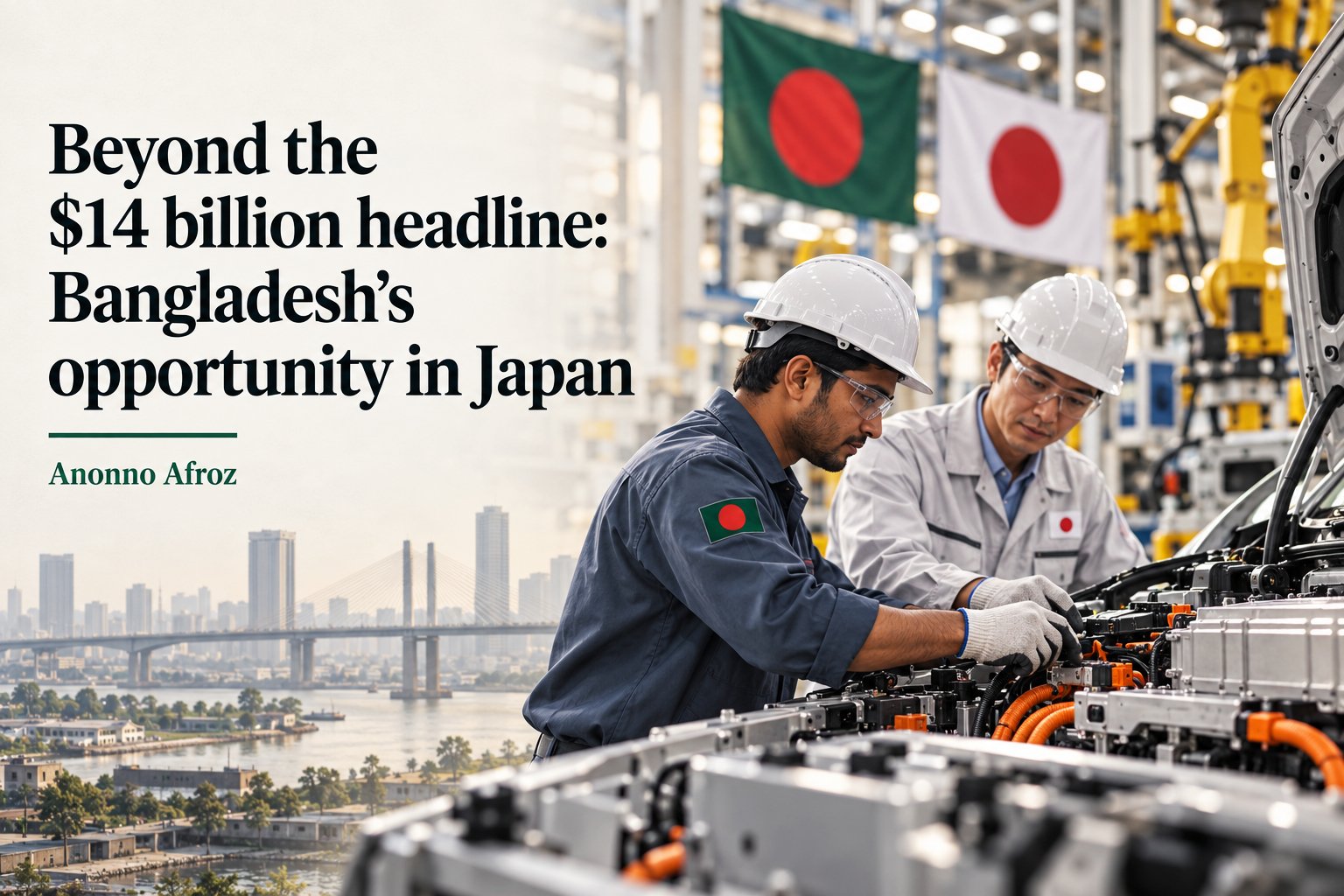
Toyota Tsusho has outlined plans for hybrid vehicle production here. The significance extends beyond cars, it raises the possibility of Bangladeshi technicians, component suppliers and engineers participating in an industry more sophisticated than those dominating our exports.
That is the opportunity underlying the four-day visit. Bangladesh needs Japanese capital, but it also needs the capabilities that make investment productive.
The proposed ¥2.2 trillion, approximately $14 billion, cooperation package for 2026–31 should be judged accordingly. Spanning 12 priority sectors, it combines concessional loans, private investment and public-private partnerships. These are proposals, not secured financing.
Their value will depend on whether Bangladesh can connect infrastructure, industrial development and skills into a functioning economic system.
Japan has reportedly committed over $34 billion in assistance since 1971, with recent annual disbursements averaging $600–700 million. Moving beyond development assistance towards private capital and technological collaboration would therefore represent an important evolution.
JETRO country representative Kazuaki Kataoka notes the opening, “The visit could provide an opportunity to showcase Bangladesh’s investment potential and encourage both prospective and existing Japanese investors to expand their engagement with the country.”
But showcasing potential is only the beginning.
The relationship already carries considerable institutional memory, Japan’s recognition in February 1972; Sheikh Mujibur Rahman’s 1973 visit; Ziaur Rahman’s visits in 1978 and 1980; and Khaleda Zia’s visits in 1994 and 2005.
The 1980 aviation and economic arrangements, 2002 technical cooperation agreement, 2014 comprehensive partnership and 2023 strategic partnership demonstrate continuity across governments.
The 2005 talks with Junichiro Koizumi situated Bangladesh within a wider Asian economic geography. Two decades later, delivering that promise remains unfinished national business.
Matarbari offers the clearest physical expression of it. Bangladesh proposes ¥500 billion, or $3.14 billion, for the Maheshkhali-Matarbari Integrated Infrastructure Development Initiative and its industrial, port and commercial hub.
Under BIG-B, the Dhaka–Chattogram–Cox’s Bazar corridor could connect factories with global shipping and potentially India’s northeast.
A JICA-supported master plan extends to 2041. Port Phase II carries a ¥105.362 billion loan for terminals, dredging, access roads and associated infrastructure. Japan has also provided eight loan tranches totalling ¥712.430 billion for Matarbari’s coal-fired power plant.
These investments make efficient customs, competitive charges and dependable cargo flows essential. A port’s economic return comes from the trade it enables.
The transport proposal seeks another ¥550 billion, or $3.45 billion, covering railways, bridges, urban connections and metro expansion.
Priorities include MRT Line-1, Line-5 North and Line-6 expansion; a Meghna bridge linking Narayanganj and Brahmanbaria; and a Cox’s Bazar–Maheshkhali channel bridge. Engineering services for Phase II of the Chattogram–Cox’s Bazar highway require ¥3.831 billion.
However, reported additional requirements of ¥596 billion for Line-1 and ¥515.25 billion for Line-5 North exceed the stated transport envelope. Dhaka should clarify their relationship to existing commitments before presenting aggregate financing claims.
Financial discipline matters here. Discussions on lowering Japanese loan interest rates are welcome, but repayment periods, currency exposure and project returns matter equally.
The cited June emergency support agreement provides up to ¥50 billion at 3.05% annually. Borrowing becomes worthwhile when completed projects generate benefits sufficient to justify their costs.
A proposed ¥25 billion PPP preparation facility could help produce commercially credible projects. A regular Development and Economic Partnership Dialogue could keep implementation under scrutiny after the summit.
Toyota provides a useful test. According to reporting citing the Prime Minister’s Office, vice-chairman Ichiro Kashitani outlined the plan on October 6, work beginning in 2027 and full-scale hybrid production targeted for 2029, under “With Bangladesh, for Bangladesh”.
Distribution expansion across divisional cities and vocational training were also discussed. Renewable energy was an invitation from PM Tarique Rahman, rather than a confirmed company commitment.
Neither an economic-zone shortlist nor initial vehicle models was identified in the reports checked. Araihazar fits Bangladesh’s wider automotive ambitions, but calling it Toyota’s selected location, or predicting particular models, would be premature. Nor is a factory agreement during this visit confirmed.
The broader $1.57 billion manufacturing proposal covers automobiles, components, electronics, machinery and precision engineering, alongside university semiconductor and nanotechnology laboratories.
The semiconductor export target is $1 billion by 2030. Such ambitions require supplier development, research capacity and skills; assembly alone will not secure meaningful technological upgrading.
As Kataoka explains, “We hope to use this opportunity to highlight how Japanese companies can contribute to these goals through investment, technology transfer, human resource development, and the creation of high-value-added industries, generating new opportunities for mutually beneficial growth in both countries.”
Trade policy must reinforce that ambition. The Economic Partnership Agreement, signed on February 6, 2026, provides an institutional foundation. Its coverage extends beyond tariffs into services, investment, customs and other commercial rules. Implementation now matters more than celebration.
Foreign Secretary Asad Alam Siam bluntly said, “In particular, the signing of the Economic Partnership Agreement (EPA) between Bangladesh and Japan in February 2026 has created new opportunities for expanding trade and investment.”
Commerce Minister Khandakar Abdul Muktadir wants ratification to proceed. Business leaders also identify the airport’s third terminal as an immediate operational priority.
Bangladesh exports over $1.4 billion in garments to Japan annually, accounting for roughly 80% of bilateral exports.
BGMEA wants $3 billion. Its Japanese-market desk, opened in September, and planned November Hong Kong roadshow show businesses pursuing that opportunity.
Japan’s promised three-year continuation of LDC-related preferences offers breathing space after graduation. With November 24, 2026 the scheduled graduation date in the supplied reporting, and an extension requested, preparation cannot wait.
Testing, certification and supplier support should help footwear, processed foods, light engineering and technology services diversify the export basket.
Investment interest is encouraging. Toyota, Mitsui and Marubeni executives have visited Bangladesh. Japan’s supply-chain diversification beyond China creates an opening, while JBIC surveys have placed Bangladesh among the top 20 promising destinations for three consecutive years.
“We should seize this opportunity to attract Japanese investment to Bangladesh, as several major Japanese companies have already shown interest in investing here,” says former JBCCI president Tareq Rafi Bhuiyan Jun.
Bangladesh hosts 338 Japanese companies and targets 500 by 2030. However, the supplied reports cite different JETRO expansion figures, 71.5% and 56.9%. Without matching survey dates and samples, they should not be treated as interchangeable.
The practical message is clear. As Kataoka says, “We would welcome clear messages on resolving common challenges for existing investors, as well as a continued commitment to business environment reforms.”
Predictable taxation, reliable utilities, timely approvals and credible dispute resolution will determine whether Araihazar becomes a convincing investment destination.
The proposed ¥350 billion, or $2.2 billion, energy and climate allocation also needs careful prioritisation: ¥200 billion for energy and green transition, and ¥150 billion for resilient infrastructure.
The 35,000MW capacity target for 2030 should be accompanied by grid reliability, storage, efficiency and renewable generation. Coastal protection, embankments and water management protect both livelihoods and investment.
Another ¥195 billion, approximately $1.22 billion, covers agriculture and agro-processing, at ¥120 billion, and the blue economy and tourism, at ¥75 billion. Smart irrigation, precision farming, food processing, certified seafood and cold chains could spread gains beyond industrial centres.
Tourism proposals encompass Cox’s Bazar, the Sundarbans, the hill tracts and heritage sites. A Buddhist circuit linking Paharpur, Mainamati, Mahasthangarh, Rangamati and Bandarban would require Japanese-language guides and interpretation alongside accommodation.
The most immediate household gains may come through employment. Dhaka’s ambition is to send 100,000 skilled workers and students annually.
The ERD figures cite over 10,000 departures during February–April, alongside approximately 25,000 study opportunities, 9,500 professional workers, 3,500 technical trainees and 1,600 specified skilled workers during the year. These categories and periods should not be added indiscriminately.
A jointly financed Human Resource Development Special Zone could connect Japanese-language instruction with recognised qualifications in nursing, caregiving, agriculture, driving, ICT, mechanics, engineering and manufacturing. Affordable recruitment, understandable contracts and enforceable protections must accompany training.
Diplomatically, three or four agreements were initially expected from eight proposals covering agriculture, fisheries, skills, aviation, trade, environmental protection and local government. Their implementation will matter more than their number.
Strategic cooperation adds another dimension. The February 3 defence-transfer framework and July handover of five patrol boats support maritime surveillance, rescue and disaster response.
Bangladesh should pursue these benefits while preserving independent relations with China, India and others.
Japan’s ¥2.57 billion Rohingya assistance announcement in March also deserves follow-through, alongside diplomacy for safe, voluntary and dignified repatriation. Regional connectivity cannot flourish beside persistent instability.
Nor should Bangladesh forget the seven Japanese citizens killed in the July 2016 terrorist attack. Protecting development partners remains an enduring obligation.
Tarique Rahman’s strongest outcome would be a credible implementation programme, financing that withstands scrutiny, factories with local suppliers, functioning trade rules and workers entering decent employment. Tokyo can open doors. Bangladesh’s institutions must make the opportunities behind them usable.
About Author:
Anonno Afroz
Anonno Afroz is a Dhaka-based political analyst and freelance journalist. He works with the Asian Development Bank, operationalising the Bangladesh Climate Development Partnership (BCDP). His writing focuses on geopolitics, strategic affairs, and governance. He can be reached at anonno.bcdp@gmail.com.