
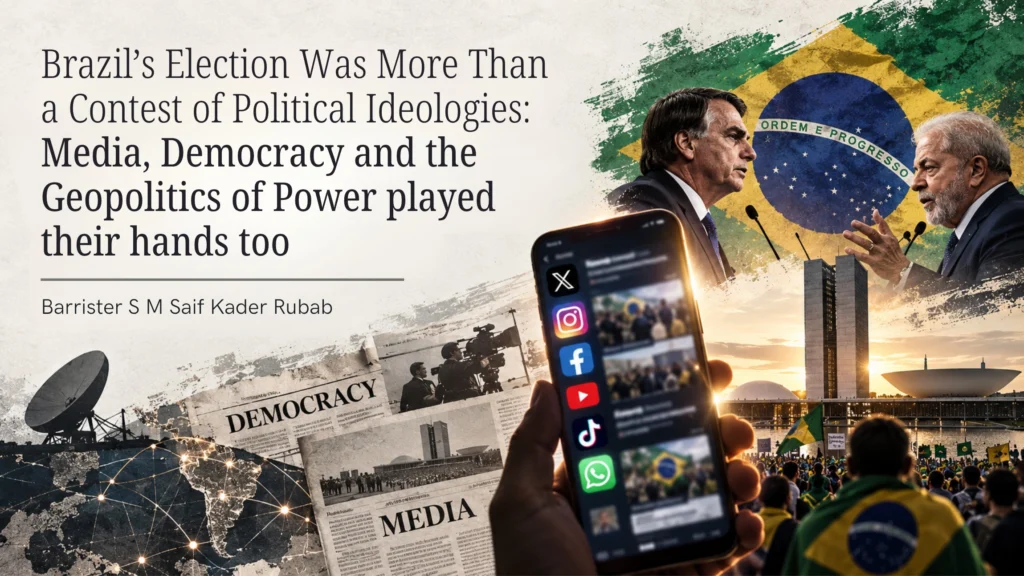
Lula da Silva’s victory reveals yet again, how political power increasingly depends not only on winning votes, but on shaping the information environment in which citizens judge candidates, institutions and the legitimacy of democratic outcomes.
Brazil’s presidential election has produced a result with implications beyond Latin America. On October 25, Luiz Inácio Lula da Silva defeated Flávio Bolsonaro, son of former president Jair Bolsonaro, winning 51.79 percent of valid votes against his opponent’s 48.21 per cent. Lula’s return, after trailing in the first round, interrupted a regional movement towards conservative leadership and complicated Washington’s effort to cultivate closer ideological partners across the Americas. The election offers a revealing case study of the relationship between media power, democratic legitimacy and national sovereignty in an increasingly polarised international order.
The central lesson is that contemporary elections are fought on two connected terrains: the formal contest for votes and the struggle to shape the information through which voters interpret politics. Neither terrain operates in isolation. News coverage influences which issues become salient; digital platforms affect what citizens encounter and share; political actors contest the credibility of institutions; and foreign powers can amplify domestic divisions. Brazil’s experience does not prove that media systems determine electoral outcomes, rather demonstrates why the fairness and transparency of those systems have become questions of democratic governance.
When the news frame becomes the political story
Al Jazeera’s The Listening Post, examining the Brazilian campaign in September, identified a problem with potentially far-reaching consequences: coverage of a major banking scandal risked reinforcing a familiar public perception that political actors were all equally corrupt. It explored how this framing could shape the election, in a country where corruption has long been central to political debate. The point is not that journalists should suppress scandals or protect candidates, it is that the way a story is organised can affect the political conclusions audiences draw from it.
A scandal can be reported as a specific set of allegations involving identifiable individuals and institutions or presented as further evidence that the entire political class is irredeemable. The first approach demands evidence, distinctions and accountability. The second risks turning distrust into a general political reflex. When every controversy appears to confirm that everyone is equally culpable, citizens may become less able to distinguish between substantiated wrongdoing, unresolved allegations and motivated accusation.
Again, this is a problem of framing, not necessarily of factual inaccuracy. Individual reports may be accurate while the cumulative narrative leaves an incomplete impression. Editorial independence cannot be measured solely by whether a report contains a falsehood. It must also be considered in terms of context, proportionality, consistency and the questions that coverage repeatedly asks, or leaves unasked. That is why the distinction matters here.
That criticism must be applied carefully. The available analysis does not establish that Brazilian mainstream media uniformly favoured one candidate, nor that a particular framing caused Lula’s victory. It does, however, raise a broader question for democratic societies: when public confidence is already fragile, does political reporting help citizens evaluate competing claims, or merely deepen the belief that meaningful distinctions between them no longer exist?
The dispute over social media have made this question concrete. Lula’s campaign alleged that Meta’s platforms like Instagram, Facebook and WhatsApp were disadvantaging its political content while benefiting Flávio Bolsonaro’s candidacy. Reuters reported on October 16 that, according to Folha de S.Paulo, internal Meta communications acknowledged that restrictions had negatively affected Lula’s Instagram accounts and that the platform had recommended Bolsonaro’s profile and WhatsApp channel. These were reported internal communications that Meta intentionally favoured Bolsonaro. On October 15, Brazil’s Superior Electoral Court ordered measures to ensure equal treatment of the two campaigns. Meta subsequently told the court that it had implemented 17 initiatives, including human review of advertising-account restrictions and expedited reviews of automated restrictions. The company denied political bias and attributed the problems raised to technical issues.
The significance is not that the dispute proves deliberate manipulation, rather that a private platform’s distribution systems became a matter for electoral oversight. In an environment where political communication increasingly depends on recommendation algorithms, content moderation and automated restrictions, equal access to the constituents cannot simply be assumed. Such a platform need not publish an editorial endorsement to influence the conditions under which political messages circulate.
This raises a pretty difficult regulatory question. Electoral authorities must be able to investigate credible complaints about unequal treatment, especially when the rules and systems involved are opaque. But intervention must also be proportionate, transparent and consistent with freedom of expression. A government or court empowered to demand fairness from platforms must not acquire an unchecked power to define acceptable political speech. The democratic objective is to protect fair conditions of political competition and make consequential platform decisions open to scrutiny, not to restrict freedom.
Lula’s own digital campaign also complicates any simple account of platform power. The Guardian reported that one of his allies, André Janones built the “Lula’s Army” WhatsApp channel from around 60,000 followers on its first day to more than 10 million by election day. Street protests renewed online mobilisation and a more direct communication strategy helped transform a campaign that had appeared vulnerable after the first round.
Digital campaigning is not simply a story of manipulation by technology companies. Political parties can use the same communications environment to mobilise supporters, circulate narratives and bring disengaged voters back into the contest. The challenge is to distinguish legitimate persuasion from deceptive practices, and political mobilisation from systems that covertly undermine an informed choice.
The legitimacy test after election day
The contest did not end when the votes counting was done. Flávio Bolsonaro rejected the outcome and called for the election to be annulled, citing a last-minute two-hour extension of voting after transportation problems and bad weather. Though the extension followed requests from both the campaigns. Lula won by approximately 4.4 million votes, and Brazil’s electoral authorities maintained that the extension did not alter the result. Reporting by the Associated Press also noted the longstanding reliability of Brazil’s electronic voting system and the absence of significant fraud detected in it.
The response from outside Brazil made the issue more consequential. Reuters reported on October 26 that US President Donald Trump questioned the election’s legitimacy, calling it “rigged” without providing evidence. Such interventions can lend international authority to domestic allegations before the evidence has been tested. They also demonstrate how political narratives about electoral legitimacy travel across borders, reinforced by ideological alliances and powerful external voices.
Democracy requires more than the physical act of voting. It requires credible procedures for counting votes, institutions capable of resolving disputes and political actors willing to concede. Media organisations and platforms cannot replace electoral institutions, but they can either clarify the difference between allegation and proof or blur it. The health of a democracy depends partly on whether citizens can still recognise that difference.
From domestic election to geopolitical choice
Brazil’s election also carried geopolitical weight. The country is a major voice in the Global South and a member of BRICS. Its relationships with the United States and China affect trade, investment, technology, critical minerals and the wider balance of influence in the region.
Before the runoff, Reuters reported that the candidates offered sharply different approaches to Washington. Flávio Bolsonaro sought closer alignment with the Trump administration, including cooperation on security. Lula emphasised sovereignty, multilateral diplomacy and Brazil’s freedom to pursue relationships beyond a single strategic partner. Both approaches carried risks: closer alignment could ease negotiations with Washington but raise questions about autonomy, while Lula’s insistence on strategic independence could complicate trade and security negotiations.
Lula’s victory, therefore, represents more than a setback for a particular political family. It preserves the prospect of a Brazilian foreign policy that seeks room to manoeuvre between major powers rather than organising itself around ideological alignment with Washington. Yet it would be misleading to treat the result as a popular mandate for any single foreign-policy doctrine. Voters made choices for multiple reasons, including security, living costs, social policy, leadership and fears about democratic institutions. An election result cannot be reduced to a referendum on the United States or China.
The connection between information and geopolitics is nevertheless important. When a country’s political debate becomes saturated with claims of foreign interference, algorithmic bias or institutional illegitimacy, the contest is no longer purely domestic. External actors can influence the environment in which those claims circulate, while domestic political leaders may use international alliances to strengthen their own standing. Sovereignty in the digital age is consequently not just a question of territory or diplomatic independence. It also involves the capacity of a society to maintain credible, transparent processes for forming political judgments without allowing opaque systems or external pressure to escape scrutiny.
The real measure of victory
Lula’s comeback is an electoral achievement, but it does not resolve Brazil’s deeper democratic tensions. A divided electorate, a conservative political opposition and continuing disputes over institutions will test his next term. His government will need to show that defending democracy means more than defeating an opponent and that the institutions and freedoms invoked during a campaign are respected when political power is exercised.
The wider lesson extends well beyond Brazil. In contemporary politics, the struggle for power increasingly involves not only persuading voters but shaping the information systems through which voters decide whom to trust, which institutions to believe and what constitutes a legitimate political outcome. Traditional media frames, platform algorithms, political messaging networks and international alliances all help define that environment.
The answer is not to imagine a media system free from political influence, nor to give the state unlimited authority to police information. It is to demand evidence, transparency, independent journalism, proportionate regulation and institutions strong enough to withstand pressure from both domestic factions and foreign allies. Brazil’s election has shown that electoral democracy can survive a fiercely contested information environment. Whether it can also rebuild public trust within that environment is the more consequential question.
About Author:
Barrister S M Saif Kader Rubab
Executive Director, The Bangladesh Dialogue