
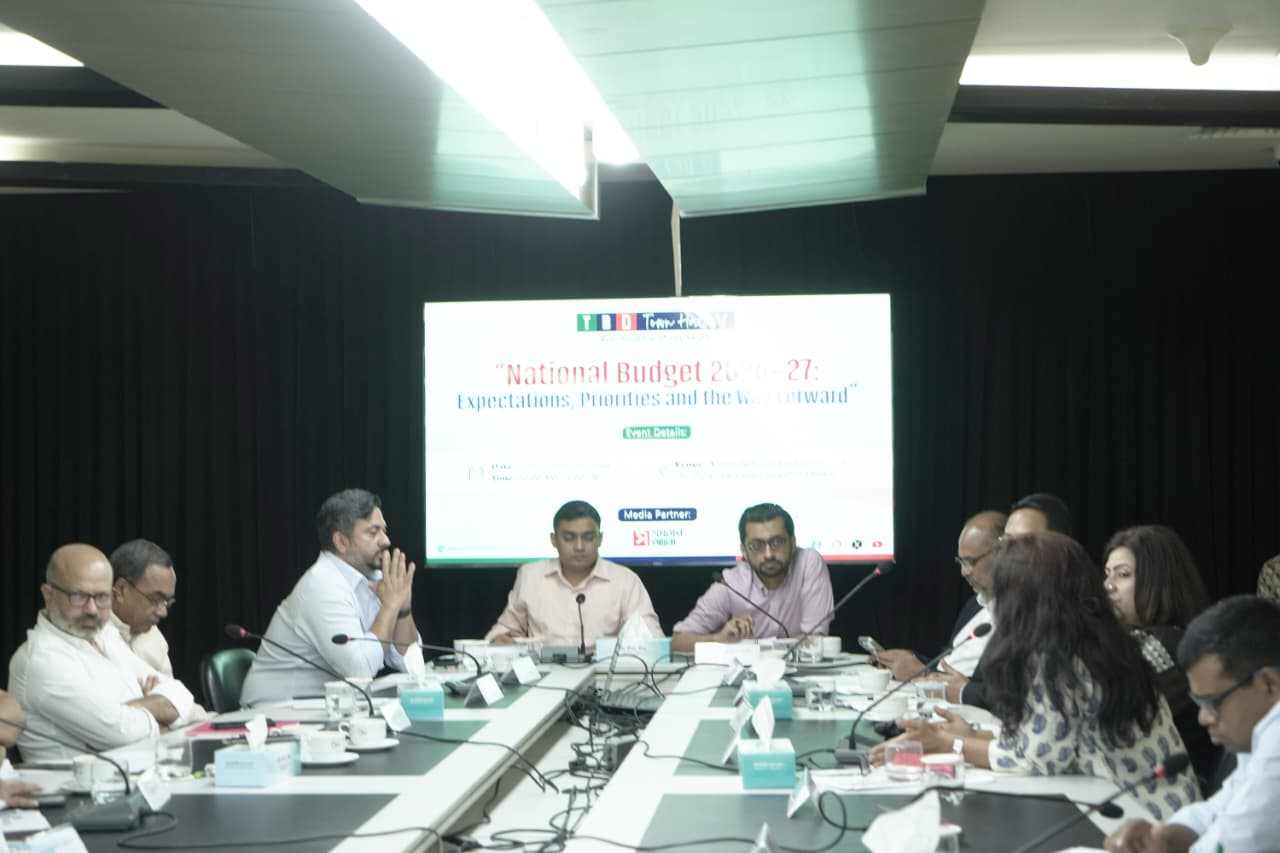
The Bangladesh Dialogue Town Hall V on “National Budget 2026–2027: Expectations, Priorities and Way Forward” convened policymakers, economists, financial leaders, entrepreneurs, development practitioners, and political representatives to deliberate on the nation’s economic trajectory at a critical juncture. The roundtable discussion highlighted the imperative of investment-led growth, employment generation, tax-net expansion, banking reform, digital financial inclusion, climate finance targeting, export diversification, skill development, and formalization of the informal economy, alongside robust governance and transparency measures.
Tahmid Hasan, PhD Researcher in Public Policy at Georgia State University, opened the discussion by emphasizing that Bangladesh’s national budget must be viewed beyond the conventional lens of numerical allocation and fiscal size. Reflecting on the country’s inherited economic fragility, he identified weak institutions, low government expenditure, poor tax collection, chronic under-implementation, and bureaucratic inefficiency as major structural barriers to effective budget execution. He also placed particular importance on evidence-based policymaking, along with digital monitoring of development projects and rigorous feasibility assessment before mega project approval, to promote faster project implementation. At the same time, he cautioned against excessive political monitoring, noting that bureaucratic performance depends on institutional autonomy and process-based accountability. His remarks strongly advocated for participatory budgeting, where citizens are not merely passive recipients but active stakeholders in shaping and evaluating fiscal priorities. In his view, a genuinely pro-poor budget must increase public engagement, strengthen accountability, and ensure that allocations translate into measurable improvements in people’s lives.
Gula Jannat Disha, an executive of the Bangladesh Dialogue, emphasized that the National Budget 2026 must be understood as a strategic instrument reflecting the government’s vision, commitments, and long-term priorities, rather than a mere financial statement. She argued that while budget allocations to sectors such as education and health are important, their effective implementation determines actual impact on society. Disha highlighted the chronic underfunding of the education sector compared to regional standards and called for enhanced collaboration with international universities to strengthen research. Furthermore, she recommended targeted incentives to emerging industries beyond the traditional RMG sector, and proactive government measures to mitigate rising energy costs. Finally, she underscored that social safety net programs must be designed with long-term effectiveness in mind, ensuring that the budget contributes to sustainable human development and equitable socio-economic progress.
Sabiha Zakir, a researcher at the Bangladesh Jute Research Institute and an executive of the Bangladesh Dialogue, offered a critical perspective on education and research funding within the National Budget 2026-27. She stressed that the effectiveness of budget allocations should be assessed through tangible outcomes like patents, startups, technological innovations, and employment, etc., rather than the sheer size of expenditures. Highlighting Bangladesh’s unpreparedness for the Fourth Industrial Revolution, she expressed the need for prioritizing emerging sectors like AI, advanced agriculture, biotechnology, bioinformatics, and climate change. She noted the lack of advanced research institutes and the underutilization of expensive equipment due to governance and expertise gaps. Using the jute sector as an illustrative example, she demonstrated how insufficient research investment prevents innovation, leading to raw material exports. Her viewpoint is that budget success should be measured not by allocations but by the tangible economic impact generated through education, skill development, and research innovation.
Abdullah Al Faisal, Joint Chief Coordinator of the National Citizen Party, highlighted an alternative framework for Bangladesh’s fiscal policy, named shadow budget, proposed by the NCP. He mentioned the critical challenges facing the economy, including high non-performing loans in the banking sector, heavy dependence on imported energy, and limited revenue collection due to public distrust and a large informal economy. The speaker emphasized the importance of protecting vulnerable populations from inflation, creating employment, and ensuring effective utilization of education, technology, and health sector allocations to prepare the country for the Fourth Industrial Revolution. He advocated for digitalization to formalize the economy, enhance tax compliance, and improve government efficiency, including strategic recruitment and salary adjustments for public employees.
Shanaullah Sakib, Senior Reporter at Prothom Alo, stated that the new government must move beyond blaming the past and prove its reform commitment through concrete institutional actions. He argued that welfare measures such as cash support through cards may offer temporary relief, but sustainable recovery requires employment generation and financial-sector reform. He recognized Bangladesh Bank, commercial banks, NBFIs, mobile financial services, BSEC, and BIDA as crucial institutions for restoring investment and job creation. He particularly highlighted the government’s handling of Islami Bank, Nagad, money laundering cases, and bank mergers as key indicators of its true reform intention. In his opinion, these decisions will determine whether the budget supports genuine accountability, financial stability, and long-term economic recovery.
The director of the Bangladesh Dialogue and Lecturer at Eastern University, Meherba Sabrin, accentuated that the budget must be understood as a comprehensive system encompassing fund sourcing, allocation, and effective management. She highlighted the importance of incorporating diverse stakeholder perspectives, particularly from youth, and stressed the distinction between funding education and ensuring quality, meaningful access. She connected social safety nets with judicial support, underlining the need for the expansion of legal aid. Regarding education research, she pointed out that both primary and secondary education should be focused on. Overall, she framed the budget as a strategic investment in human capital, with the potential to guide Bangladesh toward sustainable economic and social development even under conditions of limited resources.
Sayma Shawkat, Director of Gears Group and BACCO, and a leading voice in the IT/ITES sector, advocated for extending the current IT/ITES tax exemption until 2031 to facilitate growth and maintain industrial performance. Drawing attention to the critical gaps in skill development over the past seventeen years, she emphasized the importance of efficient resource allocation and coordinated training programs to equip professionals for emerging technologies. She further stressed the necessity of robust digital infrastructure, including cloud computing, AI, and cybersecurity, and recommended government incentives such as recognition and premium subsidies for innovation-driven companies. Additionally, she noted that private sector adaptability often outpaces public sector intervention, necessitating timely and evidence-based policy actions.
Dr. Shafiqur Rahman, Executive Director of BRAIN, provided a political economy perspective on the National Budget 2026-27, emphasizing the trade-offs between short-term relief and long-term growth. He noted that external shocks, such as the Iran conflict, disrupted energy supplies and heightened economic uncertainty, requiring immediate measures such as cash transfers, social welfare support, and assistance to distressed businesses. Simultaneously, he reinforced the importance of long-term investments in infrastructure, education, health, and research and development to ensure sustainable economic growth. Dr. Rahman foregrounded priority infrastructure projects, such as the Tista and Ganga Barrages, for their dual role in generating immediate employment and long-term economic multiplier effects.
Following Dr. Shafiqur Rahman’s speech, a brief exchange of views emerged around NCP’s shadow budget, particularly on the proposed tax measures. Dr. Rahman questioned the implications of wealth-based taxation, arguing that taxing accumulated assets could discourage long-term investment and asset formation. Abdullah Al Faisal clarified that NCP’s proposal was not a general property tax but an inheritance or estate tax targeting ultra-rich individuals during asset transfer. Another participant raised concern that such taxation could amount to double taxation, as assets are usually built from already-taxed income. The exchange reflected broader tensions between revenue generation, investment incentives, and fairness in fiscal policy.
Economist and Migration Policy Expert, Zia Hasan delivered a sharply critical political-economic assessment of the National Budget 2026-27, arguing that Bangladesh must first recognize whether it is operating under a continuing crisis rather than a normal fiscal environment. He questioned the sustainability of the government’s rising revenue targets, warning that such increases appear mechanical and insufficiently connected to real expansion in productive capacity. Additionally, he challenged conventional assumptions around revenue-to-GDP comparisons, high VAT, and tax expansion, arguing that excessive fiscal pressure may criminalize business activity, discourage formalization, and push key sectors toward a Laffer Curve effect. Drawing on his own business experience, he emphasized that formal enterprises often bear disproportionate regulatory and tax burdens while the informal economy remains largely outside the system. He further warned that Bangladesh is facing a balance sheet recession, rising debt-service pressure, and the risk of crowding out private investment if government borrowing continues unchecked. For the way forward, Hassan argued that the economy is trapped by numerous small regulatory bottlenecks and called for an institutionalized deregulation commission to systematically remove barriers to business, investment, and productive growth.
The MD and CEO of Mutual Trust Bank PLC, Syed Mahbubur Rahman, presented a comprehensive banking-sector perspective, emphasizing that Bangladesh is operating within a delicate macroeconomic trade-off marked by rising inflation, slowing growth, declining employment, and growing pressure for public spending. He focused on a critical point that Bangladesh’s financial system is excessively commercial-bank-centric, with banks bearing the burden of stimulus packages, refinancing schemes, long-term lending, and crisis response, while the capital market has failed to serve as a meaningful source of long-term finance. Moreover, he expressed deep concern over the rise of non-performing loans, weak capital adequacy, falling public confidence, and the large volume of money circulating outside the banking system. He warned that excessive government borrowing from banks could create a crowding-out effect once private sector activity recovers. His remarks also stressed the importance of stakeholder consultation, transparent reporting, stronger governance, judicial reform for default-loan recovery, and careful tax policy that does not unnecessarily burden businesses or small savers. He further highlighted the role of digital banking, mobile financial services, single QR codes, and formal financial channels in bringing black-market transactions into the regulated economy. Concluding with a call for export diversification, he urged the government to identify and activate the correct economic levers, intervene only where necessary, and pursue reforms through a holistic and consultative approach.
Kamal Quadir, the CEO of BKash, asserted that broadening the tax net requires long-term, structured efforts rather than short-term fixes, emphasizing that digital financial services like bKash have successfully integrated informal cash flows into formal banking channels, increasing transparency and government revenue. He stressed the importance of corporate discipline and adherence to regulations, showing how proper management and audit compliance can generate consistent tax contributions. He maintained that innovation-driven sectors, when supported by proper policy and governance, can create new taxable income streams without relying on loans or direct government incentives. However, he cautioned that any policy recommendations must be carefully considered to avoid unintended consequences, reinforcing the value of a practitioner’s perspective in shaping sustainable, innovation-friendly fiscal policy.
Depicting a climate perspective, Shirin Sultana Lira, Senior Program Manager, Governance, Climate Change and Environment, Embassy of Switzerland in Bangladesh, specified Bangladesh’s heavy dependence on climate loans and warned that over 90 percent of climate finance comes through borrowing, creating significant repayment pressure. She emphasized the need for strict project review, monitoring, and accountability, noting that many renewable energy and adaptation projects have failed to deliver meaningful outcomes. She suggested that climate budget allocations must be targeted to specific climate hotspots to effectively reach vulnerable communities and reduce internal displacement risks. She also called for greater private-sector engagement in climate finance and the introduction of innovative, climate-sensitive tax incentives to support environment-friendly and climate-smart businesses.
The Finance and Planning Advisor (Minister) to the Honourable Prime Minister of Bangladesh, Rashed Al Mahmud Titumir presented the most comprehensive policy framework of the discussion, arguing that Bangladesh’s economic recovery must be rooted in country-specific innovation, strategic pragmatism, and democratic legitimacy rather than textbook prescriptions. Drawing on Bangladesh’s historical recovery from the post-1971 crisis, the 1975 economic emergency, labor migration, and the rise of the garment industry, he emphasized that national transformation has always emerged from creative adaptation to global circumstances. He outlined a new economic model based on investment, production, employment, tax-base expansion, and improved public services, supported by at least five years of policy continuity to strengthen investor confidence. He placed strong emphasis on the return of industrial policy, domestic manufacturing capacity, energy diversification, strategic reserves, renewable and nuclear energy, fair pricing, and a stronger challenge to international financial structures that impose unfair costs on Bangladesh. He admitted the importance of coordinated fiscal and monetary policy, refinance schemes, and targeted financing for closed factories, agriculture, MSMEs, diversification, and northern-region industries. Rejecting uniform tax expansion, he argued that revenue should increase through growth, employment, formalization, digitization, risk-based auditing, QR-based transactions, and reform of the SRO culture rather than higher tax rates. His diversification agenda covered agro-processing, pharmaceuticals and API, leather, electronics, ICT, creative industries, blue economy, logistics, start-ups, overseas employment, green production, and rural economic activation. He also proposed stricter borrowing criteria, deeper capital markets, bond financing, stronger ADP implementation, open data governance, dashboards, and a living five-year strategic framework. Overall, his remarks framed the budget as a transition from crisis to recovery, restoration, and reconstruction for acceleration, guided by the philosophy of “Bangladesh first, and Bangladesh for all.”
Ahmed Zafrul Hasan, Chief Digital Officer of the Commercial Bank of Ceylon, brought a sharply practical banking and digital-payments perspective to the discussion, focusing first on the need for an independent asset quality review to reveal the true scale of non-performing loans and end the practice of hiding distressed assets “under the carpet.” He proposed forming asset management companies to absorb toxic assets, restructuring genuinely struggling borrowers, introducing bankruptcy and judicial reforms for willful defaulters, and regulating collateral valuation companies so that loan security reflects real market value. Turning to Bangla QR, he warned that although interoperability and infrastructure are in place, the system may stagnate unless merchant adoption, consumer motivation, acquisition costs, KYC burdens, and device-related tax structures are addressed. His proposal for fiscal incentives, inspired by India and Pakistan’s budgetary support for digital payment adoption, was contended by Kamal Quadir, who argued that profitable payment institutions should invest in their own business rather than seek subsidies, while Zia Hasan suggested making the MDR zero to accelerate cashless transactions. The exchange featured a key policy tension between subsidy-based scaling, zero-cost merchant payments, private-sector investment, and the broader goal of building a sustainable cashless payment ecosystem.
Israfil Khosru, Member of the BNP Foreign Affairs Committee, framed the upcoming budget around a set of guiding principles developed through years of policy work and stakeholder consultation, emphasizing that the government is operating within a fragile economy marked by compromised institutions, high inflation, and unemployment. He further clarified that Bangladesh must move from an oligarchic, overregulated, debt-dependent economy toward a deregulated, investment-led model. His key focus was on reducing bureaucratic barriers, formalizing informal sectors such as agriculture, creative work, content creation, arts, and sports, and turning human capital into Bangladesh’s main growth engine through serious skill development. Based on his experience, he claimed that even the RMG sector still lacks proper training infrastructure, which shows the urgency of wider workforce investment. For attracting FDI, he proposed time-bound facilitation, effective one-stop service, BIDA-based “FDI captains,” easier fund repatriation, and plug-and-play infrastructure. He also stressed moving Bangladesh beyond cheap basic production toward value-added exports, while arguing that economic democracy must become as important as political democracy.
The Chairman of the Bangladesh Dialogue, Rubayat Mannan Rafi, concluded the roundtable by framing the forthcoming budget as a test of confidence, recovery, and inclusiveness. He emphasized that after years of economic mismanagement, banking-sector controversy, and institutional erosion, the budget must focus on three urgent priorities: economic stability, employment generation, and the expansion of social safety nets. While supporting broader tax coverage, he stressed that the government must communicate clearly with lower- and lower-middle-income groups so that tax reform is not perceived as harassment. He also cautioned that safety-net programmes such as farmer cards and family cards must be protected from corruption, misinformation, and political misuse. He gave prominence to the importance of creative-industry support, youth employment, export diversification, Bangla QR, and proper oversight of NGO and endowment funds. As a concluding reflection, he noted that the budget may not be perfect, but it should create equal opportunity, restore public trust, support the return of laundered money, and give citizens a realistic sense of hope that Bangladesh can move toward economic recovery within the next two years.
The roundtable reflected a shared recognition that the National Budget 2026–2027 must combine fiscal discipline with strategic reform to restore confidence, stabilize the economy, and support inclusive growth. Across diverse perspectives, participants emphasized that the country’s recovery depends not only on higher allocations but on stronger institutions, credible implementation, transparent governance, and policies that restore confidence among citizens, investors, and development partners. Participants emphasized the need for banking-sector reform, employment generation, tax-net expansion, digital financial inclusion, climate resilience, and human capital development, while cautioning that policies must be carefully designed, inclusive, and grounded in Bangladesh’s own realities rather than imposed through rigid external prescriptions. The discussion affirmed that a well-designed budget could protect vulnerable groups, empower the private sector, and chart a credible path toward sustainable, equitable, and innovation-driven growth.
About Author:
Samiha Sara
Executive, TBD