
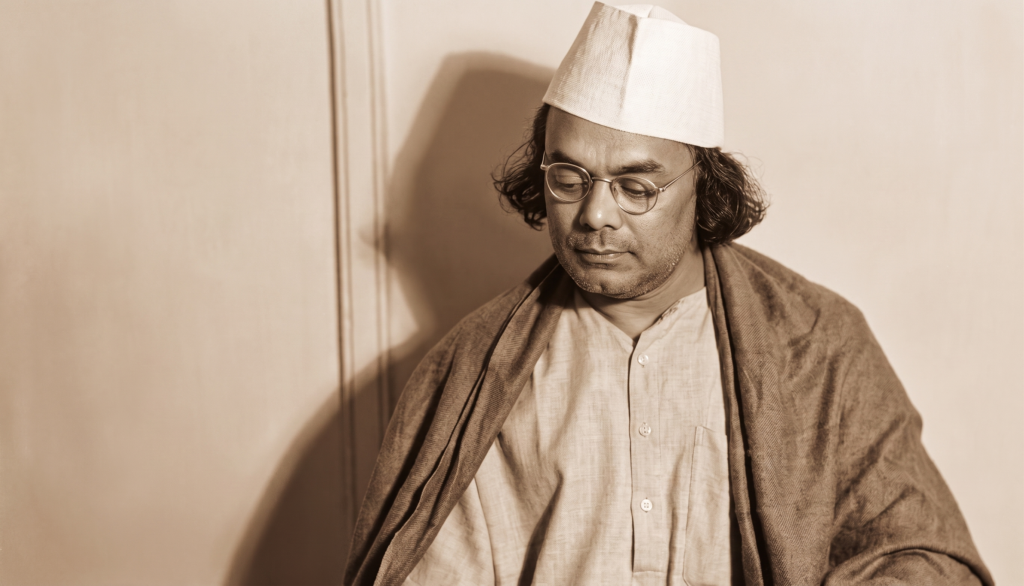
National Poet Kazi Nazrul Islam ┃ Photo: BSS
“আমি চির-বিদ্রোহী বীর —
বিশ্ব ছাড়ায়ে উঠিয়াছি একা চির-উন্নত শির!”
“I am the eternal rebel hero — I have risen beyond this world, alone, with my head forever held high.”
From the poem Bidrohi (“বিদ্রোহী”), Agnibeena, first published in 1922.
There is something quietly tragic about how societies remember their rebels. They memorize the slogans, frame the portraits, institutionalize the anniversaries and gradually forget the subtexts those voices once carried into the world.
On every Nazrul Jayanti (নজরুল জয়ন্তী), the familiar rituals return. A child in a white panjabi recites fragments of Kazi Nazrul Islam’s immortalized “বিদ্রোহী.” Somewhere, a harmonium opens into a Nazrul Sangeet long worn smooth by repetition. Television channels replay the same sepia photographs: the intense eyes, the military cap, the half-smile that seemed to know both tenderness and fury. We celebrate him with reverence now because reverence is easier than reckoning.
However, perhaps the most unsettling thing about Kazi Nazrul Islam is not that he rebelled. It is that he refused to rebel selectively.
That refusal still feels dangerous.
Nazrul’s defiance was never merely a political theatre. He did not write against oppression in the abstract or from a safe moral altitude. His rebellion was intimate. It entered religion, class, empire, masculinity, hunger, hypocrisy. It disrupted the comfort of all classes. Even today, reading him carefully can feel less like encountering a national poet and more like being interrogated by an uneasy conscience.
There is a tendency in Bangladesh to inherit Nazrul symbolically while avoiding the full implications of his moral imagination. We celebrate the fire of “বিদ্রোহী,” but often neglect the ethical loneliness beneath it. Because rebellion, in Nazrul’s world, was never about performance. It was about the willingness to stand outside normative approval.
And approval, perhaps more than censorship, is what disciplines societies.
Nazrul emerged from the borderlines of colonial Bengal carrying contradictions that other elite contemporary literary cultures could not fully contain. He worked in a bakery, joined a theatrical troupe, served in the British Indian Army, wrote Islamic songs and Shyama Sangeet with equal devotion, moved between mosques and temples without anxiety. He belonged everywhere and nowhere at once. That unsettled people then and it unsettles people yet today.
His imagination resisted orthodoxism.
At a time when identities increasingly harden into respective camps – be it ideological, or religious, or cultural – Nazrul’s life appears almost radically fluid. He did not merely preach communal harmony as an abstract liberal virtue. He inhabited multiplicity. In his writings, Allah and Kali could exist within the same emotional universe without cancelling one another out. He understood faith not as a border but as a language of human longing.
This is why Kazi Nazrul Islam remains profoundly contemporary in Bangladesh and Bengali literature, though not always in ways we acknowledge out in the open.
Modern Bangladesh often speaks proudly of pluralism while simultaneously growing anxious differences. Public discourse has become louder, but moral courage pertains rarer. Young people inherit a world saturated with performance – curated outrage, algorithmic identities, instant ideological camps. In such a landscape, Nazrul’s voice still feels startling because it asks for something more difficult than visibility. It asks for integrity.
To read Nazrul seriously is to encounter a person unwilling to simplify human dignity.
Consider the emotional architecture of his rebellion. Beneath the thunderous cadence of his revolutionary poems lies an extraordinary tenderness toward the humiliated and forgotten. His anger was inseparable from compassion. He wrote not simply against tyrants, but for those crushed quietly beneath systems — workers, the poor, women denied agency, colonized subjects stripped of voice.
There is a line running through Nazrul’s work that suggests rebellion without empathy eventually becomes vanity. That insight feels urgent today, when political language across the world often rewards cruelty disguised as conviction.
“গাহি সাম্যের গান —
মানুষের চেয়ে বড় কিছু নাই, নহে কিছু মহীয়ান।”
“I sing the song of equality — There is nothing greater than humanity, nothing more sublime.”
from the poem Manush (“মানুষ”), first published in 1925.
Nazrul understood suffering intimately enough not to romanticize power.
Perhaps this is why his writing continues to resonate with disillusioned youth — not because he offers easy hope, but because he dignifies unrest. He recognizes the moral exhaustion of living inside unjust structures while still insisting on the necessity of human tenderness. In an era where cynicism masquerades as intelligence, Nazrul’s emotional sincerity can feel almost revolutionary in itself.
Yet there is another image of Nazrul that haunts Bangladesh more quietly than the triumphant rebel of public memory.
It is the image of silence.
The final decades of his life, which was marked by illness, muteness, and withdrawal from the very language he once electrified, carry a devastating symbolic weight. A poet whose words shook empires eventually became unable to speak. The nation mourned him, celebrated him, institutionalized him. Nevertheless, there remains something unbearably poignant in imagining that silence alongside the intensity of his earlier voice.
Perhaps every society eventually silences its most inconvenient visionaries — if not through imprisonment, then through ceremonial admiration.
“সত্যকে হায় হত্যা করে অত্যাচারীর খাঁড়ায়,
নাইকো ভয়, সে সত্য আবার ফিরে আসিবে।”
“Truth may be slain by the tyrant’s blade, yet fear not — that truth shall return again.”
From the poem Shebok (“সেবক”), first published in 1924.
We turn rebels into monuments because monuments do not interrupt us.
And yet Nazrul continues to interrupt.
Not through slogans alone, but through the unresolved questions embedded in his life. Can a society truly embrace plurality without fear? Can faith coexist with freedom? Can resistance remain humane? Can we speak of justice while preserving systems of humiliation? Can culture survive if it loses moral imagination?
These are not historical questions. They are painfully current ones.
That is why Nazrul Jayanti should perhaps be less about nostalgia and more about discomfort. Not the discomfort of guilt alone, but the productive discomfort of self-examination. Nazrul’s legacy does not ask Bangladesh merely to remember him. It asks whether we are capable of sustaining the ethical courage he demanded.
There is a reason his words still feel unfinished.
Late at night, when Nazrul’s songs drift softly from old radios or YouTube playlists across Dhaka’s balconies, one sometimes senses that what survives is not simply poetry. It is a restless moral energy that is wounded, defiant, compassionate – refusing to disappear entirely into the ceremonial din and hustle of the streets.
Maybe that is the true measure of a cultural figure.
Not whether a nation celebrates him, but whether he continues to trouble its conscience long after the applause has faded.
About Author :
Md. Rafid Al Azwad
Executive at TBD