
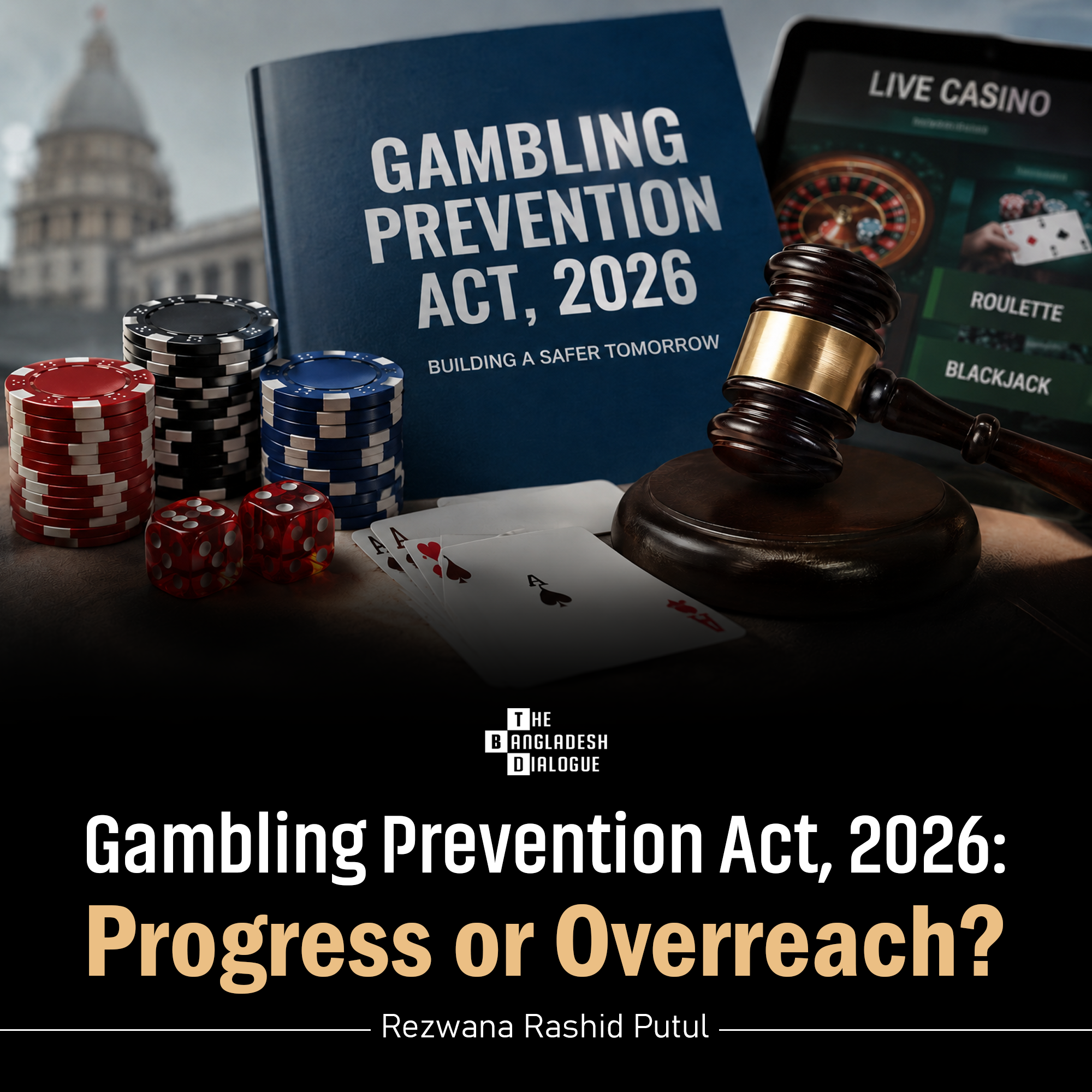
Replacing the 159-year-old Public Gambling Act,1867, Parliament passed the Gambling Prevention Act 2026 (Act No. 98 of 2026) on 1 July 2026.[1] The new law is enacted on the basis that the colonial law is no longer capable of addressing online gambling, cryptocurrency gambling, digital payment, virtual private networks (VPNs) and transnational gambling syndicates.[2] There was little debate that Bangladesh required a contemporary anti-gambling law as the Public Gambling Act, 1867 was drafted in an era when gambling largely occurred in physical gambling houses. It did not foresee online platforms or cryptocurrencies, digital wallets or mirror sites or social media promotions of gambling. This made it difficult for law enforcement authorities to investigate and prosecute advanced online gambling operations.
Although the new legislation has expanded the mandate and scope of gambling prevention but the real question still remains unanswered that whether it will be able to strikes an appropriate balance between effective enforcement and constitutional safeguards? The new law takes effect by placing liabilities on payment gateways, payment providers and payment services that host gambling sites and other gambling intermediaries, and expands the definition to include mirror websites, gambling affiliate marketing, website sponsorships and organized gambling syndicates and sports betting, as well as online betting.[3] While preventing gambling promotion is a legitimate goal, the restrictions are formulated in a broad way, which may give rise to uncertainty for journalists, researchers, cyber security experts and other digital intermediaries whose services can sometimes be linked in only an indirect manner to the prohibited activity.
Section 25 warrants special attention as VPNs are typically used for legitimate purposes such as cybersecurity, privacy protection, and secure business communications.[4] The Act’s definition of ‘gambling’ could stifle legitimate digital activity by criminalizing the use of technology that might be used to facilitate gambling but do not necessarily constitute gambling. Organized gambling accountability of holding entities is justified in certain circumstances, especially in relation to the facilitation of knowingly such organized gambling by payment gateways, hosting entities as well as their directors and managers.[5] The Act, however, fails to make a clear distinction between facilitation of a crime and provision of neutral technological services. Moreover, intermediary liability is sometimes accompanied by safe-harbor provisions for service providers who act in good faith, as in international regulation. Without equivalent protection, there is a risk that businesses will be over-monitored, over-censored and business models will be based on defensive measures.
Perhaps the most comprehensive aspects of the Act are those related to the powers of investigation.[6] However, the powers they grant can also lead to significant issues of unlawful interference with privacy and property rights and are necessary to investigate some more complex cyber-enabled gambling offences. Many of these measures are not expressly required by the Act to be confirmed or reviewed by court upon a timely request or at regular intervals and therefore leave a significant role for investigating authorities. The categorization of many offences as cognizable and non-bailable under Sections 44-46 further bolsters coercive state power, though this approach might be suitable for large-scale organized gambling operations, it is hard to see how such a process can be applied when many offences fall into the ‘big fish’ category, and what is strictly ‘proportional’ to the offence committed? There should be a difference between the ringleaders of sophisticated gambling networks and people who may be tangentially involved but not as much.
The Act establishes NID-SIM-MFS Linking System, biometric verification and facial recognition systems for enforcement purposes.[7] These could enhance investigative efficiency, but they also significantly increase the State’s surveillance capabilities. However, Bangladesh still has no comprehensive regime for personal data protection with independent oversight to control the wide range of collection and processing of personal data. The Human Rights Forum Bangladesh (HRFB) raised issues about the provisions allowing excessive investigative power, the lack of judicial oversight and the unrestricted conducting of intrusive surveillance before the law came into existence. In particular, HRFB questioned provisions on search, seizure and digital investigations.[8] The wide scope of powers granted under the Act therefore warrant careful analysis, to ensure restrictions are reasonable, proportionate and backed by robust safeguards against arbitrary action. In addition, the Act emphasizes the sentencing of offenders rather than rehabilitation. Gambling addiction is now widely acknowledged to be a public health problem and is a subject for counselling, treatment and preventive education internationally. The Act, however, doesn’t include nearly any provision that deals with rehabilitation or awareness programs for people with gambling addiction.
This is not to say that the Public Gambling Act was long overdue and needed change. The new legislation has been effective in recognizing the phenomenon of digital gambling and organized financial crime. But the parliament should pay attention to providing more explicit definitions, safe harbors for good faith intermediaries, more judicial oversight of searches and asset freezing, independent oversight of digital surveillance tools and treatment for gambling addiction. The Gambling Prevention Act, 2026 could be milestone legislation in modern criminal law. The extent to which its wide enforcement powers can be exercised, and how effectively they can be limited by the constitutional protections, will determine whether it will be a model for right-minded lawmaking or an emblem of unwarranted executive authority.
[1] Gambling Prevention Act, 2026 (Act No 98 of 2026).
[2] ‘Parliament passes anti-gambling law; up to 7 years’ jail, Tk 5cr fine for online betting’, The Daily Star (30 June 2026) https://www.thedailystar.net/news/the-parliament-watch/parliament/news/parliament-passes-anti-gambling-law-7-years-jail-tk-5cr-fine-online-betting-4212331 accessed 5 July 2026.
[3] Gambling Prevention Act, 2026, ss 3–10.
[4] Gambling Prevention Act, 2026, s 25.
[5] Gambling Prevention Act, 2026, s 31.
[6] Gambling Prevention Act, 2026, ss 37-41.
[7] Gambling Prevention Act, 2026, ss 50, 51.
[8] ‘HRFB urges review of provisions in proposed gambling law’, The Business Standard (June 2026) https://www.tbsnews.net/bangladesh/hrfb-urges-review-provisions-proposed-gambling-betting-law-1459161 accessed 5 July 2026.
About Author:
Rezwana Rashid Putul
Executive, The Bangladesh Dialogue