
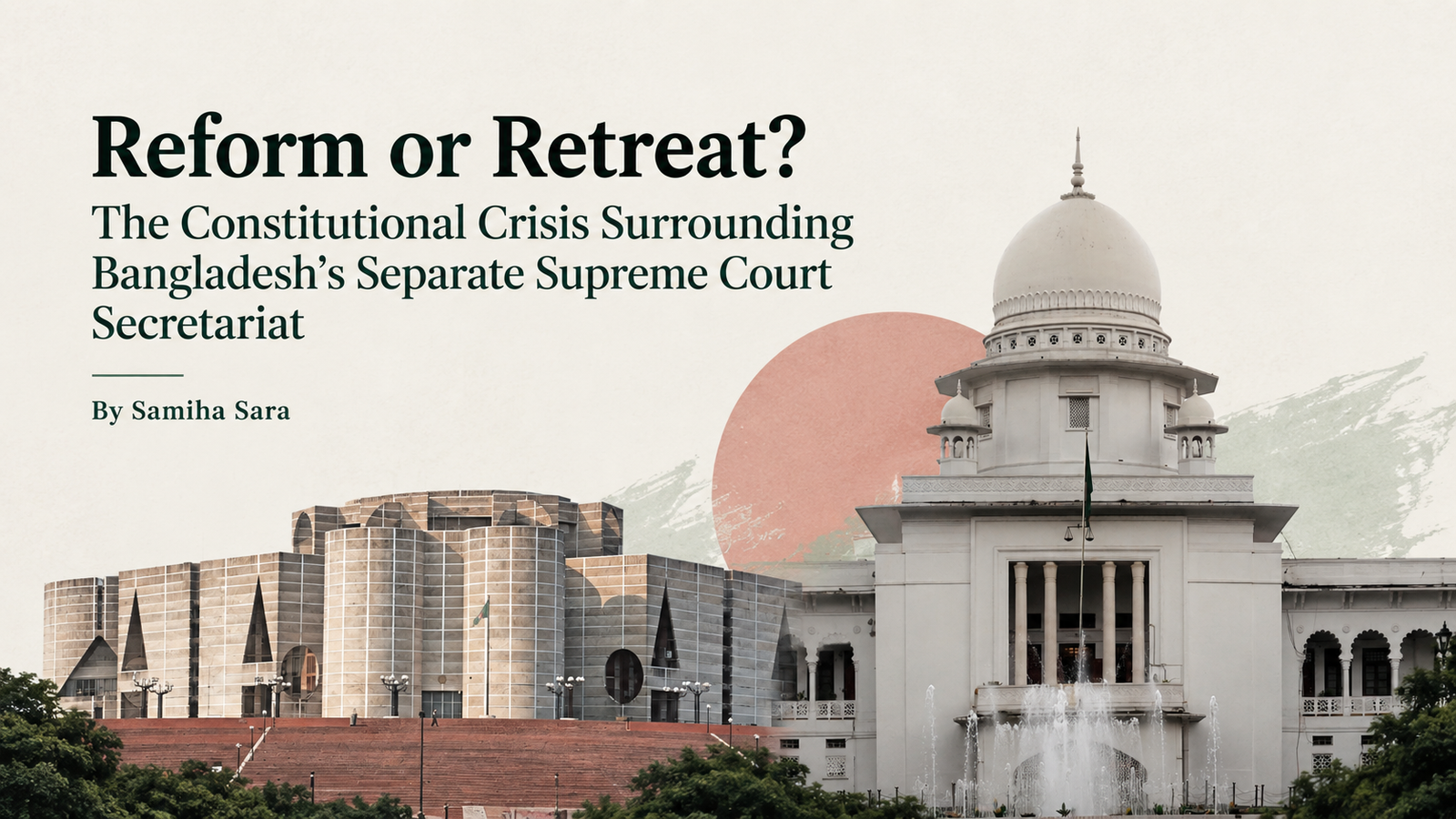
In a democracy, judicial independence is measured not only by how judges decide cases but also by who controls the conditions under which they work. Who determines a judge’s transfer, promotion, discipline, staff support and access to resources? In Bangladesh, these questions have long exposed a structural tension within the constitutional system. The Ministry of Law, Justice and Parliamentary Affairs has traditionally exercised substantial administrative influence over the subordinate judiciary, raising concerns that executive control may weaken the separation of powers. The brief establishment and subsequent repeal of the Supreme Court Secretariat brought this tension into sharp focus. It raises a fundamental constitutional question: how can judicial independence be protected while preserving Parliament’s authority and democratic accountability? The answer requires understanding judicial independence as more than freedom from direct political instructions. It also requires institutional safeguards over appointment, posting, promotion, leave, discipline, court administration and financial resources.
To comprehend why the establishment and subsequent repeal of the Supreme Court Secretariat triggered such intense constitutional crises, we must examine the structural architecture governing the subordinate judiciary. The core of this controversy lies in the textual evolution and practical application of Article 116 of the Constitution; a provision that has served as the primary battleground between judicial autonomy and executive oversight for over five decades.
When the Constitution was written in 1972, its institutional design sought to separate the judiciary from executive control while preserving the constitutional relationship among the branches of government. Under the original Article 116, the control (explicitly encompassing the power of posting, promotion, and grant of leave) and the discipline of persons employed in the judicial service and magistrates exercising judicial functions were vested directly in the Supreme Court. This framework ensured the lower judiciary was free from external pressures like the influence of the political branches of government. Although the entry into the service was regulated separately, the internal affairs regarding career progression and disciplinary matters of the judicial officers were strictly handled by the apex court.
Nevertheless, this system was dismantled by the Constitution (Fourth Amendment) Act, 1975. This amendment stripped the Supreme Court of its direct control over the subordinate judiciary and transferred it to the President. This control over lower court transfers, promotions, and discipline was placed under executive oversight, specifically involving the President acting through the Ministry of Law, Justice and Parliamentary Affairs. Subsequently, the Fifteenth Amendment introduced a requirement that the President exercise this authority “in consultation with the Supreme Court”. Nonetheless, the legal meaning of “consultation” remained vague, as it was not clear whether consultation merely requires the executive to seek the Supreme Court’s opinion, or whether it requires the executive to follow that opinion. If the President retains final authority, the consultation requirement may be insufficient to secure judicial independence in practice. For decades, this arrangement transformed into what legal scholars term a “dual control” mechanism. On paper, Article 116A mandated that judicial officers be independent in the exercise of their judicial functions. However, in practice, a profound paradox emerged: How could a judge remain truly independent when the very executive branch appearing before them as a frequent litigant held absolute power over their transfers, annual confidential reports, promotions, and disciplinary exposures? Even the requirement of “consultation” frequently devolved into a mere formality since the day-to-day administrative machinery remained in the hands of the Ministry of Law, Justice and Parliamentary Affairs. This institutional design allowed the executive to retain discretionary leverage, creating an environment of self-censorship where career advancement often depended as much on bureaucratic compliance as on judicial merit.
This issue cannot be understood without examining Secretary, Ministry of Finance v Md Masdar Hossain, where the Appellate Division recognised the judicial service as distinct from the executive service and required reforms to secure judicial independence. The judgment addressed not only decisional independence but also the recruitment, administration and discipline of judicial officers. Although it helped separate judges from the ordinary civil service, executive influence over judicial administration remained, making the separation incomplete.
In late 2025, the controversy regarding Article 116 gained sharp momentum against a background of intensified constitutional litigation and political change, resulting in a restructuring of judicial administration that briefly transformed the institutional relationship between the judiciary and the executive.
The landmark judgment in Mohammed Saddam Hossen v. Bangladesh worked as a legal catalyst. In this case, confronting the decade-long executive encroachment, the court boldly invoked the Basic Structure Doctrine. The court challenged the alterations to Article 116 that occurred through the amendments as fundamentally incompatible with the foundational pillars of the Constitution, specifically the separation of powers and the rule of law. This ruling also mandated that the government establish a fully independent judicial secretariat within a strict three-month window.
Capitalizing on this judicial mandate during the period of interim governance, the final approval was granted to draft the Supreme Court Secretariat Ordinance,2025. With its formal inauguration on December 11, 2025, an autonomous administrative body was established to govern the lower judiciary for the first time in our post-independence history. One of the core features of this structure included primary authority over the posting, promotion, transfer, grant of leave, and initial disciplinary proceedings of subordinate judges being vested directly in the Supreme Court Secretariat instead of the Ministry. The secretariat also assumed independent control over drafting, allocating, and executing the lower judiciary’s budgetary requirements, protecting court resources from executive-driven fiscal bottlenecks. Some hailed the ordinance as the completion of the unfinished constitutional journey that was revived with the Masdar Hossain case. The secretariat promised to shield judicial officers from political patronage and subtle forms of coercion. Judges could finally evaluate executive actions without the latent anxiety of impending punitive transfers or delayed promotions.
However, this reform did not last long. Following the transition to an elected government, the Jatiya Sangsad moved rapidly to dismantle the newly established judicial infrastructure. On April 9, 2026, parliament passed the Supreme Court Secretariat (Repeal) Bill, 2026, formally repealing the 2025 Ordinance. The immediate consequence of the Repeal Act was the reversion of budgetary, administrative, and personnel authority back to the executive branch.
The 2026 repeal highlights a major question in any democracy: How can the courts remain completely independent while still being part of the government structure? The repeal of the Supreme Court Secretariat can be viewed in two different ways. The Government may argue that the Secretariat was created through an Ordinance without sufficient parliamentary scrutiny, that the High Court exceeded its proper role and that the institution lacked adequate accountability mechanisms. From this perspective, repeal was a legitimate attempt to reconsider an incomplete reform. The opposing view is that the repeal restored executive influence over the very matters that had caused the constitutional dispute. The main concern is not that Parliament could never amend or replace the Secretariat, but that it abolished the institution without establishing an equally effective alternative.
The timing of the repeal also raises important political concerns. The Secretariat was established after years of demands for judicial reform but was dismantled soon after a change in government, showing the vulnerability of reforms created through temporary measures rather than a lasting constitutional framework. This risks creating a cycle in which one government establishes a reform, a successor repeals it, and executive control over the judiciary returns. This does not prove that the repeal was motivated solely by political convenience. That conclusion would require examination of parliamentary debates, official explanations, consultation records, and the availability of alternative safeguards. However, the practical effect of the repeal remains important regardless of motive. Even if the repeal was enacted in good faith, it may weaken judicial independence if it restores executive control over judicial administration.
The trajectory of Bangladesh’s Supreme Court Secretariat demonstrates that structural independence cannot be secured by judicial decree or executive ordinance alone. True institutional resilience requires navigating the delicate balance between freedom from political pressure and accountability to democratic governance. Examining how other common law jurisdictions approach this dilemma offers valuable lessons for Bangladesh’s constitutional future. The United Kingdom demonstrates that courts can be professionally administered while remaining subject to parliamentary funding and public accountability. Under the Constitutional Reform Act 2005, the constitutional position of the Lord Chancellor was restructured, while His Majesty’s Courts and Tribunals Service administers courts in partnership with the judiciary. India provides a closer constitutional comparison. Article 235 places control over district and subordinate courts in the High Courts, including posting, promotion and leave. Indian jurisprudence treats this control as an important safeguard of subordinate judicial independence. These examples suggest that judicial control over judicial administration can coexist with democratic accountability.
The legal position remains unsettled because although the State appealed against the High Court’s judgment, the Appellate Division stayed its direction to establish a separate Supreme Court Secretariat without finally rejecting its reasoning. The controversy nevertheless exposes Bangladesh’s incomplete judicial separation. While the High Court rightly recognised that independence includes administrative control, its remedy raised concerns about judicial overreach. Parliament could review the Secretariat, but abolishing it without an equivalent safeguard risks restoring executive dependence. Bangladesh therefore needs a permanent framework that protects Supreme Court control while ensuring parliamentary appropriation, financial audit, professional administration and public accountability.
About Author:
Samiha Sara
Executive, TBD