
Bangladesh presses for climate finance, loss-and-damage support and stronger global action as Prime Minister Tarique Rahman and his Special Assistant Dr Md Saimum Parvez outline the country’s climate priorities in New York
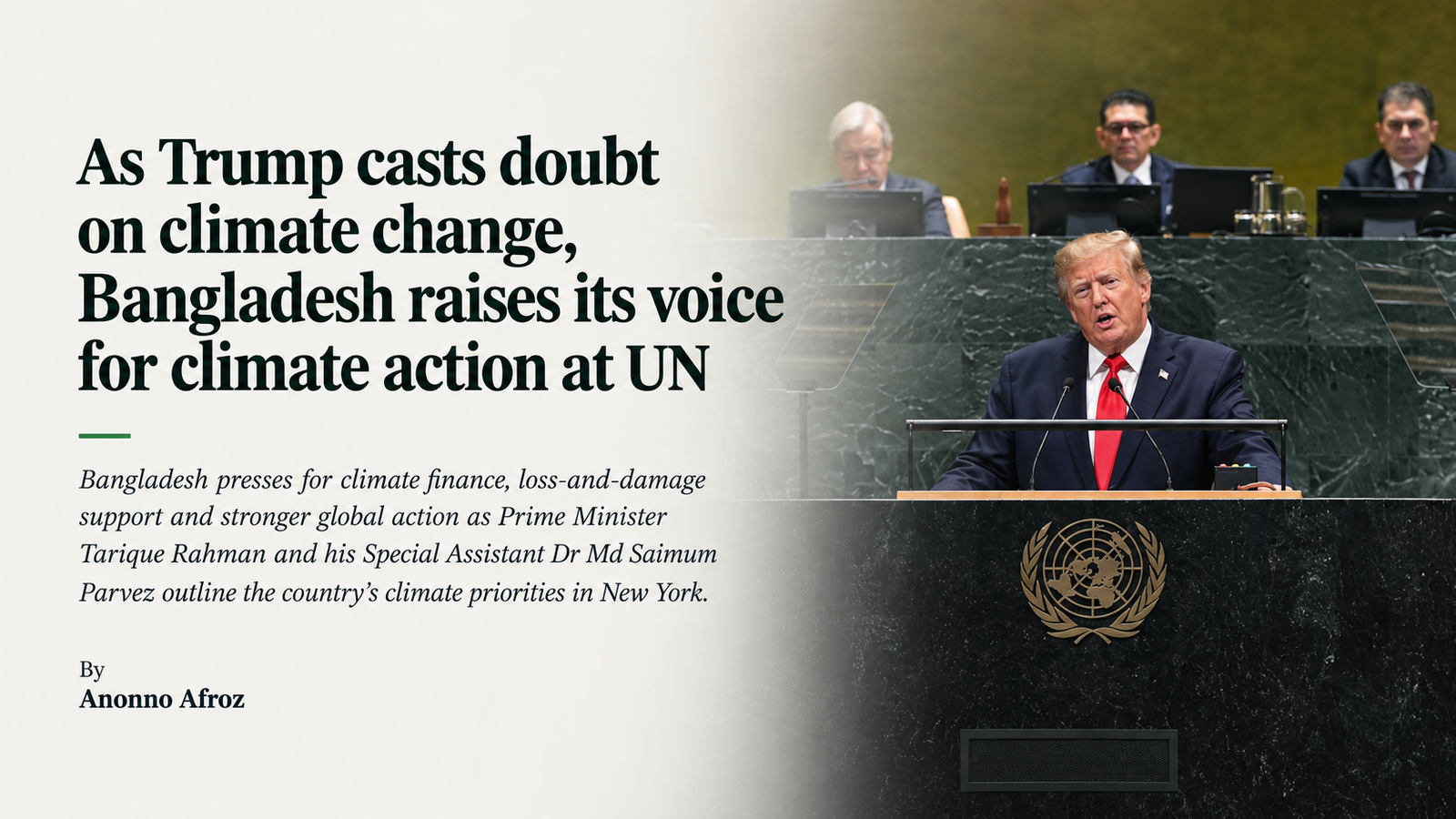
At the 81st session of the UNGA where US President Donald Trump again questioned climate warnings and criticised the global green agenda, Bangladesh has taken a markedly different position, using the world stage to press for stronger climate action, greater international financing and protection for countries bearing the consequences of a crisis they contributed little to creating.
The contrast has emerged during the 81st session of the United Nations General Assembly in New York, where Bangladesh Prime Minister Tarique Rahman and Dr Md Saimum Parvez, Special Assistant to the Prime Minister on Environment, Forest and Climate Change Affairs, have placed climate vulnerability, adaptation, loss and damage and climate finance near the centre of Bangladesh’s message.
Trump, meanwhile, has continued a long-running rejection of much of the international climate agenda.
Addressing the UN General Assembly on September 22, the US president mocked earlier warnings over global warming and linked advocates of climate action with groups he accused of exaggerating other global risks. He said those who once warned about global warming were the same people now warning about existential dangers from artificial intelligence, before grouping “climate change” with what he described as other political “hoaxes.”
The remarks followed an even more explicit attack at the UN a year earlier. In his September 2025 General Assembly address, Trump described climate change as “the greatest con job ever perpetrated on the world” and characterised green-energy policies as a “scam.”
Trump’s position stands in conflict with the assessment of the Intergovernmental Panel on Climate Change, which says human activities, principally greenhouse-gas emissions, have “unequivocally caused global warming” and that vulnerable communities which contributed least to the problem are disproportionately affected.
Bangladesh presents climate change as an immediate threat
Bangladesh’s message in New York has been almost the reverse.
Prime Minister Tarique Rahman highlighted that Bangladesh contributes less than 0.5% of global greenhouse-gas emissions while remaining among the countries most exposed to the consequences of a warming planet.
He warned that rising seas threaten Bangladesh’s coastal areas and the livelihoods of tens of millions of people, while climate-related losses, pressure on food security and the growing cost of adaptation are placing an increasing burden on the economy.
He said Bangladesh had allocated nearly $3.19 billion for climate adaptation in its latest budget, but argued that domestic expenditure alone would not be sufficient.
“Without international support, we risk severe damage,” the prime minister said.
His intervention combined demands for international assistance with a list of measures Bangladesh says it is undertaking at home.
The government has launched a programme to plant 250 million trees over five years, an initiative formally inaugurated earlier this year. It is also pursuing the excavation and restoration of around 20,000 kilometres of rivers and canals, while advancing plans involving the Padma and Teesta river systems to improve water retention, reduce flood risks and lessen dependence on groundwater.
Rahman also highlighted plans to expand renewable electricity, electric transport, waste-to-energy projects, circular-economy initiatives and a national carbon market.
Bangladesh’s official NDC 3.0 commits the country to reducing greenhouse-gas emissions by 20.31% below the business-as-usual trajectory by 2035 if both its unconditional measures and measures dependent on international support are implemented.
At the UN meeting, the prime minister called for five areas of international action: keeping the 1.5°C goal of the Paris Agreement alive through deeper emissions cuts; predictable and accessible adaptation finance; a just transition supported by climate technology; greater renewable-energy finance and technology transfer; and sustained financing for the Loss and Damage Fund.
The message was that climate responsibility cannot rest solely on states that are already spending heavily to adapt to consequences they played a comparatively small role in causing.
Saimum Parvez puts loss and damage, finance at centre of Bangladesh’s case
That position was reinforced by Dr Md Saimum Parvez at the Fourth Climate Vulnerable Forum Leaders Meeting, held on September 23 at UN Headquarters.
The meeting, chaired by Barbados Prime Minister Mia Amor Mottley, brought together representatives of climate-vulnerable economies and development partners, with discussions focused on the Vulnerability to Viability, or V2V, Compact and the proposed Lifeline Fund for economies hit by climate shocks.
Parvez described climate change not as a distant future threat for Bangladesh but as a present struggle involving rising seas, floods, salinity intrusion and cyclones.
“For us, climate change is not tomorrow’s headline; it is today’s struggle of existence,” he told the forum.
He argued that Bangladesh’s climate diplomacy has for years sought to elevate the concerns of vulnerable countries, particularly the principle of loss and damage, compensation and financial support for countries suffering climate impacts that can no longer be prevented through mitigation or adaptation alone.
Parvez backed the V2V Compact, designed to improve access to affordable long-term financing for vulnerable economies, and expressed support for the Lifeline Fund, which is intended to provide rapid liquidity when climate disasters create severe fiscal or balance-of-payments pressures. The CVF itself has identified both initiatives as central priorities of its 2026 UN meetings.
He also linked climate vulnerability to the international debt system, arguing that vulnerable countries should not be forced to divert money from education, healthcare and development simply to service debt while simultaneously financing reconstruction and adaptation.
Looking towards COP31, Parvez called for predictable and concessional climate finance, effective implementation of the Loss and Damage Fund, debt relief and reform of the global financial architecture.
He also urged countries to draw on the International Court of Justice’s climate advisory opinion to strengthen international accountability for climate-related obligations.
Two very different messages from New York
The exchanges in New York expose a widening divide in international climate politics.
Trump is questioning the underlying case for much of the climate agenda and portraying green policies as economically damaging. Bangladesh, by contrast, is arguing that the economic cost of inaction is already being felt by vulnerable states.
For Dhaka, the issue is therefore not limited to environmental diplomacy.
It encompasses food security, water management, disaster protection, energy, public finance, infrastructure and economic development.
That approach is also visible beyond this week’s UN meetings. Earlier this year, Rahman called for more climate finance for developing economies, saying the existing global financing goal was inadequate and arguing that climate resilience required cooperation on finance, technology and implementation.
During UNGA week, climate change has consequently emerged as one of Bangladesh’s prominent diplomatic themes. Rahman’s programme includes the UN’s high-level meeting on Climate Action and the Just Transition as well as discussions on the existential threat posed by sea-level rise.
The message coming from the Bangladeshi delegation is increasingly consistent: a country responsible for only a small fraction of historic and current global emissions does not intend to remain silent about the costs it faces.
At a time when one of the world’s largest powers is questioning the climate consensus and criticising the international green agenda, Bangladesh is choosing the opposite diplomatic course, putting climate vulnerability, adaptation, loss and damage, renewable energy and climate finance firmly on the international agenda.
As Rahman told world leaders, Bangladesh is seeking partnerships to implement its plans.
And as Parvez told representatives of the world’s climate-vulnerable nations, the objective is no longer simply to recount vulnerability, but to turn that vulnerability into a case for finance, accountability and collective action.
About Author:
Anonno Afroz
Writer, Analyst