
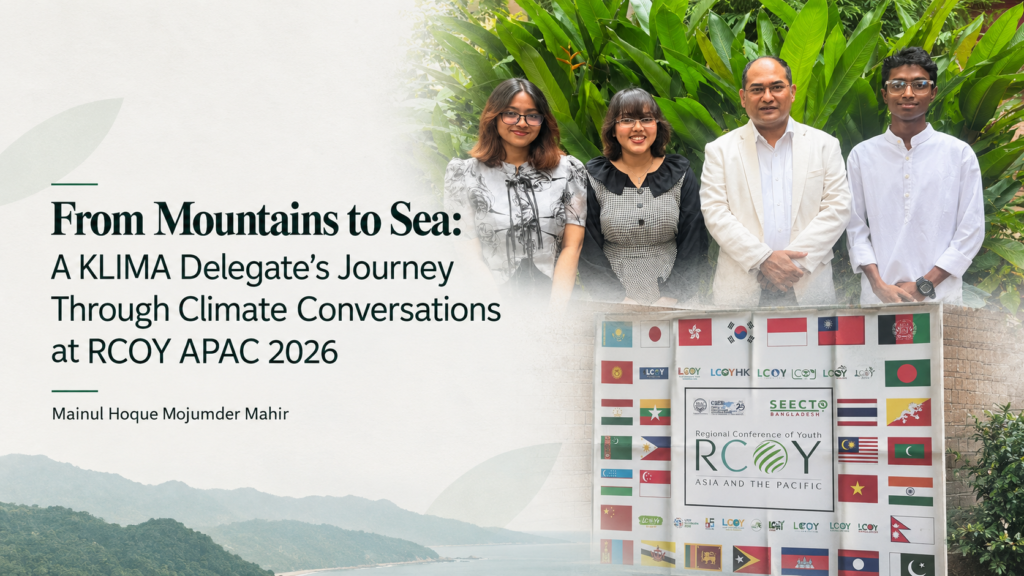
For a delegate representing KLIMA, an environmental initiative of The Bangladesh Dialogue (TBD), the Regional Conference of Youth for Asia-Pacific (RCOY APAC) 2026 was more than an opportunity to attend discussions on climate change. Held at BRAC University from 3 to 5 October under the theme “From Mountains to Sea, United for Climate Justice,” the conference offered an opportunity to encounter different realities, exchange ideas with young people from across the region, and reflect on what meaningful climate action should look like beyond policy documents and conference halls.
From the opening ceremony, the diversity of participants made the regional character of the conference tangible. Young people arrived with different cultural backgrounds, community experiences, and understandings of climate change, yet many shared a common concern: how to ensure that the people most affected by environmental challenges are heard when decisions are made about their futures.
The opening ceremony featured Shaikh Faridul Islam, State Minister for Environment, Forest and Climate Change, as the Chief Guest, and Dr. Saimum Parvez, Special Assistant to the Prime Minister on Environment, Forest and Climate Change, as the Special Guest. A keynote presentation by Dr. Md. Golam Rabbani, Director of the Centre for Climate Change and Environmental Research (C3ER) at BRAC University, explored climate change and its impacts across the Asia-Pacific region. These discussions provided an important starting point, but the conference’s significance became clearer as delegates moved from listening to actively exchanging ideas.
One of the most engaging parts of the programme was the Regional Youth Statement (RYS) validation process. Divided into thematic groups, delegates discussed priorities, shared perspectives, and worked towards recommendations reflecting the concerns of young people across the region. The process required participants to consider not only the issues affecting their own communities but also how those concerns connected with the experiences of others. Through group discussions and presentations, individual perspectives became part of a wider conversation about collective climate priorities.
For the KLIMA delegate, this process illustrated an important distinction between being present in a discussion and having the opportunity to contribute to it. Climate action often involves ambitious commitments, but turning those commitments into meaningful outcomes requires participation, collaboration, and a willingness to consider perspectives that may differ from one’s own. Activities such as Climate Quest: The Nature-Based Solution Game reinforced this practical dimension by encouraging delegates to engage with environmental challenges through interactive, collaborative problem-solving.
The conference became particularly relevant to Bangladesh when discussions turned towards the experiences of climate-vulnerable communities. In the session titled “TEESTA: The Beat of the North, From Policy to Practice: Youth Mandates and Local Realities in Northern Bangladesh,” delegates encountered the challenges faced by communities affected by river erosion, flooding, and recurring natural disasters. These are not merely environmental problems measured through statistics. They can mean losing a home, facing uncertainty over livelihoods, struggling to continue education, and rebuilding daily life after a disaster.
The session brought together school and college students, professionals, and policymakers, including State Minister for Disaster Management and Relief Iqbal Hossain. Young participants shared their experiences, local concerns, and ideas for future action. Their contributions highlighted the value of hearing directly from people who understand these challenges through lived experience. For a delegate engaged in environmental work, the discussion offered a reminder that climate policy becomes meaningful only when it responds to the realities of the people it is intended to protect.
A similar lesson emerged from “From Indigenous Voices to Climate Policy: Findings and Recommendations from the CHT Climate Declaration 2026.” The session provided a platform for Indigenous and hill communities from the Chittagong Hill Tracts to discuss environmental changes affecting their regions, including challenges involving livelihoods, water, natural resources, and vulnerability to climate-related hazards. Their perspectives brought attention to the importance of community knowledge in climate discussions. They also raised a broader question about representation: whose experiences inform climate policy, and whose voices risk being left outside the conversation?
For the KLIMA delegate, these discussions connected the broader idea of climate justice with the need to recognise differences in vulnerability. Climate change affects communities in different ways, and a response designed without understanding local circumstances may fail to address the challenges people actually face. Listening to communities, therefore, is not simply a gesture of inclusion; it is an essential part of developing more responsive environmental policies.
Beyond the sessions, interactions with delegates from other countries added another dimension to the experience. Conversations about culture, community life, and environmental challenges offered opportunities to understand how young people across the Asia-Pacific interpret the climate crisis. The exchange of cultural experiences made these interactions more personal, helping delegates connect beyond their organisational affiliations and national backgrounds. Despite their differences, participants could recognise shared concerns about environmental protection, community resilience, and the need for young people to have a meaningful role in decision-making.
These exchanges also demonstrated the value of regional solidarity. A river community in Bangladesh, an Indigenous community in the Chittagong Hill Tracts, and a climate-vulnerable community elsewhere in the Asia-Pacific may face different circumstances, but their experiences can inform one another. Learning across these contexts helps young people move beyond viewing climate change as an isolated national issue and recognise it as a shared challenge requiring cooperation.
For a delegate representing KLIMA, RCOY APAC 2026 was ultimately an experience of connecting ideas with people and policy with lived realities. The Regional Youth Statement process demonstrated how collaboration can turn individual concerns into collective recommendations, while the discussions on northern Bangladesh and the Chittagong Hill Tracts underscored why local experiences must remain central to climate action. Interactions with international delegates further strengthened the understanding that environmental challenges require both local knowledge and regional cooperation.
The conference did not make the challenges of climate justice any less complex. Instead, it offered a clearer understanding of why addressing them requires more than awareness or good intentions. It requires meaningful participation, attention to communities whose voices are often underrepresented, and continued engagement beyond formal events.
As the delegates left the conference, the importance of the experience lay not simply in the sessions they had attended, but in the perspectives they had encountered and the connections they had developed. For KLIMA, these conversations reinforced the importance of carrying environmental concerns into wider public dialogue and supporting approaches to climate action that are inclusive, locally grounded, and responsive to the needs of vulnerable communities. The message of “From Mountains to Sea, United for Climate Justice” was therefore not only a conference theme, but a reminder that collective climate action begins by listening to one another and recognising the realities that connect people across the region.
About Author:
Executive, TBD