
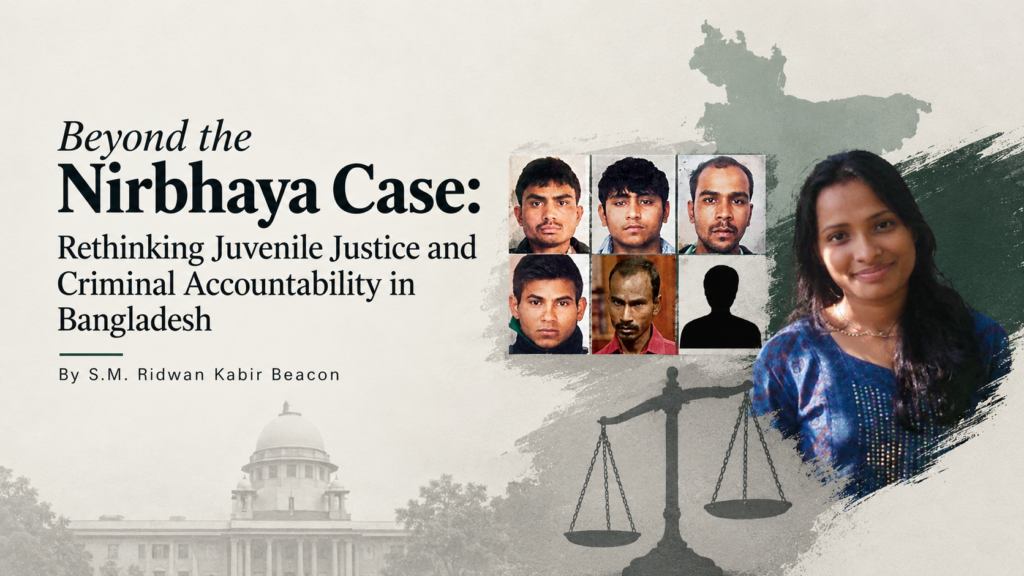
On the night of 16 December 2012, a 23-year-old physiotherapy student was brutally gang-raped and assaulted on a moving bus in Delhi, India. She died thirteen days later, leaving behind a country demanding justice. Known to the world as Nirbhaya, meaning “fearless”, her case became a turning point in India’s debate on sexual violence, criminal accountability, and women’s safety.
But one aspect of the case sparked a debate that went beyond the crime itself. Among the six accused was a boy who was around 17 years and six months old at the time. While the adult accused faced trial in the ordinary criminal courts, the boy was dealt with under India’s Juvenile Justice Act of 2000, even after being the most atrocious one among the accused. He was sent to a special home for three years and released in December 2015 after completing that period.
The public anger sparked all across the country. Yet the legal position was more complicated than it first appeared. Under the law at the time, three years was the maximum period a juvenile could be kept in a special home. His release was therefore a result of the law in force, not a declaration by the court that the crime was any less serious.
The case raises a difficult question for Bangladesh: how can the law hold children accountable for exceptionally serious crimes without losing sight of rehabilitation, child protection, and a fair trial?
The Indian Reform: A Lesson
Following the Nirbhaya case, India introduced the Juvenile Justice (Care and Protection of Children) Act, 2015, which came into force on 15 January 2016. One of its major changes was a new process for assessing children aged 16 to 18 who are accused of heinous offences.
Under Section 15, the Juvenile Justice Board examines the child’s physical and mental capacity, ability to understand the consequences of the alleged offence, and the circumstances in which it took place. Depending on the assessment, the case may be considered by a Children’s Court under the process set out in the law. This does not mean that every child accused of a serious crime is automatically tried as an adult. The assessment is a safeguard for making a careful decision, not a replacement for a trial or proof of guilt.
India’s response offers a useful lesson for Bangladesh, but it should not be copied without considering our own legal and social realities. Simply lowering the age of criminal responsibility or automatically exposing older children to adult punishment would miss the purpose of juvenile justice. The real question is how the law can recognise differences in responsibility while preventing unfair or arbitrary decisions.
Bangladesh’s Existing Legal Framework
Bangladesh already has a separate legal framework for juvenile justice under the Children Act, 2013. Section 4 defines a child, for the purposes of the Act, as a person up to the age of 18. The law also provides for Children’s Courts, Child Affairs Police Officers, probation officers, and measures designed to protect children who come into conflict with the law.
The basic idea is clear: children should not always be treated in the same way as adults within the criminal justice system. The law also allows alternatives to formal criminal proceedings in appropriate cases, with the aim of rehabilitation and a return to society.
However, having a law on paper does not guarantee that it works as intended. UNICEF’s assessment of diversion and alternative measures in Bangladesh has pointed to the limited use of alternatives to formal proceedings and institutional confinement, despite their recognition in law. This suggests that the problem is not only about legislation. It is also about how police officers, prosecutors, probation officers, and courts apply it in practice.
Bangladesh therefore needs a focused reform agenda, rather than an approach that treats harsher punishment as the answer to every serious crime.
Five Reforms Bangladesh Should Consider
1. Introduce a careful asse ssment process for exceptionally serious offences
Bangladesh should consider whether the Children Act, 2013, needs a clearly defined preliminary assessment process for children aged 16 to 18 accused of exceptionally serious crimes, including aggravated sexual violence resulting in death.
Such an assessment could examine the child’s maturity, understanding of the alleged conduct, role in the incident, the circumstances surrounding the offence, and relevant psychological or social evidence. It should be conducted by a properly trained and independent body, with legal representation for the child and an opportunity to challenge the findings.
Most importantly, the assessment must not assume that the child is guilty. The seriousness of the allegation alone should not decide whether a child is treated as an adult. Any decision to depart from the ordinary juvenile justice process must be properly explained, open to review, and consistent with constitutional protections and Bangladesh’s international obligations.
2. Look at each accused person’s role separately
Not everyone involved in the same crime necessarily carries the same level of responsibility. A child who plans and leads an assault may have a different level of culpability from someone whose involvement, knowledge, or understanding of the consequences is substantially different.
The law should require courts to examine the individual role of each accused rather than treating everyone in the same way simply because they were involved in one incident. At the same time, being young should not automatically excuse deliberate and exceptionally harmful conduct.
This approach would allow the law to respond more fairly to different levels of responsibility. A person’s age should neither become an automatic shield from accountability nor be treated as irrelevant.
3. Make accountability and rehabilitation work together
For children who remain within the juvenile justice system, serious offences should lead to appropriate and individualised intervention. Depending on what the law permits and the circumstances of the case, this could include secure placement, psychological assessment, structured rehabilitation, education, behavioural programmes, and continued supervision.
Bangladesh should also review whether the existing range of lawful measures adequately addresses the needs of older children convicted of grave offences. Any proposal to extend the maximum period of placement must be based on evidence, proportionality, independent oversight, and regular review.
Rehabilitation does not mean allowing a child to escape accountability. Equally, accountability should not mean keeping a child confined for as long as possible without addressing the factors that may have contributed to the offending.
4. Put survivors and victims’ families at the centre of justice
Debates about juvenile justice often focus heavily on the rights of the accused, while the suffering of victims and their families receives less attention.
Bangladesh needs to strengthen access to legal aid, medical and psychological support, witness protection, privacy safeguards, timely compensation, and clear communication with survivors and their families. Sexual violence cases also require professional investigations and fewer unnecessary delays. This means improving staffing, forensic capacity, and case management.
Survivors should not have to recount traumatic experiences repeatedly because different institutions fail to coordinate with one another. Their dignity and safety must remain a priority throughout the legal process.
The Women and Children Repression Prevention (Amendment) Act, 2026, provides a recent legislative context for examining Bangladesh’s response to sexual violence. Any further reform should build on existing law and experience, rather than assume that increasing penalties alone will deliver justice.
5. Focus on implementation, training, and transparency
Bangladesh needs reliable information about juvenile cases involving serious violence, how long these cases take to resolve, how often diversion is used, whether rehabilitation programmes work, and rates of reoffending where such information can lawfully and ethically be collected.
Police officers, prosecutors, judges, probation officers, and social workers should receive specialised training. Children’s Courts need adequate resources, and decisions involving exceptionally serious offences should be subject to appropriate judicial review.
Transparency is also important, but it must be handled carefully. Public reporting should help people understand how the justice system is performing without exposing the identities of children or survivors. Accountability should come from examining institutions and their decisions, not from humiliating vulnerable individuals.
The Principle Bangladesh Must Not Lose
When a crime is particularly brutal, the demand for the harshest possible punishment is understandable. But criminal law must do more than respond to public anger. It must remain fair and consistent even when the facts are disturbing and the accused belongs to a category that the law is designed to protect.
The Nirbhaya case shows both the limits of a rigid sentencing framework and the risks of allowing public anger to shape criminal policy on its own. India responded by introducing a process to assess older children accused of heinous offences. Bangladesh can learn from that experience while developing a system suited to its own Constitution, institutions, and social realities.
The goal should not be to copy India’s reform or to guarantee adult punishment for every child involved in a grave crime. It should be to build a legal framework that can recognise exceptional responsibility, provide meaningful consequences, protect survivors, and preserve the rights that separate justice from revenge.
A justice system must protect society without abandoning its responsibility towards children. It must recognise the suffering of victims without turning punishment into an act of public retaliation.
The real test of juvenile justice is not whether the law can be harsh, but whether it can remain fair, proportionate, effective, and humane even in the most difficult cases. That is where Bangladesh’s reform should begin.
About Author:
S.M. Ridwan Kabir Beacon
Executive, The Bangladesh Dialogue