
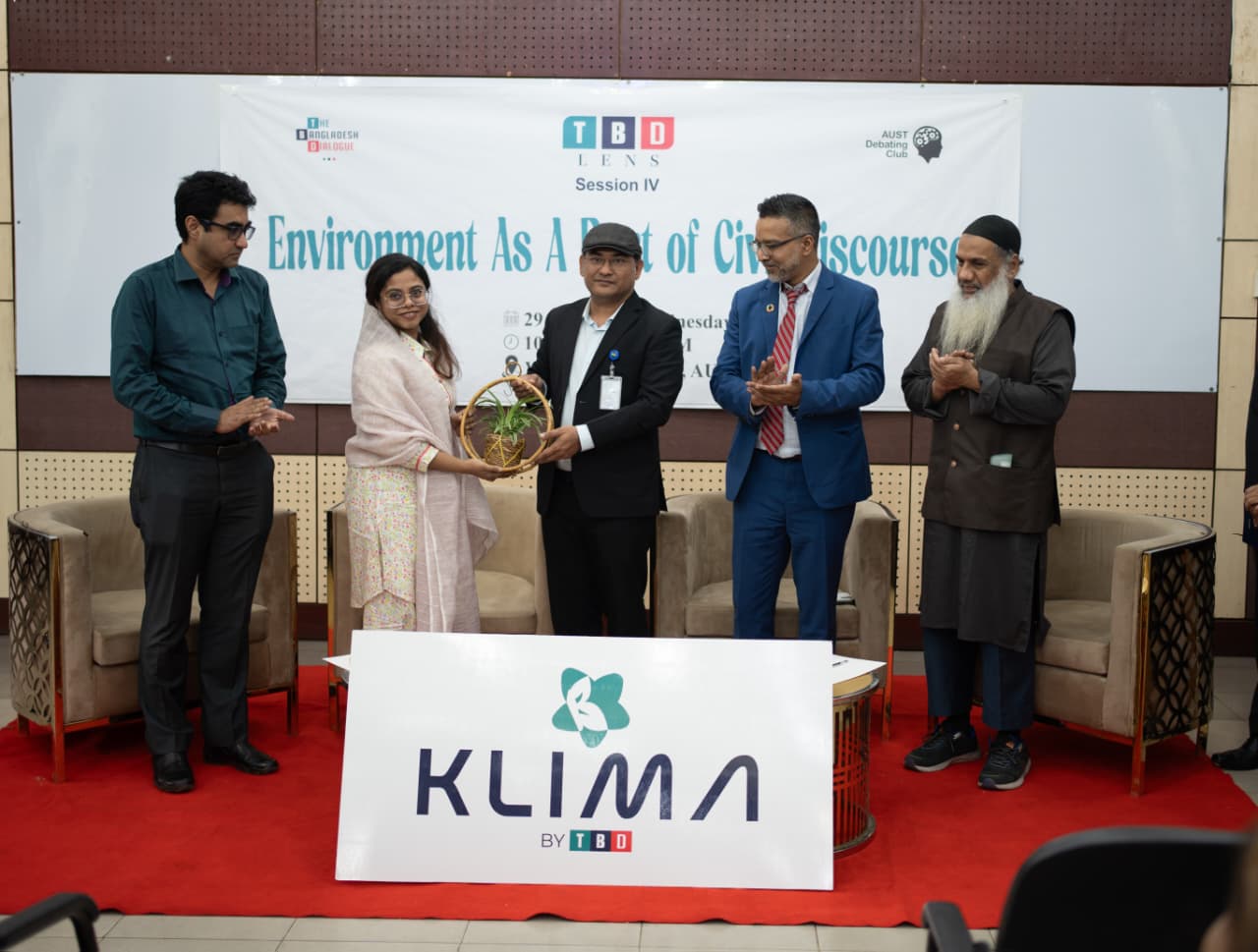
The Bangladesh Dialogue (TBD), organized the fourth session of TBD Lens titled “Environment as a Part of Civil Discourse.” The event aimed to explore how environmental issues can be integrated into public dialogue, policymaking, and civic engagement to foster a more sustainable and climate-resilient Bangladesh.
The session brought together policymakers, academics, climate experts, researchers, students, and representatives from environmental organizations to exchange ideas on strengthening environmental governance through informed public discourse.
The distinguished speakers included Dr. Saimum Parvez, Special Assistant to the Prime Minister on Environment, Forest and Climate Change Affairs; Prof. Dr. Ashraful Hoque, Vice Chancellor of Ahsanullah University of Science & Technology (AUST); Prof. Dr. Mazharul Islam, Director of the Institutional Quality Assurance Cell (IQAC), AUST; Mohammad Subail Bin Alam, Founding Member of the Centre for Science, Technology Policy and Diplomacy; and Dr. Nurun Nabi, Climate Change Specialist.
Also present at the event were Aslam Beg Sayem, Secretary of The Bangladesh Dialogue, and Meherba Sabrin, Assistant General Secretary of The Bangladesh Dialogue.
The event commenced with a welcome address and the formal inauguration by Prof. Dr. Ashraful Hoque, Vice Chancellor of Ahsanullah University of Science & Technology (AUST).
Dr. Saimum Farvez emphasized the importance of incorporating environmental issues into civil discourse. He noted that integrating environmental concerns into public discussions can help make environmental responsibility a part of society’s culture. He stressed that without widespread public awareness and participation, environmental initiatives would remain incomplete. He also underscored the need to present environmental issues in an engaging and accessible manner so that discussions on such critical topics become more interesting and relatable to the general public.
Prof. Dr. Mazharul Islam, Director of the Institutional Quality Assurance Cell (IQAC), AUST, delivered a technical presentation on “Renewable Energy and Environmental Sustainability.” He provided an overview of the global energy transition, highlighting the increasing importance of renewable energy technologies and discussing Bangladesh’s opportunities and challenges in achieving a sustainable energy future. He stressed that accelerating renewable energy adoption is essential for ensuring long-term environmental sustainability.
Dr. Nurun Nabi, Climate Change Specialist, emphasized the importance of environmental sustainability, transparency, and accountability in climate governance. He highlighted that evidence-based policymaking, transparent institutions, and inclusive participation are fundamental for effective climate action.
Mohammad Subail Bin Alam, Founding Member of the Centre for Science, Technology Policy and Diplomacy, emphasized that environmental protection requires active citizen participation. He urged the public to become more environmentally conscious while encouraging the Government to take stronger responsibility in expanding renewable energy and sustainable energy policies.
One of the major highlights of the event was the official launch and logo unveiling of KLIMA, a new initiative by The Bangladesh Dialogue.
KLIMA is a collaborative climate-action platform that connects policymakers, investors, businesses, NGOs, INGOs, youth, local communities, researchers, and other stakeholders. The platform aims to promote Locally Led Adaptation (LLA), Nature-based Solutions (NbS), climate innovation, civic engagement, and partnerships that make climate initiatives practical, investable, scalable, and commercially viable.
During the session, Hasibul Islam Rafi was introduced as the Coordinator of KLIMA. He presented the initiative’s vision for strengthening collaboration among government, the private
sector, development organisations, investors, young people and communities.
Under his coordination, KLIMA will work to identify promising climate solutions, connect initiatives with potential partners and financing opportunities, and create spaces for dialogue among stakeholders. The platform will also seek to strengthen the participation of communities and young people in climate-related decision-making.
Strengthened dialogue on integrating environmental issues into civil discourse.Increased awareness of renewable energy and sustainable development pathways.Recognition of the importance of transparency and accountability in climate governance.
Emphasis on public participation and environmental awareness as key drivers of climate action. Successful launch of KLIMA, creating a collaborative platform for climate stakeholders across Bangladesh.
TBD Lens IV successfully created a meaningful platform for dialogue among policymakers, academics, climate experts, youth, and civil society representatives. The discussions reinforced that environmental sustainability requires collective action, informed public engagement, and evidence-based policymaking. The launch of KLIMA marked an important milestone in The Bangladesh Dialogue’s commitment to advancing collaborative climate action and strengthening Bangladesh’s climate resilience through innovation, partnerships, and inclusive civic participation.
— Mahir Ibna Omar