
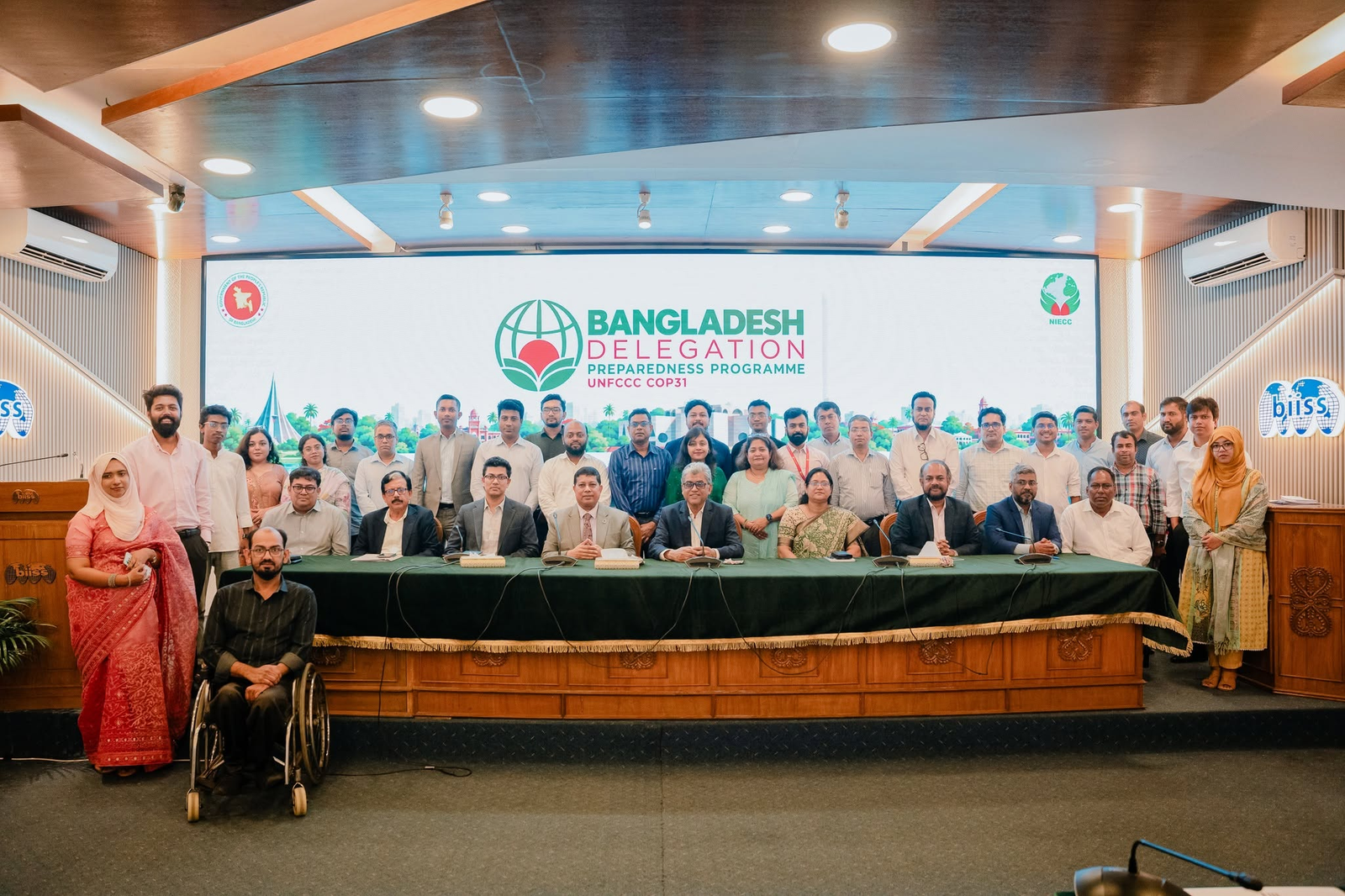
With COP31 less than two weeks away, Bangladesh’s climate negotiators spent two days at the Bangladesh Institute of International and Strategic Studies (BIISS) in Dhaka on 27–28 October 2026, preparing for the UN climate conference to be held in Antalya, Türkiye, from 9 to 20 November. The Bangladesh Delegation Preparedness Programme – UNFCCC COP31 was organised by the National Institute of Environment and Climate Change (NIECC) under the Ministry of Environment, Forest and Climate Change (MoEFCC). It was the country’s first government-hosted, inter-ministerial training programme designed specifically for climate negotiators and the COP process, bringing together officials, technical experts, researchers, lawyers, youth leaders and civil society representatives who will support Bangladesh across the negotiating streams in Antalya.
KLIMA, the climate initiative of The Bangladesh Dialogue Foundation, served as Strategic Partner and led coordination among government institutions, development partners, national and international NGOs, technical experts and participants. The programme was supported by the Embassy of Switzerland in Bangladesh; the British High Commission Dhaka, through UK International Development; the Global Alliance for Improved Nutrition (GAIN); Climate Action at Local Level (CALL); HELVETAS Swiss Intercooperation; the Center for Participatory Research and Development (CPRD); Save the Children; and Nature Conservation Management (NACOM). The Department of Environment, resource persons, technical experts and members of the youth climate community also contributed to its preparation and delivery.
Why Preparation Matters
Bangladesh comes to every COP with a strong moral case and a thin bench. The country contributes less than 0.5 per cent of global greenhouse gas emissions, and its per capita emissions of about 1.48 tonnes of CO₂-equivalent are far below the global average. Yet as the world’s largest delta, with roughly two-thirds of its land less than five metres above sea level, it faces some of the most severe climate impacts anywhere: floods, cyclones, salinity intrusion and river erosion that already cost the economy an estimated one to two per cent of GDP a year. Within the Least Developed Countries (LDC) Group and the G77 and China, Bangladesh has long been one of the more active voices for climate-vulnerable nations.
That influence depends on people. The programme’s concept note identified a set of recurring problems. The negotiating streams have multiplied and grown more technical, while the pool of Bangladeshi negotiators with sustained, stream-specific expertise remains narrow. Institutional memory is often lost between COPs as negotiators rotate out of their assignments. Younger researchers, climate lawyers, youth leaders and civil society experts are rarely paired with experienced negotiators in ways that prepare them for future roles. National positions are also frequently finalised close to the conference, leaving little room for structured input.
The programme was designed to address these gaps. Rather than briefing a delegation for a single conference, it set out to build a wider and younger bench of negotiation capacity, establish a regular rhythm of coordination, and lay the foundation for a long-term national roster of climate negotiators. COP31 adds its own complexity. Türkiye holds the COP Presidency and leads the Action Agenda, while Australia has been given designated authority to lead the formal negotiations. For a delegation, that means two centres of power to engage, and a clear need to understand which is which.
Opening Ceremony
The programme opened on the morning of 27 October with Mohammad Navid Shafiullah, Additional Secretary, MoEFCC, as Chief Guest. The session was chaired by Monira Sultana, Joint Secretary, MoEFCC. Welcome and introductory remarks came from Dr S. M. Munjurul Hannan Khan, Executive Director of NACOM, followed by Major General A S M Ridwanur Rahman, Director General of BIISS, and a representative of the British High Commission in Dhaka.
Muhammad Solaiman Haydar, Additional Director General (Current Charge) of the Department of Environment, and Lisa-Tanita Greminger, Deputy Head of Cooperation at the Embassy of Switzerland in Bangladesh, also addressed the participants. Abdul Awal Mintoo, MP, Minister for Environment, Forest and Climate Change, and Dr Saimum Parvez, Special Assistant to the Prime Minister for Environment, Forest and Climate Change, were unable to attend but sent their greetings and good wishes.
The ceremony set out the programme’s purpose: Bangladesh should arrive in Antalya prepared, coordinated and able to defend its interests with evidence, rather than relying on the experience of a few individuals. The presence of government, development partners and civil society on the same stage also reflected the programme’s inter-ministerial and multi-stakeholder character.


Day One: From the Basics to the Negotiating Streams
Md. Ziaul Haque, former Additional Director General (PRL) of the Department of Environment, opened the technical sessions with the history and governance of the UN Framework Convention on Climate Change (UNFCCC). He traced the regime from the 1992 Rio Earth Summit through the Kyoto Protocol to the Paris Agreement, and explained how decisions emerge from a party-driven, consensus-based process. He paired this with the latest climate science. The years 2015 to 2025 were the eleven warmest on record, and for Bangladesh, sea-level rise threatens to submerge 12 to 18 per cent of the coastal zone by 2100.
Dr S. M. Munjurul Hannan Khan then set out the direction, agenda and themes of COP31. He described Antalya as an implementation-focused conference that inherits unfinished business from COP30 in Belém, from adaptation indicators to scaling up climate finance. He urged negotiators to read operative language carefully and to distinguish the Presidency’s voluntary initiatives from decisions negotiated by the Parties.
Dr Fazle Rabbi Sadeque Ahmed, Additional Secretary (Retd.) and Adjunct Professor at Independent University, Bangladesh, explained the architecture of climate finance and the New Collective Quantified Goal (NCQG) of at least USD 300 billion a year by 2035. He argued that the quality of finance, including grants, access and predictability, matters as much as the amount, noting that Bangladesh’s own needs are estimated at around USD 20 billion a year. Mirza Shawkat Ali, Director, Climate Change and International Convention at the Department of Environment, followed with a session on adaptation, resilience and loss and damage. It covered the Global Goal on Adaptation, Bangladesh’s National Adaptation Plan 2023–2050 and the Fund for Responding to Loss and Damage.
Shaymal Barman, an international carbon market and climate change expert, led the session on mitigation, carbon markets and just transition. It centred on Bangladesh’s third Nationally Determined Contribution (NDC 3.0), which commits to a 20.31 per cent cut below business-as-usual by 2035, about two-thirds of it conditional on international support. The session also examined how the country can take part in Article 6 carbon markets with integrity. The day closed with Professor Sharmind Neelormi of Jahangirnagar University and a representative of Save the Children, who placed gender equality and the rights of children and young people at the centre of climate action.
Day Two: Diplomacy, Coalitions and the Mock Negotiation
If the first day was about what is being negotiated, the second was about how Bangladesh negotiates. After a recap by Md. Ziaul Haque, he examined the positions of the negotiating blocs that shape outcomes at every COP. These include the G77 and China, which Bangladesh belongs to, the 44-member LDC Group, the Alliance of Small Island States, and the Climate Vulnerable Forum, alongside groups such as the European Union, the Umbrella Group and the Like-Minded Developing Countries. Understanding where these blocs converge and diverge, he stressed, is essential for a country whose influence comes largely through alliances.
Md Shamsuddoha, Chief Executive of CPRD, widened the lens to global climate politics. The discussion took place against a difficult backdrop. At the June 2026 subsidiary body sessions in Bonn, some Parties sought to weaken references to science and to the 1.5°C goal, and negotiators could not agree to address climate misinformation. A K M Sohel, Additional Secretary and Wing Chief (United Nations) at the Economic Relations Division, then spoke on coalition building, climate diplomacy and finance, connecting what happens in the negotiating room to the bilateral and multilateral relationships through which finance actually flows.
A session on international partnerships and global cooperation opened with a keynote by M. Zakir Hossain Khan, Co-Founder and Managing Director of Change Initiative, followed by a panel moderated by Hasibul Islam Rafi of the Asian Development Bank. The panellists were A. S. M. Marjan Nur, Climate and Environment Adviser at the UK Foreign, Commonwealth and Development Office; Shirin Sultana Lira, Senior Programme Manager at the Embassy of Switzerland in Bangladesh; and Mousumi Pervin, Senior Climate Change Officer at the ADB. Civil society organisations and youth delegates from the Local and Regional Conferences of Youth (LCOY and RCOY) then presented their key messages on Bangladesh’s priorities, in a session moderated by Mohammad Navid Shafiullah.
The centrepiece of the day was a mock UNFCCC negotiation, facilitated by Dr Munjurul Hannan Khan and Md. Ziaul Haque. In a format similar to Model United Nations, participants were assigned to represent different countries and negotiating groups and asked to negotiate a draft text. They had to put the previous day’s lessons into practice: reading operative language, defending national positions, building coalitions, drafting compromise wording and recognising when a proposal crossed a red line. A debrief followed, reflecting on how the groups had approached the exercise and what it revealed about negotiating under time pressure.
The final technical session, on action planning and synthesis, was led by Mohammad Navid Shafiullah, Dharitri Kumar Sarkar, Joint Secretary, MoEFCC, and Md. Ziaul Haque. It brought together the messages that had run through both days. Bangladesh must negotiate as one coordinated national team, ground its positions in evidence, and define its priorities, its possible compromises and its non-negotiable positions before arriving in Antalya. It should also deepen its engagement with the LDC Group, the G77 and China, regional partners and other climate-vulnerable countries. Success, participants agreed, should be measured by the delegation’s ability to influence decisions, strengthen partnerships and secure meaningful outcomes for the people of Bangladesh.


Closing Ceremony and Outcomes
The programme concluded on the evening of 28 October with a closing ceremony attended by Mohammad Navid Shafiullah, Additional Secretary, MoEFCC; A S M Marjan Nur, Climate and Environment Adviser, FCDO; Monira Sultana, Joint Secretary, MoEFCC; and Kaji Rounukul Islam, Managing Director of the Bangladesh Climate Change Trust. The highlight was the official unveiling of The Climate Negotiator’s Guide, a resource designed to give Bangladesh’s negotiators the knowledge and practical insight they need for international climate negotiations.
The closing session also produced commitments that extend well beyond the two days. The MoEFCC confirmed that the preparedness programme will be held every year ahead of each COP, turning delegation preparation into a regular institutional process rather than an ad hoc exercise. From this year, Bangladesh’s delegation will also be organised into stream-based teams. Experienced negotiators will lead each negotiating stream, supported by associate members who will learn through direct engagement with their leads while contributing to preparation and negotiation. The arrangement is intended to preserve institutional knowledge and develop the next generation of Bangladeshi climate negotiators.
Speakers reaffirmed the priorities Bangladesh will carry to Antalya. These are predictable and accessible climate finance, stronger implementation of the Global Goal on Adaptation and an effective Fund for Responding to Loss and Damage. Alongside them, the country will press for cooperation on renewable energy, technology transfer, capacity-building, just transition and credible carbon markets, all grounded in climate justice.
Looking Ahead
The Bangladesh Delegation Preparedness Programme marks a shift in how the country approaches international climate negotiations. Preparation is becoming an institution rather than a last-minute briefing, expertise is being shared rather than held by a few individuals, and a younger generation of negotiators is being brought into the room alongside experienced hands. Over two days, participants moved from the history of the UNFCCC and the physical science of a warming planet to the fine print of finance goals, adaptation indicators and carbon-market rules. They then tested themselves at the negotiating table.
For KLIMA, the measure of this preparation will not be the programme itself but what follows in Antalya and beyond: Bangladesh’s ability to influence decisions, build partnerships and secure meaningful outcomes for its people. That will require sustained knowledge sharing, technical coordination and institutional cooperation long after the closing ceremony. As COP31 opens on 9 November, Bangladesh’s delegation will arrive better coordinated and better prepared, with the foundations in place for a lasting national pool of skilled climate negotiators.
About Author:
Rafid Al Azwad
Executive, The Bangladesh Dialogue