
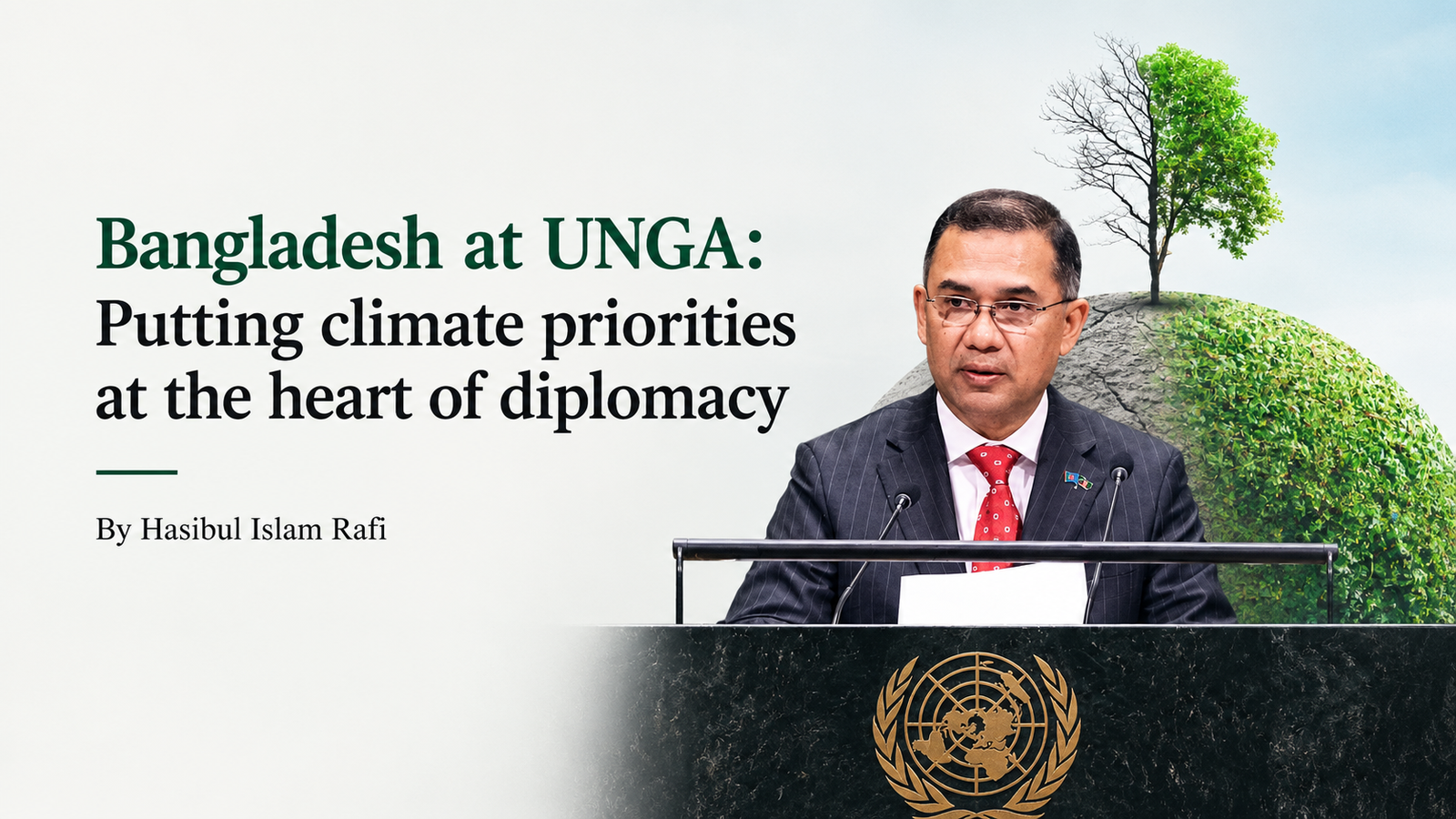
For Bangladesh, climate change increasingly shapes what the country seeks from the world: finance to protect vulnerable communities, technology to strengthen resilience, investment in cleaner development and cooperation over shared natural resources. Bangladesh’s engagements at the 81st United Nations General Assembly brought these priorities into a common diplomatic frame. Across high-level meetings and specialised discussions, the country presented climate action as a national development priority requiring sustained international partnership.
The engagements of Prime Minister Tarique Rahman and Dr. Saimum Parvez, Special Assistant to the Prime Minister for Environment, Forest and Climate Change, reflected this approach. Their interventions connected climate justice with financing, implementation and regional cooperation. The opportunity emerging from New York is to translate this diplomatic emphasis into partnerships that help Bangladesh protect its people and advance its development ambitions.
At the high-level meeting on Climate Action and the Just Transition, Prime Minister Tarique Rahman outlined five priorities: emissions reductions consistent with the Paris Agreement’s temperature goal, predictable adaptation finance, access to climate technologies, renewable-energy support and sustained financing for loss and damage. “Bangladesh seeks partnerships that help us implement our plans,” the prime minister said. That statement gave the agenda a practical direction: international cooperation should help deliver national priorities.
Prime Minister Tarique Rahman also presented ambitions covering tree plantation, river and canal restoration, renewable electricity, greener industries and a national carbon market. These priorities create potential openings for technical assistance and investment. Their inclusion in international discussions allows Bangladesh to connect its development plans with partners possessing relevant expertise and resources. Converting those openings into effective projects will require credible feasibility studies, environmental safeguards and clear implementation responsibilities.
At the high-level meeting on sea-level rise, Prime Minister Tarique Rahman placed human security at the centre of Bangladesh’s appeal. Alongside emissions cuts and coastal adaptation finance, the prime minister sought access to climate technologies and early-warning systems, and cooperation on displacement, dignified resettlement and livelihoods. These priorities recognise that protecting a delta involves more than defending land. It means helping families retain their livelihoods, access essential services and make choices about their future.
Climate concerns also featured in Prime Minister Tarique Rahman’s General Assembly address and meeting with UN Secretary-General António Guterres. The address sought stronger action on climate justice, finance and adaptation ahead of COP31, while the meeting addressed climate impacts alongside the Rohingya crisis and wider Bangladesh–UN cooperation. This positioning matters: climate resilience affects economic stability and human security, making it an essential component of Bangladesh’s broader foreign-policy agenda.
Dr. Saimum Parvez’s intervention at the Fourth Climate Vulnerable Forum Leaders Meeting added a coalition-building dimension. “When vulnerable countries speak with one voice, the world can no longer turn away,” Dr. Saimum Parvez said. Bangladesh shares concerns with countries facing climate shocks, costly borrowing and constrained public finances. Collective engagement can strengthen their influence over international financing arrangements and keep vulnerable countries’ priorities visible in global decision-making.
Dr. Saimum Parvez’s support for the proposed Lifeline Fund, intended to provide rapid liquidity after climate shocks, connected climate diplomacy with economic security. Disasters can damage infrastructure and production while increasing public expenditure. Financial arrangements that respond promptly can help countries manage these pressures without sacrificing essential development needs. Bangladesh’s engagement in this discussion therefore addresses a practical concern: how to protect development gains when climate shocks place additional demands on public resources.
At the loss-and-damage event organised by the Philippines and the Secretariat of the Fund for Responding to Loss and Damage, Dr. Saimum Parvez focused on delivery. The intervention called for simplified direct access, faster disbursement and small-grant channels reaching affected communities. Dr. Saimum Parvez also emphasised that complementary financing should add to developed countries’ responsibilities. These priorities give climate justice practical meaning: people experiencing unavoidable losses need timely assistance through procedures they can realistically access.
Water security provided another connection between diplomacy and national needs. At “United for Water: A Call for Collective Action,” Dr. Saimum Parvez observed: “Water connects us. It sustains people, economies and ecosystems.” The intervention advocated equitable use of shared waters, sustained dialogue and transparent data exchange, alongside finance and technology for resilient water services. For Bangladesh, these issues connect regional cooperation directly with efforts to address floods, water scarcity, river erosion and coastal salinity.
Bangladesh’s emerging approach is broadly consistent with international climate-finance practice. The Green Climate Fund emphasises country ownership, national coordination and support extending from institutional readiness and project preparation to implementation. The UNFCCC’s capacity-building work similarly focuses on translating national climate commitments and adaptation plans into investment strategies and fundable projects. Bangladesh’s emphasis on nationally identified priorities and implementation partnerships follows this direction. Meaningful alignment, however, requires inclusive consultation, strong institutions and measurable results alongside diplomatic advocacy.
There are grounds for hope. Bangladesh is articulating specific needs across adaptation, water security, energy and disaster recovery, while established international mechanisms offer pathways to support them. Bangladesh also has experience to build upon: the Green Climate Fund’s country portfolio includes the completed Extended Community Climate Change Project–Flood, implemented through PKSF. Such experience provides a foundation for preparing further proposals and strengthening delivery capacity. It demonstrates that access to climate finance is possible, although future funding will require sustained preparation.
The next step is coordinated follow-through. During the loss-and-damage discussion, Dr. Saimum Parvez referred to a developing National Climate Finance Strategy and a national climate-finance committee. These efforts could connect diplomatic outreach with a clear project pipeline. Each proposal should identify its beneficiaries, climate rationale, costs and appropriate financing source. Community recovery and adaptation need funding suited to public welfare; commercially viable clean-energy projects may attract investment through different arrangements.
Bangladesh’s UNGA engagements offer a hopeful direction, building on an established history of climate advocacy. Their lasting value will emerge through partnerships concluded, projects approved and resources reaching people. Prime Minister Tarique Rahman and Dr. Saimum Parvez have articulated priorities that connect Bangladesh’s vulnerabilities with its development ambitions. Sustaining that focus through COP31 and beyond can make climate diplomacy more consequential: a stronger voice internationally, supported by greater resilience and opportunity at home.
About Author:
Hasibul Islam Rafi
Climate and Development Practitioner
Former International Consultant for UNDP Asia and the Pacific