
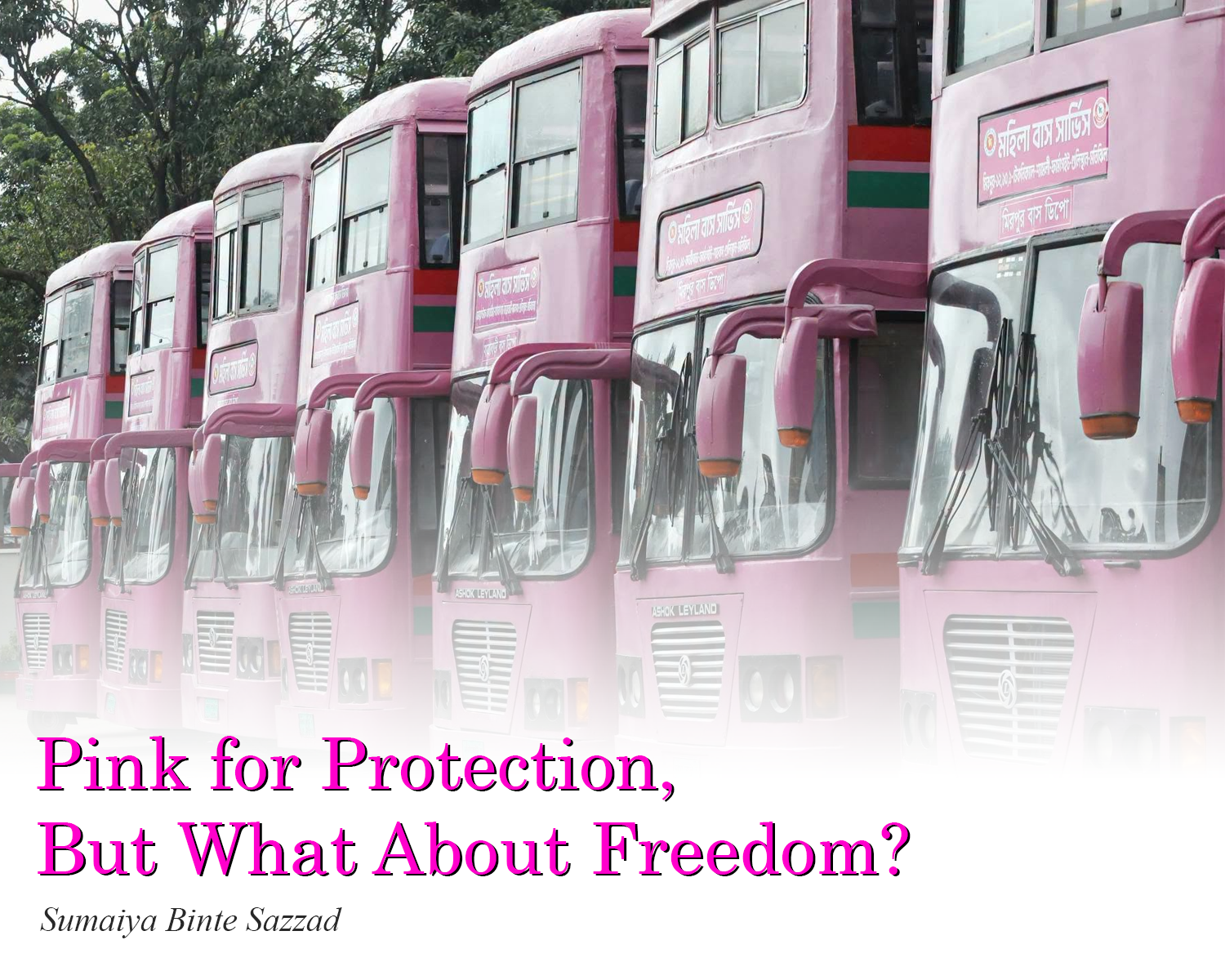
Photo: Daily Sun
For the past couple of decades, Bangladesh has slowly been becoming an increasingly difficult place to live for many of its citizens. Men, women, and children have all fallen victim to different forms of crime and suffering. However, women continue to occupy a major part of this list.
From being harassed on the streets to being violated on public transport and in countless other aspects of everyday life, Bangladeshi women have seen it all. Ask around, and it is highly unlikely that you will find a woman who has never experienced some form of harassment or violation in her lifetime.
It has almost become normalised. As if this is simply how life is supposed to be, as if this is the standard women are expected to accept. Anyone who complains is often told to tolerate more, adjust more, and stop making such a fuss.
Public transport has been one of the most vulnerable spaces for women for as long as I can remember. No matter how urgent the need to travel may be, many women hesitate before getting on a bus because they know that something could happen, something that might leave a scar long after the journey is over. The numbers back this up. A 2022 survey by the Aachol Foundation found that 63.4 percent of women and adolescent girls in Dhaka had faced some form of harassment on public transport within just six months, with 46.5 percent reporting sexual harassment specifically. A separate nationwide survey by UNDP Bangladesh and the National Human Rights Commission, covering more than 5,000 women across 24 districts, found that 87 percent had experienced harassment at least once in their lives, and 57 percent considered public transport the most unsafe space of all.
Local buses, especially, have often been among the worst of them all. Hyena-like people wait with their claws out, ready to violate the half of the population they do not consider deserving of basic respect. Sometimes, even the helpers and drivers belong to the same pack. They facilitate the perpetrators, ignore what is happening, and at times, even join in.
Yet every day, women have to use these modes of transportation regardless. For many, this is the most affordable way to commute from one place to another, and women are not paid any additional amount simply because they may need a safer alternative.
To address this issue, the government launched a women-only public transport service called the ’Pink Bus’ on 18 August. These BRTC buses are coated in baby pink, representing the feminine half of the population. For now, 14 buses have been launched, covering nine routes in Dhaka and one route each in Chattogram and Bogura.
The drivers of these buses are also women, which can certainly be seen as a symbol of women’s empowerment in the current world. They are fully trained and licensed drivers, unlike many of the underaged and unfit drivers often seen operating local buses on the streets.
Yet, despite this, they are already facing criticism.
Much of that criticism comes from the age-old and overused stereotype that women are bad drivers. But the reality tells a different story. Men are statistically more likely to be involved in fatal accidents and are often more reckless on the road. A recent study analysing crash data from Dhaka Metropolitan Police found that male drivers had nearly ten times the odds of being involved in a severe road accident compared to female drivers, a gap researchers described as statistically significant. Training, or the lack of it, is a large part of the problem too. Over 600,000 vehicles are currently unfit or without updated fitness certificates, and reports have found that more than half of the buses operating in Dhaka fail to meet basic fitness standards, with many drivers holding so-called contract licences obtained without proper testing. Still, whenever women take the driver’s seat, their competence is questioned before they are even given the chance to prove themselves.
The Pink Bus service is, initially, a good short-term remedy for the current state of society, where women genuinely feel unsafe using public transportation. There is no denying that a space where women can commute without constantly fearing harassment can offer relief.
But when we look at the bigger picture and think about the long term, this kind of gender segregation can also create space for further isolation.
Women are increasingly secluded into separate spaces, almost as if the entire world belongs to the male half of the population and women should simply be grateful for whatever little corner they are granted. They are expected to be thankful for having a space where they are not going to be violated, as if being violated is the norm. As if safety is a privilege rather than the bare minimum.
And in some cases, segregation may even worsen the existing problem.
We have already seen something similar after the introduction of women’s compartments in the metro. Some men began reacting bitterly when women entered the common compartments, treating them as though they were men’s compartments and only men were entitled to use them.
There are six compartments in the metro. Only one is reserved for women.
There are thousands of local buses in Bangladesh. Only 14 have been introduced exclusively for women.
Slowly, this risks giving the world to the male half of the population while only granting women the right to exist within whatever limited spaces are specially created for them.
This does not always feel like empowerment.
Sometimes, it feels more like pity.
It can almost be compared to expecting a prisoner to be grateful because you gave them a bigger room to be jailed in instead of giving them freedom.
Women are not prisoners.
They have the right to exist safely, just like every other citizen of this country. They have constitutional rights and are entitled to the same benefits, freedoms, and public spaces as the other half of the population.
They have the right to use every form of public transport. They have the right to exist freely in every public space without constantly worrying about their safety. They should not have to breathe a sigh of relief simply because they have been granted one safe corner in which to confine themselves.
The Pink Bus, therefore, should not be dismissed. For many women, it may offer something desperately needed right now: a safer journey home, to work, to university, or wherever life takes them. In a society where public transport has so often failed women, any attempt to make that journey safer deserves recognition.
But it should also not become the final answer.
A separate bus can provide temporary relief, but it cannot solve the larger problem. The ultimate goal should not be to create a few safe spaces for women in a world that remains unsafe everywhere else. The goal should be to make the entire public transport system safe enough that women do not have to search for a pink bus before deciding whether they can travel without fear.
Until then, the Pink Bus may be a solution.
But it is also a sigh, a reminder of how far we still have to go before safety stops being a special privilege granted to women and becomes what it should have been all along- a basic right.