
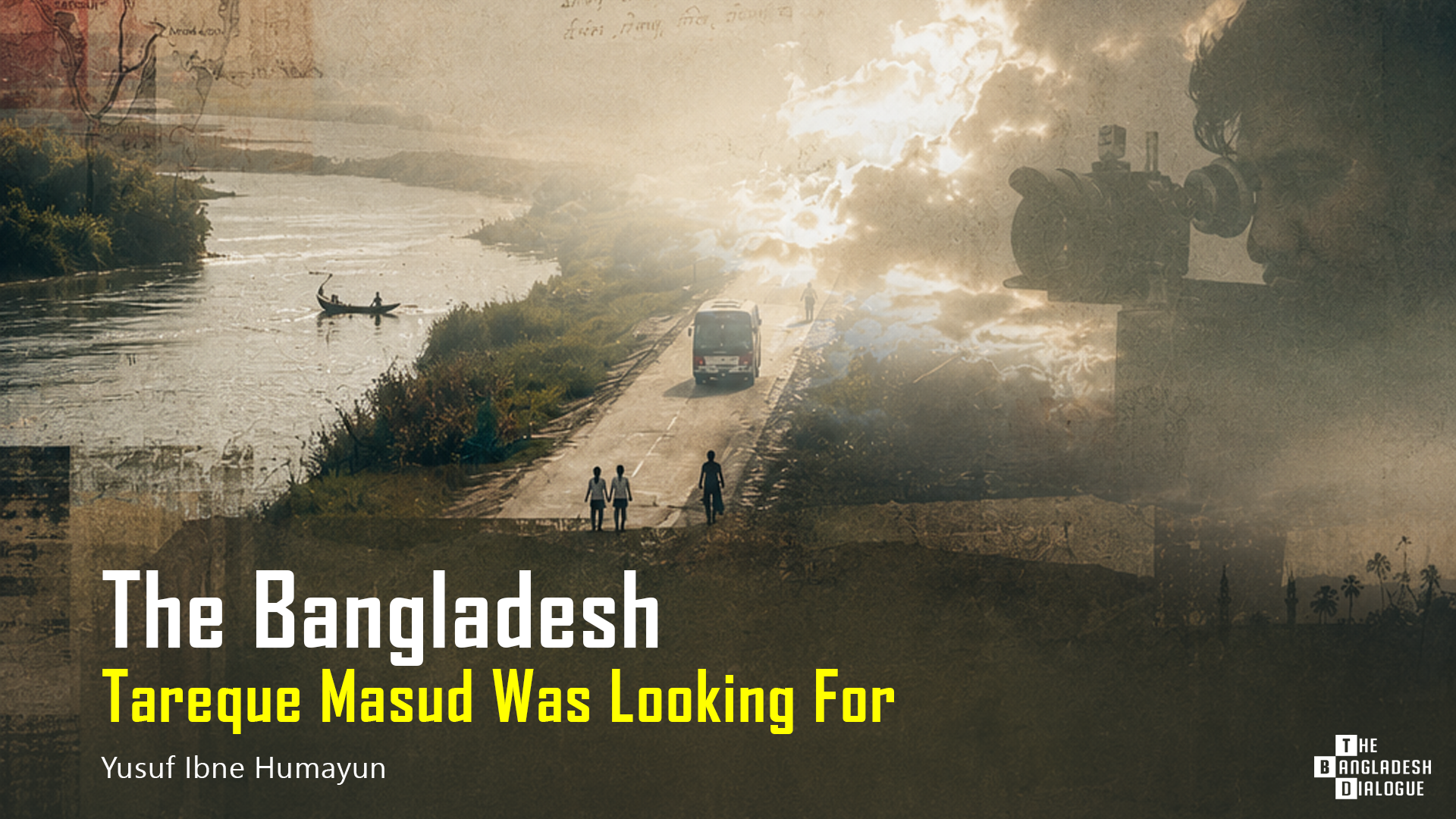
There is a recurring movement in Tareque Masud’s cinema. People walk across fields, travel along rivers, gather in village squares, wait at bus stations, migrate toward cities, return to forgotten memories, or simply stand still while the world around them changes. Watching his films today, one is struck by how rarely they feel interested in destinations. Movement itself is the subject. Bangladesh, in his work, is never a settled place. It is always becoming something else.
This may be why Tareque Masud continues to matter. Not because he occupies a revered position in the history of Bangladeshi cinema, and not because time has transformed him into a cultural icon. He remains relevant because many of the questions that animated his work still define contemporary Bangladesh. Questions about memory, faith, identity, history, migration, belonging, and the relationship between culture and nationhood continue to shape public life. His films feel alive because the country they were trying to understand remains unfinished.
The easiest way to misunderstand Tareque Masud is to see him primarily as a filmmaker of history. His films frequently return to the Liberation War, collective memory, and the formation of national identity, but history in his work is never a closed chapter. It is a living force that continues to shape the present. In Muktir Gaan, perhaps his most widely celebrated documentary, the Liberation War appears not through generals, politicians, or military strategy but through songs, performances, conversations, and ordinary people. The film’s extraordinary achievement lies in its ability to transform archival footage into something immediate. Watching it does not feel like looking at a distant past. It feels like entering a moment that has not entirely ended.
The musicians traveling through a country at war become more than historical subjects. They embody an idea that would remain central throughout Masud’s work: culture is not something that exists after politics. Culture is one of the ways politics becomes meaningful. The songs in Muktir Gaan do not merely accompany history. They help create it. The camera repeatedly returns to faces in crowds, villagers gathering to listen, children watching performances. The war unfolds not only as a military struggle but as a collective cultural experience.
What interested Masud was not simply how a nation is born but how it remembers itself afterward. This concern becomes even more visible in Muktir Kotha, a film that follows screenings of Muktir Gaan in villages across Bangladesh. Here the documentary itself becomes part of the story. People watch images from the war and respond with memories of their own. They interrupt, argue, recall forgotten details, and tell stories absent from official narratives. The film reveals memory as something active rather than archival. National history emerges not from monuments or textbooks but from countless personal recollections scattered across the country.
This attention to memory would remain one of the defining features of Masud’s cinema. He seemed deeply skeptical of singular narratives, whether national, religious, or ideological. His films repeatedly search for spaces where competing histories overlap. Bangladesh, in his imagination, was never reducible to a single identity.
Nowhere is this more apparent than in Matir Moina. The film is often discussed through the lens of religion, but its deeper achievement lies in how it refuses simplistic oppositions. Many films dealing with faith and modernity fall into predictable patterns. Religion becomes either a source of wisdom or a source of repression. Tradition becomes either something to preserve or something to escape. Masud was interested in a more complicated reality.
The world of Matir Moina exists between certainties. The madrasa is not presented as a caricature, nor are folk traditions romanticized as pure alternatives. Instead, the film explores the tensions and conversations between different ways of understanding the world. Through the eyes of a child, we encounter a society negotiating multiple identities at once: Muslim, Bengali, rural, modern, traditional, political. None of these categories remain fixed.
What makes the film remarkable is its patience. Masud allows meaning to emerge gradually through observation. A classroom lesson, a folk performance, a family conversation, a moment of silence. These scenes do not announce themselves as statements about national identity. Yet together they form a subtle meditation on the cultural forces shaping Bangladesh.
This method reflects a larger artistic philosophy visible throughout his work. Tareque Masud was not interested in abstraction. Political and philosophical questions appear in his films through lived experience. Rather than constructing arguments, he created situations in which viewers could observe people navigating complex realities. The result is a cinema that feels simultaneously intimate and political.
His treatment of rural Bangladesh illustrates this approach particularly well. For decades, rural life occupied an uneasy place within South Asian visual culture. Villages were often portrayed either as idyllic landscapes untouched by modernity or as sites of deprivation awaiting development. Masud resisted both perspectives. In his films, rural Bangladesh is neither paradise nor problem. It is a living cultural landscape.
One sees this sensibility in Adam Surat, his documentary on artist S. M. Sultan. On paper, the film is about a painter. In practice, it becomes a portrait of a relationship between art, people, and place. The camera lingers on children, farmers, conversations, rivers, and daily routines. Sultan’s paintings emerge from this world rather than standing above it. The documentary suggests that creativity itself is inseparable from the social and cultural environments that produce it.
Masud’s camera possesses a rare attentiveness to everyday life. He notices gestures, rhythms, and textures that many filmmakers overlook. A child wandering through a field. A crowd gathering beneath a tree. The sound of distant music carried by wind. These moments rarely advance plot, but they reveal how people inhabit the world. Watching his films, one senses a filmmaker convinced that ordinary life contains its own forms of drama and meaning.
This attentiveness also shaped his visual language. Tareque Masud belonged to a generation of filmmakers searching for alternatives to dominant cinematic conventions. Mainstream South Asian cinema often relied on heightened melodrama, elaborate performance styles, and rigid distinctions between fiction and documentary. Masud moved in a different direction. His films frequently blur these boundaries. Documentary techniques enter fictional narratives. Fictional structures shape documentary storytelling. Professional actors appear alongside nonprofessionals. Locations retain their natural textures rather than being transformed into cinematic spectacle.
The effect is a form of realism that feels both observational and poetic. His films never confuse realism with plainness. Reality, in his cinema, is filled with metaphor. A landscape can carry emotional weight. A song can reveal historical tensions. Silence can communicate more than dialogue. He understood that authenticity was not simply a matter of recording the world accurately. It was a matter of paying attention to its complexities.
This becomes particularly striking in Runway, a film that captures a Bangladesh undergoing rapid transformation. By the time of its release, urbanization, migration, globalization, and religious politics were reshaping everyday life. The film’s world is populated by garment workers, migrants, NGO programs, religious networks, and young people searching for direction. Yet once again Masud avoids grand declarations. Instead, he observes how larger forces enter individual lives.
The Dhaka of Runway feels especially important in retrospect. It is not the city of tourist imagery or development narratives. It is an unfinished city, marked by uncertainty and transition. Construction sites, airport fences, crowded roads, temporary settlements, and aspirations toward elsewhere define its visual landscape. People are constantly preparing to leave, hoping to leave, or imagining departure.
The runway of the title functions as more than a physical location. It becomes a metaphor for a society suspended between possibilities. Migration promises opportunity. Religious movements promise belonging. Economic development promises progress. Yet the film remains attentive to what these promises leave unresolved.
This concern with uncertainty runs through Masud’s entire body of work. He was fascinated by moments when societies stand between competing futures. Bangladesh appears repeatedly as a country negotiating transitions without fully abandoning older histories. The result is a cinema deeply interested in contradictions.
Perhaps this is why his films continue to resonate across generations. They refuse to present Bangladesh through familiar clichés. There is no simplistic celebration of tradition, no unquestioning embrace of modernity, no singular definition of national identity. Instead, his work insists on complexity. It recognizes that cultures are shaped by overlapping influences, conflicting memories, and ongoing debates.
At the heart of this vision lies a search for a distinctly Bangladeshi cinematic language. Not a nationalist language in any narrow sense, but a way of seeing rooted in local realities. Masud understood that cinema is not merely about stories. It is also about rhythm, sound, space, and perspective. What should a Bangladeshi film look like? How should it move? What details should it notice? Whose voices should it privilege?
His answer was never theoretical. He answered through practice. Through the cadence of village conversations. Through folk songs and religious recitations. Through the texture of rivers and fields. Through the memories of ordinary people. Through an attentiveness to places and experiences that mainstream cinema often overlooked.
The enduring power of Tareque Masud’s work lies in this commitment to looking closely. His films invite viewers to see Bangladesh not as an abstract idea but as a lived reality filled with contradictions, negotiations, and unfinished conversations. The country that emerges from his cinema is not a symbol. It is a complex human landscape.
To engage with Tareque Masud today is therefore not primarily an act of cultural remembrance. It is an opportunity to revisit questions that remain unresolved. How should Bangladesh remember its past? What relationship should exist between faith and pluralism? How do migration, urbanization, and globalization reshape identity? Where does culture fit within national life? His films do not provide definitive answers, nor do they attempt to. Their value lies elsewhere. They remind us that understanding a country requires patience, curiosity, and a willingness to embrace complexity.
The Bangladesh Tareque Masud was trying to see was never fully contained within any single film. It existed in fragments: in songs, memories, landscapes, arguments, silences, and journeys. That search remains compelling because the country itself is still engaged in the same process. Revisiting his cinema today is less about returning to a filmmaker than returning to a set of questions Bangladesh continues to ask about itself.
About Author:
Yusuf Ibne Humayun
Executive, TBD