
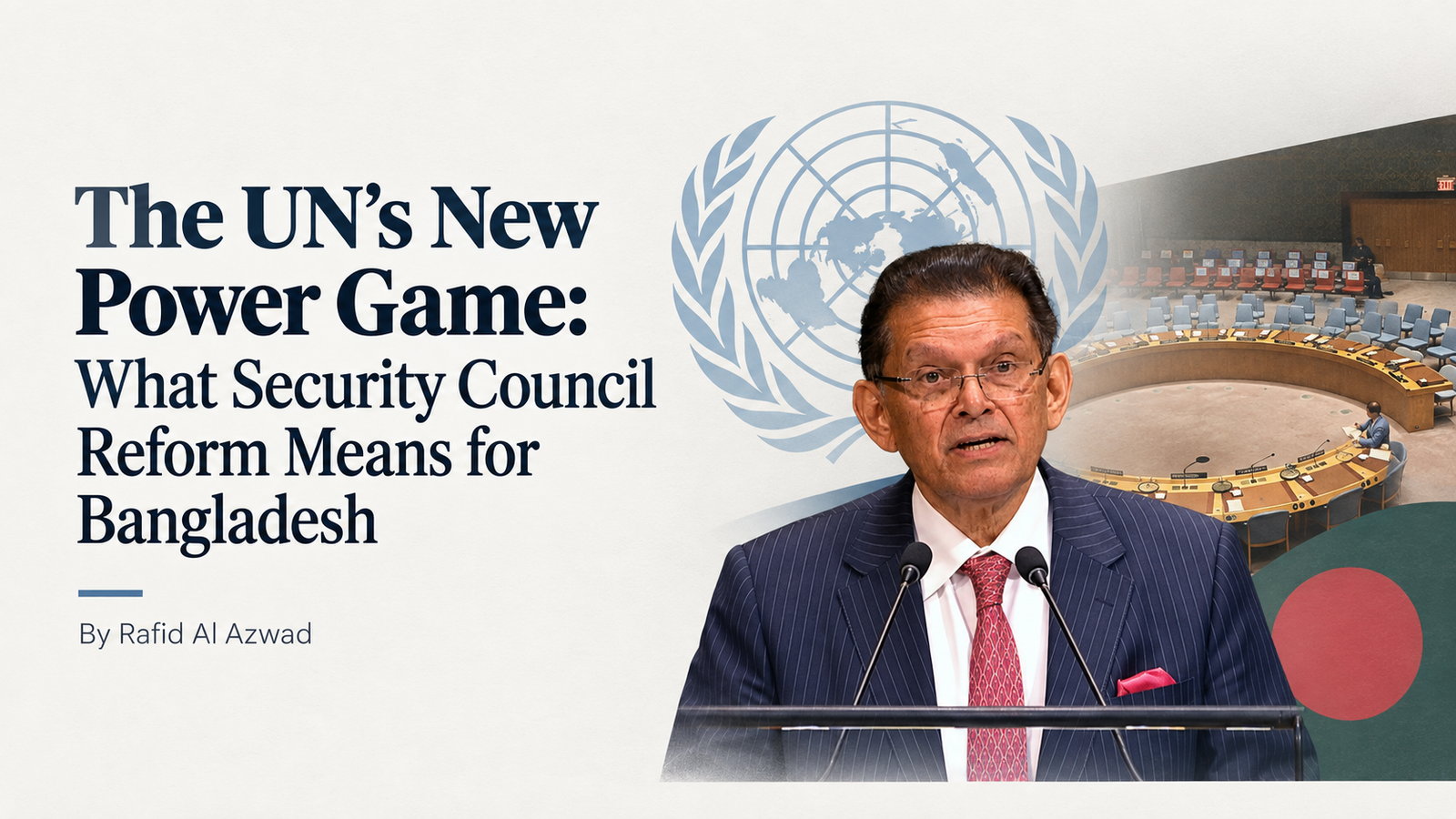
On 22 September, the man who opened the world’s largest diplomatic gathering was a Bangladeshi. Khalilur Rahman, elected President of the 81st session of the UN General Assembly in June after serving as Bangladesh’s foreign minister, used his first general debate to press a point that has hung over the UN for decades. After eight decades, he noted, Africa still has no permanent seat on the Security Council, and fixing that is a question of fairness, justice and the organisation’s own credibility. Africa, he told the hall, needs a seat at the table, not to be on the menu. A week later, closing the debate, he called the continent’s exclusion a continuing injustice.
Put that way, the demand sounds almost too obvious to argue with. If the United Nations claims to speak for the world, why does a continent of 54 member states, whose conflicts fill much of the Council’s agenda and host many of its peacekeeping missions, have no permanent voice at its most powerful table?
The difficulty begins with the next question. The moment anyone asks who else should get a seat, the language of fairness runs straight into geography, rivalry and national interests. Security Council reform is a debate in which almost every participant speaks of justice, and almost every participant has something to gain or lose. For Bangladesh, whose most senior diplomat now chairs the Assembly where this argument plays out, it is worth asking what kind of outcome would actually serve a country like ours.
A Council built for 1945, sitting in 2026
The Security Council was designed by the victors of the Second World War, and it still shows. China, France, Russia, the United Kingdom and the United States hold permanent seats and the veto. The only structural change came through a 1963 Charter amendment, in force from 1965, which raised the Council from 11 to 15 members by adding elected seats. UN membership has since grown from 51 founding states to 193 while the permanent club has remained unchanged.
Formal Intergovernmental Negotiations (IGN) have run since 2009, and progress is slow for a reason written into the Charter. Under Article 108, an amendment needs two-thirds of the Assembly and ratification by two-thirds of member states, including all five permanent members. Reform must pass both the many and the powerful.
There has been some movement. In the 2024 Pact for the Future, governments pledged to make the Council more representative and accountable and to redress the historical injustice against Africa as a priority. The Co-Chairs’ revised Elements Paper of July 2026 records broad agreement on a Council of 21 to 27 seats with more room for developing and small states, and equally plain division over the veto and permanent membership. The talks have been rolled into the current session with little actual realization. So, the reform is undeniably a live negotiation, not a settled outcome.
Africa’s seat is about more than Africa
Africa’s claim is the oldest and most coherent in the debate. The Ezulwini Consensus and Sirte Declaration of 2005 form the Common African Position, and in April the AU’s Committee of Ten tabled a formal African Model in the negotiations. It asks for at least two permanent and five non-permanent seats for Africa (it now holds three elected seats), a Council of at least 26, and the AU’s right to choose Africa’s nominees.
On the veto, Africa says it should be abolished; but as long as it exists, new permanent members, African ones included, must have it “as a matter of common justice”. The stated principle is equality of status among permanent members. The claim enjoys unusually wide sympathy, and few governments publicly dispute the injustice.
Yet recognising the injustice does not settle the design. Whether Africa’s seats should be permanent or long-term elected, whether they carry a veto, and how the AU would choose its candidates are still contested; the Co-Chairs themselves flagged open questions on selection, accountability and review. Supporting Africa’s case and endorsing one model are different things, and most of the politics lives in the gap between them.
Once one seat appears, everyone starts counting
Once permanent seats are on the table, a second arithmetic begins. The G4 (India, Brazil, Germany and Japan) back each other’s bids and want expansion in both categories; on 22 September their ministers called for reform at the earliest and welcomed the African Model. Each makes a serious case from population, economic weight and contributions to the UN.
Uniting for Consensus, coordinated by Italy and including Pakistan, the Republic of Korea, Argentina, Mexico and Spain, rejects new permanent seats and proposes longer, re-electable terms, arguing that only elections keep members accountable to the Assembly. Many of its members neighbour G4 aspirants: Pakistan and India, Korea and Japan, Argentina and Mexico with Brazil, Italy and Spain with Germany. Rivalry plainly shapes some positions. But the objection that permanence itself is undemocratic is a real argument, shared well beyond those capitals.
The African Group holds to its common position. The permanent five agree on little beyond guarding their own prerogatives. In 2024 the Biden administration backed two permanent African seats but no extension of the veto; the current administration has not clearly restated that. France and the UK support Africa and all four G4 bids. Russia’s Sergey Lavrov told this year’s Assembly that Moscow backs India and Brazil but no new Western seats. China stresses the voice of developing and small and medium-sized countries and warns against “contentious” proposals, language nearer Uniting for Consensus than the G4.
So there is no single Global South position. India and Pakistan, Brazil and Argentina, Africa and the Arab Group want different things, and they disagree even on procedure: the G4 and the L.69 group of developing countries want text-based talks now, while Uniting for Consensus and the African and Arab Groups want principles settled first. What exists is a set of overlapping claims, each mixing principle and interest in different proportions.
What Bangladesh actually needs from reform
The tempting question for Dhaka is whose candidacy to back. Bangladesh has taken sides before: in a 2011 joint statement, the then government reiterated its support for India’s candidature. This government’s UN statements have not addressed individual candidates. But candidacies are only one part of reform. The better question is what kind of Council would serve a country like ours.
Bangladesh’s record points to an answer. In February its delegation told the UN that the Council should be more representative and accountable, with the General Assembly keeping its central role. In 2025 the then Chief Adviser warned that reform must not silence developing countries. Bangladesh has argued that the veto should not block decisions such as admitting new members, citing Palestine, and its diplomats have called the Council a mute witness to the Rohingya crisis. Prime Minister Tarique Rahman’s address last week reaffirmed multilateralism but set out no reform model. This is an orientation, not a blueprint, and it suggests four principles.
Representation should matter. Backing Africa’s claim fits what Bangladesh already says. A country that has spent half a century on the UN’s list of least developed countries knows what it means to be discussed rather than heard.
Regions, not only champions. For an Asia-Pacific developing country, the question is not only which powerful candidates rise but how the region’s many developing members are represented. Adding one or two permanent members could leave most of them no closer to the table.
Representation without accountability is not enough. A Council of 25 that is as easily paralysed as a Council of 15 solves little. What helps Bangladesh is the unglamorous agenda: restraint on the veto in mass atrocities, the Assembly’s standing mandate to debate every veto, real consultation with troop contributors, and fuller reporting by the Council to the Assembly.
Keep strategic flexibility. Bangladesh’s interests cut across camps: it stands with troop contributors on peacekeeping, vulnerable states on climate, LDCs on graduation, and the OIC on Palestine and the Rohingya. Locking into one reform bloc would trade that range for gratitude that may never be repaid.
None of this is abstract. More than 200,000 Bangladeshis have served under Council mandates, yet Bangladesh has held an elected seat only twice, in 1979–80 and 2000–01. It shelters more than 1.2 million Rohingya, is among the most climate-exposed countries on earth, and is preparing to leave LDC status. Its leverage over reform is modest. But a more representative and accountable Council, and a stronger Assembly, would give it more ways to be heard.
Khalilur Rahman’s role needs care here. As President of the General Assembly he speaks for the presidency, not for Bangladesh’s foreign ministry, and his emphasis on Africa follows the Pact for the Future. Social-media claims that he aims to weaken India’s bid have no public evidence behind them; his speeches name no candidate. What his presidency does is make Bangladesh unusually visible, which gives its own diplomats an opening to say what reform should mean for smaller developing states.
A voice without a chair
Strip away the seat counts and the real argument is about something older: what gives a state the right to help govern the world. Population, geography, economic size, military strength, regional standing, years of service in peacekeeping – every reform model weights these differently, and every capital prefers the weighting that flatters it. That is not hypocrisy. It is how international politics has always worked, and the language of justice in this debate is often sincere even when it is also convenient.
Bangladesh cannot decide the final shape of the Council. The world has changed since 1945; the Council’s core has not, and it will change only when the many and the powerful agree. What Bangladesh can do is be clear about the test it applies to any proposal: does it widen meaningful participation for developing and smaller states, make the Council more accountable for its choices, and strengthen the Assembly where every member has a vote?
For Bangladesh, the question is not simply who deserves another permanent chair. It is whether reform will create a United Nations in which countries without a permanent chair still have a meaningful voice.
Source Note
- UN General Assembly, Revised Co-Chairs’ Elements Paper on Convergences and Divergences, July 2026, and PGA letter on IGN rollover
- AU Committee of Ten, African Model on UNSC Reform, April 2026 (Ezulwini Consensus and Sirte Declaration)
- PGA 81, Opening of the general debate, 22 Sept 2026; opening statement, 8 Sept 2026; UN News coverage
- UN, President of the 81st session; UN Press on his election
- African Union: AUC Chairperson meets PGA, 24 Sept 2026
- G4 ministerial statement, 22 Sept 2026 (Jiji/Nippon.com; News India Times)
- Wang Yi, Keynote to the Group of Friends of Global Governance, May 2026
- US Mission to the UN, Thomas-Greenfield remarks, Sept 2024
- Bangladesh Permanent Mission, statement on the UN Charter Committee, Feb 2026; Chief Adviser at UNGA80, Sept 2025; Prime Minister at UNGA81, Sept 2026
- UN Press, Assembly debate on the veto initiative, 2024; Bangladesh MoFA, Amb. Muhith on the Rohingya, May 2023
- MEA India, India-Bangladesh joint statement, 2011
- UN Charter, Articles 23, 27 and 108
About Author:
Rafid Al Azwad
Executive, TBD