
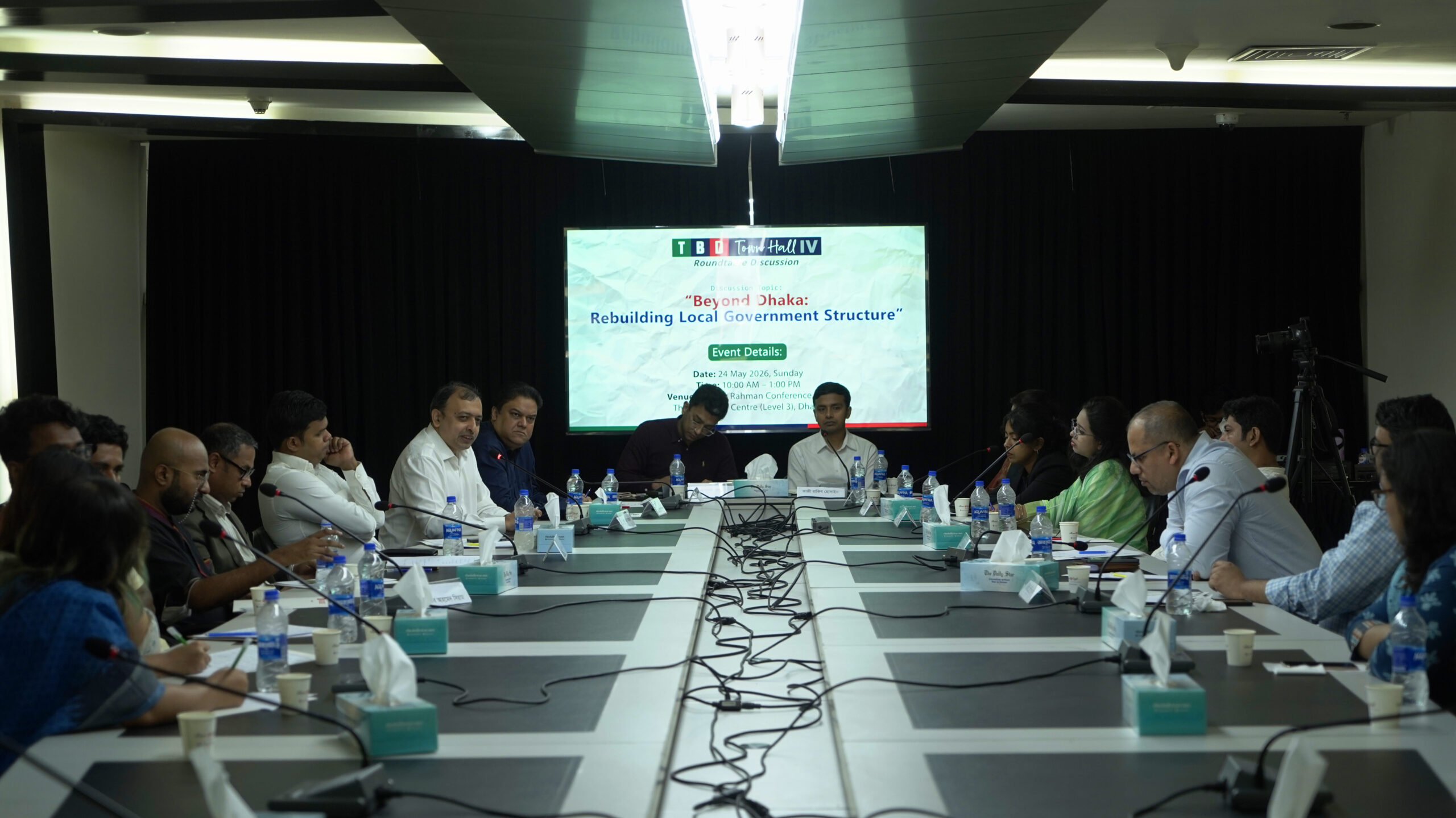
A timely and substantive roundtable discussion titled “Beyond Dhaka: Rebuilding Local Government Structure” was held on 24 May as the fourth episode of the Town Hall series hosted by The Bangladesh Dialogue. The discussion assembled diverse perspectives from policy, academia, civil society, youth journalism, and governance-related sectors to deliberate on one of Bangladesh’s most urgent institutional concerns: the persistent weakness of local government and the disproportionate concentration of power, resources, services, and opportunities in Dhaka. The central premise of the roundtable was that local government should be recognised not simply as an administrative mechanism, but as an essential democratic institution for ensuring accountability, participation, and balanced national development.
In his keynote address, S M Saif Kader Rubab underscored that the objective of the discussion is not to weaken the centralised system, but to strengthen the local government structure, ultimately strengthening the overall governance system. He noted that declining public interest in local elections reflects a broader loss of confidence in local institutions, largely because they are often perceived as extensions of central authority rather than autonomous democratic bodies. He also highlighted that younger citizens seek participation beyond voting, making participatory democracy essential to rebuilding trust. He called for a shift in perspective, stating that local government must be treated as a primary democratic institution, capable of bringing the state closer to the people and strengthening citizens’ ownership of governance.
The first speaker, Sumaiya Binte Sajjad, Executive, The Bangladesh Dialogue, located our centralised governance problem within the colonial administrative legacy inherited from the British and Pakistan eras, which continues to shape a capital-centric state. She further highlighted that women’s participation in local government remains structurally constrained, as reserved seats often overlap with male members’ wards and weaken women representatives’ authority. To move beyond Dhaka, she proposed district-wise economic zones in sectors such as agriculture, fisheries, textiles, information technology, and renewable energy, so that young people are not forced to migrate to the capital for opportunity. A unique yet significant point of her speech was the identification of climate migration as a neglected challenge, and she stressed the need for climate-resilient local economies, rehabilitation, local employment, and green infrastructure.
Oliur Rahman Sun, member of the Network for People’s Action, questioned the fate of earlier commissions, particularly the 1991 Nazmul Huda Commission, suggesting that valuable reform proposals from those commissions have repeatedly been ignored despite being produced through public resources. He also criticised the lack of local accountability within the district administration since Deputy Commissioners remain answerable to bureaucratic career structures rather than to local citizens. He believed that meaningful reform requires addressing the overriding powers embedded in laws led by the central ministry, which often weakens local decisions. He described local representatives as electoral “foot soldiers” who are used to influence voters during national elections, revealing the deeper partisan function of local government, despite the political masking that is the omission of the party symbol “reform”. Ultimately, he warned that any serious restructuring would face resistance from the bureaucracy, making political will essential for real decentralisation.
The subsequent speaker, Mohammad Mamunur Rashid, Head of the Law Department of Eastern University, approached local government reform from a legal and socio-historical perspective, arguing that Bangladesh’s problem lies less in the absence of laws than in their ineffective implementation. Drawing on the historical panchayat system, he observed that earlier local justice mechanisms worked because they relied on trusted, locally rooted, and charismatic community figures who understood the social context of disputes. He argued that present village courts suffer from a trust deficit because elected members and chairmen do not always command similar respect. He, therefore, proposed that unelected but socially respected local leaders should be considered within village court structures. Through examples from coastal electoral politics and rural perceptions of MPs as the visible face of government in most rural places, he stressed that governance is experienced locally, not abstractly. Referring to Max Weber, his remarks called for a reform approach that allows unelected and charismatic local leadership as the third force in effective local governance.
Offering a media-centred perspective to the discussion, Sakib Ahmed Siam, Representative of Jahangirnagar University, The Daily Star, stated that rebuilding local government requires not only the decentralisation of power but also the decentralisation of the media. He observed that national media coverage remains largely capital-centric, while union, upazila, and district-level problems often remain underreported. He further clarified that strong local journalism is essential for exposing corruption, highlighting grassroots suffering, and making local government more transparent and accountable. His remarks positioned local media as a necessary accountability mechanism for any meaningful reform of the local government structure.
Dr. Bulbul Siddiqi, Professor, Department of Political Science and Sociology, and Director, Confucius Institute, North South University, cautioned against discarding all existing practices and instead emphasised the need to evaluate and strengthen initiatives such as village courts and digital centres at the union level. He insisted that local governance problems cannot be separated from national-level corruption, politicisation, and weak accountability, and therefore, reform must address both local and central structures. Siddiqi also stressed that reform proposals must be tested against feasibility, local revenue potential, administrative capacity, and the real workload of local representatives. Pointing out the importance of bottom-up planning, better coordination among officials and local representatives, and the creation of facilities outside Dhaka, he concluded that decentralisation would remain ineffective without sustained political will and continuous civil society pressure.
The following participant, Dr. Tanvir Ahmed, Professor, Department of Civil Engineering, BUET, focused on a service-delivery and technical capacity angle, particularly on waste management, sanitation, and water supply. He argued that Dhaka itself demonstrates the failure of local governance in the environmental aspect, while many smaller municipalities perform comparatively better. A remark was made that although legal reform may be necessary, the existing Local Government Act of 2009 is not even being fully implemented. His most distinctive contribution was the idea that local bodies cannot develop proper ownership over infrastructure if projects are designed and implemented externally and merely handed over to them. Therefore, he recommended gradual capacity building through smaller locally implemented projects, while retaining central technical agencies for complex infrastructure.
Presenting a distinct political-economic perspective, Aaqib Md. Shatil, Special Correspondent, Netra News, contended that Bangladesh does not need to reinvent its local government system, as the basic structures and laws already exist. Rather, the central challenge lies in implementation and political will. Mentioning the United Kingdom’s “levelling up” policy, he compared Bangladesh’s Dhaka–Chattogram concentration with England’s London–Oxford–Cambridge economic triangle and highlighted the role of private investment in producing regional imbalance. According to him, centralisation benefits those who control land, rent, investment, and the means of production, making decentralisation an economic opportunity loss for powerful elites. Thus, reforms must address elite incentives, not only institutional design. As practical recommendations, he proposed Key Performance Indicators for local public representatives, clarification about distinct roles among MPs and local representatives, and the development of secondary cities such as Khulna and Rajshahi as practical centres for decentralised growth.
Advocate Fayazuddin Ahmed framed decentralisation as a fundamentally citizen-centred concern, arguing that meaningful reform can occur only when citizens personally recognise local government as central to their rights, services, and everyday relationship with the state. He suggested that before rebuilding the local government structure, the existing system must first be deconstructed to identify its inconsistencies and service-delivery failures. His central contribution was to shift the language from “power” to “responsibility,” describing public actors as duty-bearers whose role is to ensure citizens’ rights and services. To avoid the present scattered condition, he proposed a unified local government law that would harmonise the separate legal frameworks for union parishads, upazilas, municipalities, city corporations, and district councils. While he mentioned transparency, participation, accountability, and local revenue authority, he put special emphasis on women’s leadership and context-specific reform for diverse regions such as coastal, char, Barind, hill tract, and plain-land areas. For him, local government must function as an integrated service-delivery chain.
The Joint Member Secretary of the National Citizen Party (NCP), Alauddin Mohammad, viewed decentralisation as not only a technical issue but also a political question, because many powerful groups benefit from keeping resources, investment, and opportunities concentrated in Dhaka. Linking Dhaka’s dominance to higher returns on labour, capital, and production, he noted that the city has developed a complete economic ecosystem while production outside Dhaka remains isolated and less sustainable. Connecting local government weakness with Bangladesh’s low tax-GDP ratio, he pointed out that the state is not visibly present at the local level, union parishads lack meaningful tax authority, and the informal sector remains largely outside the tax net. Overall, from his perspective, local government should not be seen only as a service-delivery body, but as a key foundation for democratic participation, revenue generation, accountable governance to reduce Dhaka’s overwhelming pressure.
Addressing the parliamentary dimension of local government reform, Manabendra Deb, Member of the Central Committee of the Communist Party of Bangladesh (CPB), criticised the tendency of Members of Parliament to function as local project managers rather than as legislators. He observed that Parliament itself has institutionalised MP dominance over local government through advisory and supervisory roles, thereby limiting the autonomy of local bodies. Describing upazila chairmen as structurally powerless, he warned that citizens cannot feel ownership of governance while they remain excluded from decision-making, development planning, and budget processes. He also questioned whether an election alone can be considered a democracy when political and social elites dominate local institutions. In discussing party symbols, he argued that their removal would not produce qualitative change without deeper political-cultural reform and could even intensify local electoral violence. His central argument was that local government cannot be reformed in isolation and must be inserted into a holistic redesign of the entire governance structure.
Nurul Huda Sakib, Department of Government and Politics, Jahangirnagar University, emphasised that local government reform must begin with public trust, local ownership, and citizen empowerment. He highlighted that institutions fail when they do not reflect local realities, as seen in the limited success of village courts in areas where people trust traditional systems more. He proposed to establish union-level skill development centres based on each area’s economy, migration patterns, and labour-market needs. He argued that economic empowerment would reduce youth unemployment, weaken patron-client politics, and encourage citizens to question local authorities. He also supported participatory budgeting, home-grown initiatives, a Local Government Commission, and a broader mindset change to reduce corruption and strengthen accountability.
Providing a perspective from elected representation, Honourable Member of Parliament, Sunsila Jabrin Priyanka emphasised that rebuilding local government requires practical implementation, coordination, and unity among elected representatives, local political actors, and administrative offices. Drawing from her electoral experience in Sherpur, she argued that members, chairmen, mayors, MPs, and DC offices must work together rather than remain divided by political grouping or rivalry. She maintained that MPs should not be viewed as separate from local governance, since they represent specific constituencies and are directly connected to local development. Priyanka also highlighted the influence of local political figures in informal dispute resolution, market control, land occupation, and resource spaces, noting that such influence is not limited to ruling-party actors alone. She called for improved education, communication capacity, documentation, and funding for local representatives, while warning that legal reform must be accompanied by attention to small but urgent local problems. Her Sherpur example demonstrated how political conflict, even within the same party, can deprive an area of development, reinforcing her central claim that unity is essential for both local and national progress.
Honourable Member of Parliament, Bithika Binte Hossain, addressed the concerns raised by other participants of the discussion. In her statement, she insisted that moving “Beyond Dhaka” must begin with making the capital livable and spreading services, employment, education, healthcare, and administrative functions outside Dhaka. Placing strong emphasis on implementation, mindset change, and collective responsibility, she asserted that citizens must practise the discipline and civic behaviour they expect from the state. She pressed that moral values, technical capacity, and institutional competence must become priorities, while also criticising symbolic training, visible but shallow development, and infrastructure without skilled human resources. While supporting media accountability and women’s empowerment, she urged that elections remain a central condition of democracy and that meaningful reform requires cooperation between government, citizens, local representatives, and social institutions.
Concluding the event, the President of the session, Aslam Beg, Director, The Bangladesh Dialogue, identified Dhaka’s crisis as fundamentally economic, observing that migration to the capital is driven largely by the concentration of higher income opportunities. He also scrutinised development that became detached from citizens’ welfare and argued that electionlessness over the last seventeen years severely weakened local government accountability. His remarks further highlighted revenue mobilisation, holding-tax enforcement, women’s effective participation through family cards, regional economic hubs, and the need for government-opposition consensus. In closing, he positioned dialogue, accountability, fiscal integrity, elections, and negotiation as essential foundations for Bangladesh’s democratic and decentralised future.
About Author:
Samiha Sara
Executive, TBD