
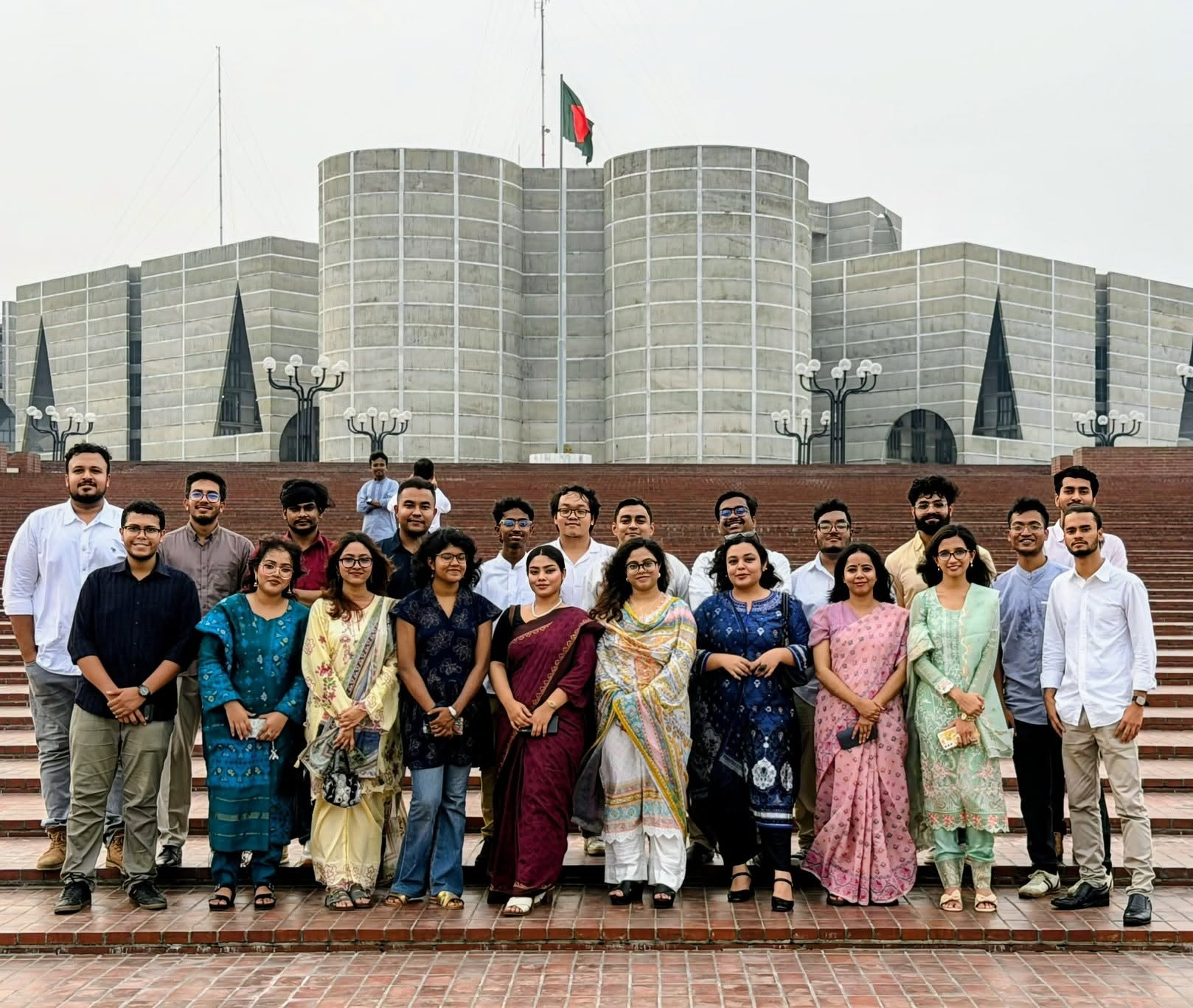
The National Parliament of Bangladesh stands as one of the most significant institutions of the country, representing democratic values and constitutional governance. It is equally recognized as an architectural landmark of international significance. On 24th June, 2026, Team The Bangladesh Dialogue had the opportunity to visit the National Parliament under the supervision of Honorable Whip Mr. Rakibul Islam, MP and at the invitation of Honorable Member of Parliament Advocate Fahima Nasrin.
The journey began from TSC, University of Dhaka, and we reached the Parliament premises at approximately 1:00 PM. Following the completion of necessary security procedures, officials from the Parliament Secretariat received us and facilitated a guided tour of the National Parliament complex.
The National Parliament Building, designed by renowned architect Louis I. Kahn, is regarded as one of the finest examples of modern monumental architecture. Construction of the complex began in 1961 and was completed in 1982 following the independence of Bangladesh. The structure was designed not only to function as a legislative center but also to reflect national identity and democratic principles. One of the most notable features of Kahn’s design philosophy was the effective use of natural elements. During the visit, it became evident how carefully light and ventilation had been integrated into the architectural plan. The use of geometric forms, open spaces, and surrounding water bodies contributes to both the functionality and aesthetic quality of the structure.
The tour began with a brief introduction to the history of the Parliament complex and its architectural significance. Learning about the conception and development of the building provided valuable context for the remainder of the visit.
Following this session, the team visited the Parliament Library, one of the largest public libraries in Bangladesh. The library houses more than one hundred thousand books covering a wide range of disciplines including law, history, economics, politics, and literature. The collection reflects the importance of research and informed decision making within parliamentary activities.
One of the most historically significant aspects of the library visit was the opportunity to see the xerox copy of the first handwritten Constitution of Bangladesh. The Constitution was artistically designed by Shilpacharya Zainul Abedin and handwritten by Abdur Rouf. Observing this important national document provided a direct connection with the constitutional foundation of the country and its historical development.
After completing the visit to the library, team proceeded to the North Block of the Parliament complex, where an official photo session was arranged. Following this, we went to the Parliament cafeteria for lunch.
The most anticipated segment of the visit was the opportunity to observe the ongoing budget session of the Parliament. After lunch, we were escorted to the Visitors’ Gallery of the National Parliament House to witness the proceedings directly. Observing the parliamentary session from close proximity offered a practical understanding of legislative processes and parliamentary discussions.
During the session, Members of Parliament presented their observations and recommendations concerning the proposed budget for FY 2026-27. Discussions focused on national development priorities and matters relating to public welfare and economic planning. Witnessing these deliberations provided valuable insight into the functioning of parliamentary decision making and policy discussions.
Following the session, we visited the office of the Honorable Whip of Parliament, where we had the opportunity to meet Honorable Whip Mr. Rakibul Islam MP, Advocate Fahima Nasrin MP, Mahmuda Habiba MP and Mansura Alam MP. The interaction offered an opportunity to engage with public representatives and gain a broader understanding of their responsibilities within the parliamentary system.
Thus, TBD team concluded their visit to the National Parliament of Bangladesh. The experience provided an opportunity to observe an important national institution and gain practical understanding of its history, functions, and significance. Beyond the architectural excellence of the structure, the visit highlighted the role of Parliament as a central institution representing the aspirations and collective interests of the people.
A nine storied complex holding the ultimate will of the people within its heart. A place where voices transform into laws, ideas become policies, and dreams seek reality.
As we walked out of its gates, the sun was quietly descending over the waters surrounding the Parliament House. Yet it felt as if we carried a different light within us.
Some buildings are built with bricks and concrete,
Some are built with dreams and sacrifice.
And some silently stand carrying the heartbeat of an entire nation.
The National Parliament is one of them.
About Author:
S.M. Ridwan Kabir Beacon
Executive, TBD