
“We carved no coal, nor fueled the roaring mills,
Yet tides now claim our valleys and our hills.
The distant smoke that built your towers high,
Became the storm that stole our quiet sky”
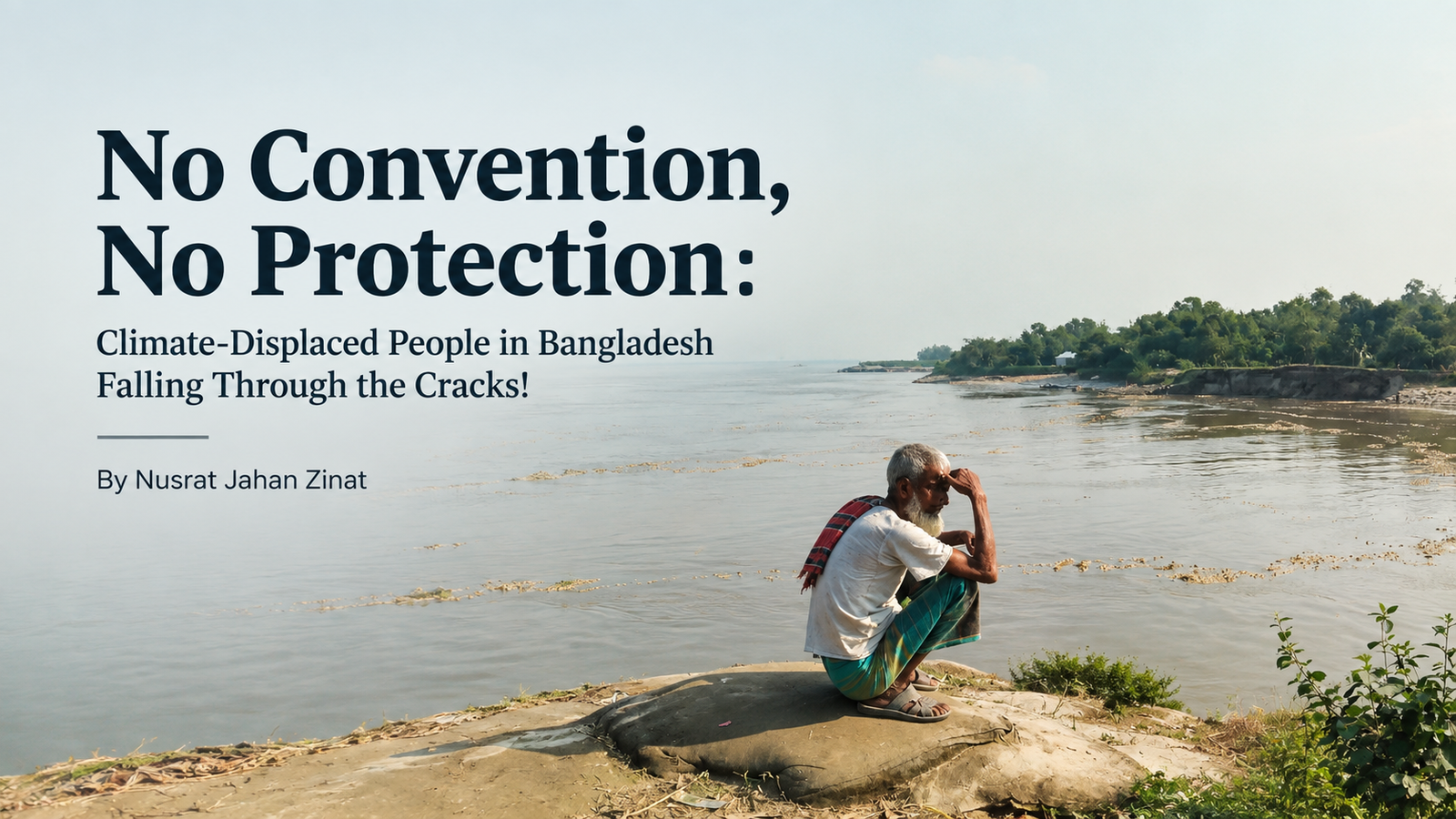
When Cyclone Remal tore through Bangladesh’s coast in 2024,thousands of families in Patuakhali, Barguna, and Bhola lost their homes overnight. Many will never return , not because they chose to leave, but because the land itself is disappearing under rising water and advancing salinity.
In Bangladesh , discussions about climate change often focus on migration .Rising sea levels, cyclones,riverbank erosion and increasing salinity are expected to make many areas increasingly difficult to live in and forcing households to relocate their livelihood . Bangladesh has long experienced climate-induced displacement, with the World Bank estimating that climate impacts could internally displace up to 13.3 million people in the country by 2050 . The 1951 Refugee Convention , still the cornerstone of global displacement protection, was written for people fleeing persecution ; not people fleeing the sea. For a country that produces almost no global emissions but absorbs a disproportionate share of their consequences, this legal silence is not a technicality. The World Foundation for Environment and Development and The Norwegian Council could not overcome it while working on the definition for the environmental displaced people.When the number of environmentally induced internally displaced people is nearly 10 million every year and often they suffered the most among the internally forced migrants .
Environmental displacement occurs when sudden or slow climate hazards, like severe flooding and rising sea levels, permanently strip families of their land and agricultural livelihoods. This triggers an immediate humanitarian chain reaction: displaced families lose their income, experience severe malnutrition, move into heavily congested urban slums, and face a total breakdown of their community safety nets.
Bangladesh is a home to the Sundarbans , the world’s largest contiguous mangrove forest and a UNESCO World Heritage Site. Yet, Bangladesh’s geographical location also leaves it highly exposed to the impacts of climate change, including rising sea levels, increasingly intense cyclones, frequent flooding, and other climate-related hazards. The story of the climate crisis in Bangladesh is the story of wealthy nations polluting while developing countries pay the cost.The International Organization for Migration (IOM), together with the Government of Bangladesh and development partners today launched its first comprehensive nationwide estimate of internally displaced persons (IDPs) caused by natural hazards and it estimates that 4,955,527 people are currently internally displaced due to natural disasters between September and October 2025.
For Bangladesh, there stands a dilemma: what legal initiative it takes to keep these internally displaced people safe while Bangladesh serves a large number of Rohingya .
Well,It would be easy to assume this is simply a gap no one has tried to fill. That isn’t quite true. In 2021, Bangladesh introduced the National Strategy on Internal Displacement Management to help people who are forced to leave their homes because of disasters and climate change. It aims to prevent displacement, protect displaced people, and help them return home, settle where they are, or move to a new place. However, the strategy is only a policy, not a law. This means it does not give displaced people strong legal rights or guarantees . Bangladesh may not need to create an entirely new system to protect people displaced by climate change. Article 15 and Article 32 of the Constitution already provide a foundation for protecting people’s basic needs, well-being, and right to life. What is needed is to turn these constitutional principles into specific laws and policies for climate-displaced people.What is needed is to turn these principles into specific laws and policies for climate-displaced people. One proposed solution is a National Climate Migration Policy, connected with the Bangladesh Delta Plan 2100 and the National Adaptation Plan. Such a policy could provide clear guidance on planned relocation, access to land, and helping displaced people settle and integrate into new communities .
These all are the policies that are proposed but like the refugee convention there is no binding legal document for the displaced people , in this situation the national action plan would be the only solution to protect these vulnerable people . There is currently no legally binding, enforceable law specifically dedicated to climate or environmental displacement in either Bangladesh or the wider South Asian region.
Displaced people in this region exist in a severe legal blind spot. The situation reflects several critical gaps across domestic and international legal frameworks. Bangladesh’s climate displacement challenges fit within the Paris Agreement, particularly Article 8 on Loss and Damage and Article 7 on Adaptation. However, international funding for Loss and Damage remains limited, leaving Bangladesh heavily dependent on domestic resources. Its National Adaptation Plan is aligned with the Bangladesh Delta Plan 2100, but there is still no dedicated international funding for planned relocation . So for the upcoming COP 31, it is calling for fair, grant-based climate financing rather than debt – inducing structures, pushing the developed world to treat climate action as an essential investment in global stability, not a charitable cost .
For the ongoing national concern , On April 15, 2026, Environment, Forest and Climate Change Minister Abdul Awal Mintoo told Parliament that Bangladesh has taken several measures to address climate change and strengthen climate resilience including National Adaptation Plan (NAP), Nationally Determined Contributions (NDCs), and Locally Led Adaptation Framework (LLAF) as key initiatives.
Bangladesh’s situation highlights its vulnerability to environmental problems, its densely populated areas, and inadequate laws. A prime example of how current legal remedies are ineffective in addressing climate displacement can be found elsewhere.In areas such as Satkhira, increasing salinity gradually damages agricultural land and reduces livelihoods, causing economic displacement even before people are forced to leave their homes. In Bhola, riverbank erosion can suddenly destroy homes and push families to relocate repeatedly. With each move, they may face greater social and legal insecurity. Existing laws do not fully address these complex forms of displacement. Although the Disaster Management Act, 2012 provides an important framework for disaster preparedness and resilience, it does not specifically address the permanent or long-term relocation of affected communities . Civil society organizations such as the Refugee and Migratory Movements Research Unit (RMMRU) have documented climate displacement and called for stronger legal recognition, better access to services, and protection from repeated relocation. However, many of these recommendations have not yet been incorporated into formal law.
Displacement also has serious social consequences, particularly for women and children, who may face greater risks of violence and hardship. Losing identity documents can further limit access to education, healthcare, and other public services. As a result, many displaced people become both socially and administratively invisible.
Bangladesh therefore needs a stronger legal framework that recognizes climate displacement and provides displaced people with clear rights, protection, and access to justice.
Lastly, Climate-induced displacement is no longer a distant concern for Bangladesh; it is an unfolding legal and human crisis. As sea-level rise, salinity, and riverbank erosion continue to uproot communities, those affected remain largely unrecognized within existing national and international legal frameworks. This is not simply a gap in protection, but a structural limitation of a system built around traditional ideas of displacement and refuge. The challenge for Bangladesh is therefore not only to protect those who move, but also to recognize the rights of those who are forced to leave their homes yet remain without a clear legal status. Until this gap is addressed, climate-displaced people risk remaining unrecognized, unprotected, and unheard.
About Author:
Nusrat Jahan Zinat
Student,
Department of Peace and Conflict Studies, University of Dhaka