
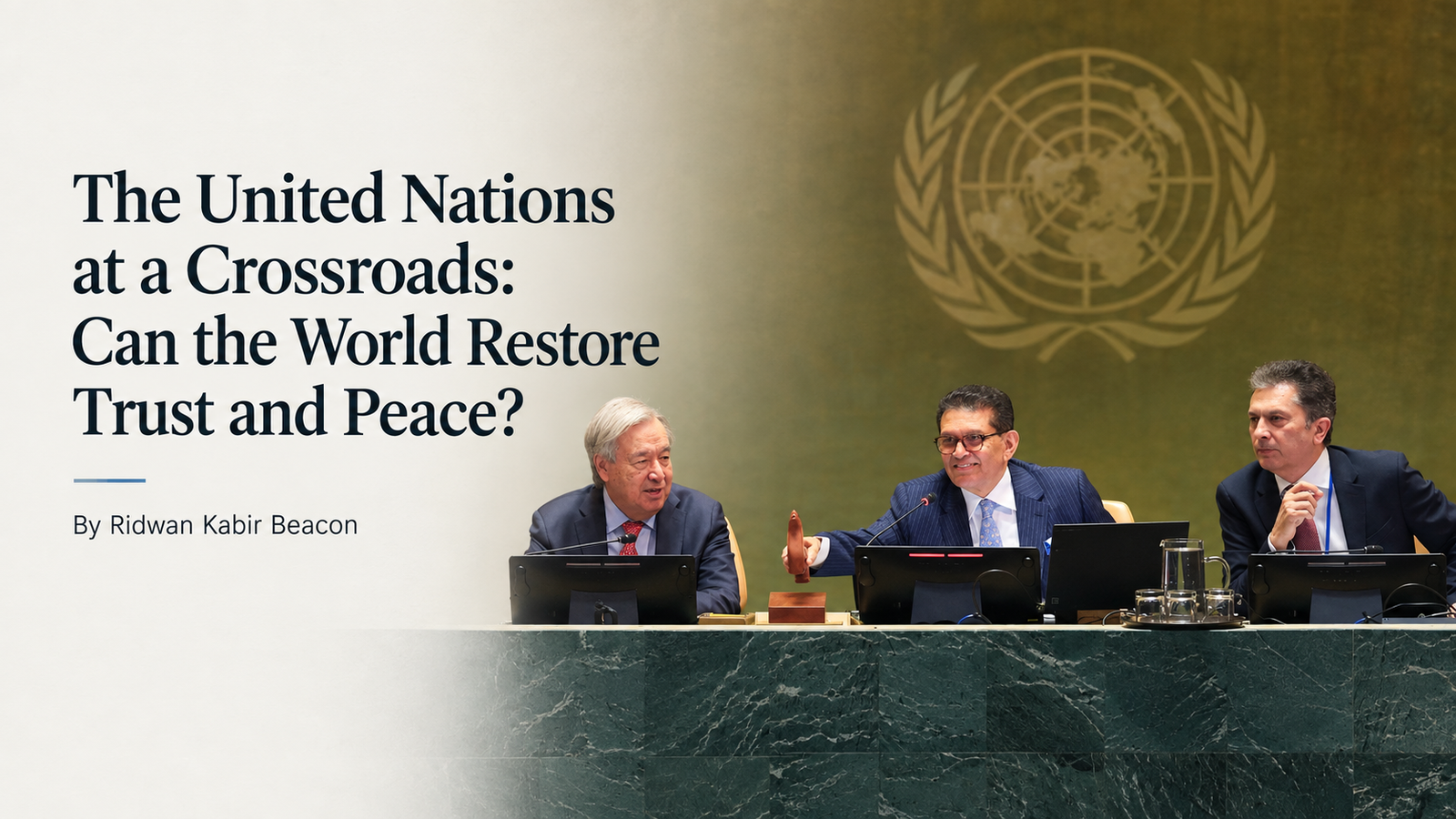
The 81st session of the United Nations General Assembly is taking place at a time when the international system appears more divided than it has been in decades. The official theme of this year’s General Assembly is “Restoring Trust, Managing Transformation: A United Nations That Delivers for All”. Bangladesh’s Foreign Minister Dr. Khalilur Rahman is presiding over the session as the President of the General Assembly.
How do we restore trust in an international system when so many people around the world are watching wars continue, humanitarian crises deepen, and international institutions struggle to respond?
This year’s General Assembly is not simply another annual gathering of world leaders. It comes at a moment when the multilateral system itself is being tested. In an interview ahead of the General Assembly, UN Secretary-General António Guterres described the global situation in stark terms, pointing to deepening geopolitical divisions and a Security Council increasingly struggling to reach consensus. These divisions are making it more difficult to address conflicts, advance climate action, and provide people with basic needs.
A Convergence of Global Crises
The world is not facing one crisis. It is facing several overlapping crises at the same time.
Wars are affecting food and energy prices, climate change is making disasters more frequent, and millions of people are being forced from their homes. The UNHCR reported that 117.8 million people worldwide were forcibly displaced at the end of 2025 because of persecution, conflict, violence, and human rights violations. Behind every statistic is a family that left home, a child out of school, and a parent who does not know when they will return.
In Gaza, more than 73,700 Palestinians have been killed in Israel’s military campaign since October 2023, according to Gaza health authorities, while the humanitarian situation remains dire. The human cost has raised difficult questions about the ability of the international system to protect civilians and enforce international humanitarian law.
Guterres has repeatedly stressed that the answer cannot simply be more force, stating: “The force of law must always prevail over the law of force.” If international law applies only when it is convenient, trust in the system naturally disappears.
The same concern extends to conflicts in the Middle East, including tensions involving Iran. The consequences of war travel through markets, supply chains, and economies, eventually reaching ordinary people far away from the battlefield. A farmer feels it through fertilizer prices, a family through food costs, and a nation through rising energy bills.
A UN System Under Pressure
If the consequences are so widespread, why is it so difficult for the world to prevent them?
The United Nations Security Council was created to maintain international peace and security, but when major powers remain divided, collective action stalls. The credibility of the United Nations is being tested across every pillar of its mandate.
UN human rights officials have warned that more than 60 active conflicts are now taking place worldwide, a level unprecedented since the end of the Second World War. Global conflicts and supply disruptions continue to drive up basic living costs, pushing vulnerable populations deeper into poverty and hunger.
Ten years after the Paris Agreement, the climate crisis has entered a dangerous phase. Developing countries face rising sea levels, extreme heat, and flooding without adequate adaptation financing.
Artificial intelligence and emerging technologies are developing faster than international law can adapt, creating new challenges for global governance.
Amina Mohammed, the UN Deputy Secretary-General, was asked what the UN can say to a mother in Gaza waiting for aid, or to a family in Sudan that feels abandoned. Her response was that their voices remain on the international agenda. Hope is necessary, but people affected by war and crisis need more than discussion in New York. They need food, shelter, security, and a realistic path toward peace.
The UN may not have solved every conflict or prevented every war, but the world still needs a place where countries can sit at the same table. Without it, the alternative is a world where power becomes the main language of international relations.
Priorities for Restoring Trust
If the United Nations is to fulfill its mandate, three immediate priorities must guide its work:
- Peace and Diplomacy: Dialogue must take precedence over confrontation. A ceasefire may stop immediate violence, but lasting peace requires addressing the underlying political and social conditions.
- Humanitarian Protection: A child should not have to understand geopolitics to deserve food, shelter, and medical care. Humanitarian assistance must reach people regardless of location or political alignment.
- Climate Action and Adaptation: For developing nations facing disproportionate climate risks, discussions must move beyond emissions reductions to include tangible financing for climate adaptation.
The Next Secretary-General: A Pivotal Test for Multilateralism
As the UN navigates these systemic strains, eyes are turning toward the upcoming election of the next UN Secretary-General. The incoming leader will step into office at a defining moment in modern history, bearing the direct responsibility of restoring faith in an institution that many feel has lost its leverage.
Rebuilding this confidence will depend heavily on whether the next Secretary-General can drive meaningful institutional reforms, bridge the widening divide between major powers, and ensure that international law is enforced impartially. The next leader must prove that the UN can adapt to reflect today’s geopolitical realities rather than those of 1945.
Earned Trust in a Divided World
The 81st General Assembly has arrived at a critical junction. Its theme is “Restoring Trust,” but trust cannot simply be requested; it must be earned.
The people of Gaza, Sudan, Ukraine, and other conflict-affected regions do not need another promise that the world is watching. Developing countries facing climate disasters do not need sympathy alone; they need resources, technology, and support.
The United Nations may be imperfect and slow, but the answer to the weaknesses of multilateralism cannot be its abandonment. The world still needs a common table, diplomacy, and international law. The fundamental challenge before the international community is not whether the United Nations can build a perfect world, but whether, amid war, climate change, and economic disruption, nations are still willing to work together to keep the peace.
About Author:
Ridwan Kabir Beacon
Law Student, University of Dhaka.