
Every four years, the world pauses.
For a month, borders appear to blur. Political disputes recede from the headlines, replaced by line-ups, goals and dreams. Billions of people become captivated by a single spectacle. Yet beneath the colours, chants and celebrations lies a reality that governments understand well: the World Cup is never just football.
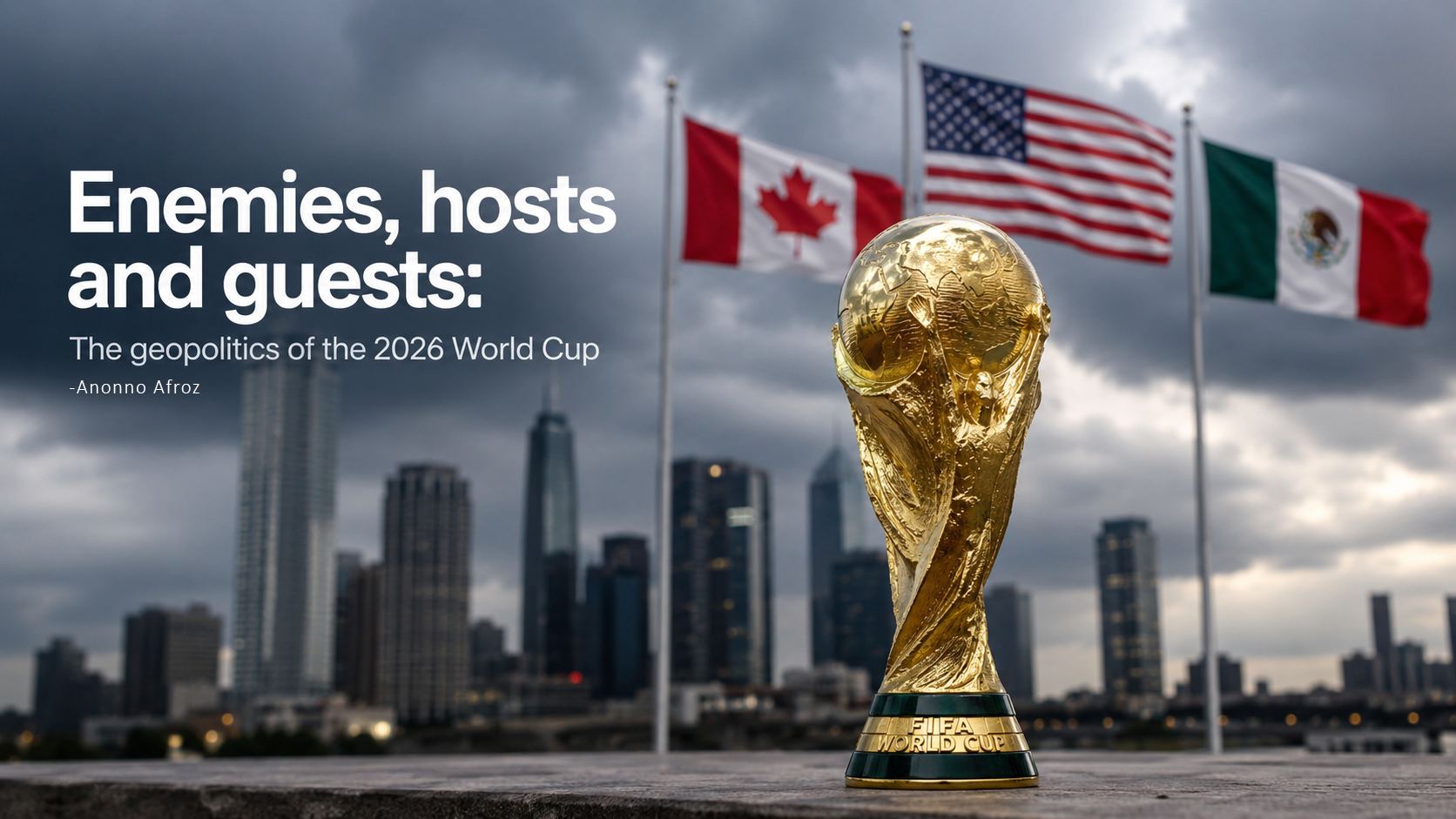
As the US prepares to co-host the 2026 FIFA World Cup alongside Canada and Mexico, the tournament arrives at a moment of heightened geopolitical tension. Among the participating nations are Iran and Iraq, two teams whose presence in the US carries historical and political weight far beyond the pitch.
The main question is unavoidable: what happens when footballers from countries that have fought, been sanctioned by, or confronted American power arrive on American soil for the world’s biggest sporting event?
Iran’s participation sits at the most sensitive edge of this question. The US and Iran are currently engaged in an active military confrontation, marked by escalating strikes, retaliations and deepening strategic hostility across the Middle East.
Despite this, Iranian players have been granted visas to enter the US and compete in the tournament. For one month, athletes from a country in direct conflict with the host nation will become guests on its soil, watched by billions around the world.
That paradox captures the essence of modern sport diplomacy.
The World Cup is never just football.
For Iraq, the symbolism is different but equally charged. More than two decades after the 2003 US-led invasion that toppled Saddam Hussein’s regime, Iraq continues to grapple with the political fragmentation, violence and institutional instability that followed. While the country has rebuilt parts of its state structure and football identity, many Iraqis still view the war as a turning point from which full recovery has been elusive.
Now Iraqi footballers arrive in the US not as soldiers, diplomats or displaced citizens, but as athletes representing a nation still shaped by that conflict. On the other side stands the country that led the invasion. Between them lies ninety minutes of football, disconnected, at least in theory, from history.
But history rarely stays outside the stadium.
The US remains the dominant military, cultural and financial power in the international system. But precisely because of that position, the tournament becomes politically significant. It is not about introduction; it is about narrative control.
Mega-events have long been used as instruments of what political scientist Joseph Nye called “soft power”, the ability to influence through attraction rather than coercion. The World Cup, watched by billions, is one of the most powerful platforms for that purpose.
Russia demonstrated this in 2018 when, despite Western sanctions and diplomatic isolation, it used the tournament to project stability, modernity and global relevance. Qatar followed in 2022 with unprecedented infrastructure spending, using football as part of a long-term strategy to reposition itself as a global hub of diplomacy and commerce. In both cases, the event did not erase political tensions, but it reshaped global attention.
That is the defining logic of mega-events: they amplify everything.
They amplify success, and they expose contradiction.
For the US, the 2026 World Cup arrives amid rising geopolitical competition and domestic polarisation. It also coincides with broader debates over immigration, identity and America’s global role. Against this backdrop, the presence of Iran and Iraq gives the tournament an additional layer of political meaning that cannot be ignored.
Security arrangements and FIFA protocols ensure that all participating teams are protected regardless of political relations between their governments. There is no indication that Iranian or Iraqi players face targeted risk in the US. The more relevant question is not safety but symbolism.
Can football remain separate from politics when adversaries share the same stadiums?
History suggests it cannot.
Iranian players have often found themselves at the intersection of sport and politics. A gesture, an armband, a celebration or even silence can become an international statement. In the context of an active US–Iran conflict, any symbolic act during the World Cup would likely be amplified far beyond sport.
Iraqi players, too, carry symbolic weight. Their presence in the US evokes memories of war and intervention, even when unspoken. Football becomes the only arena where such histories meet without negotiation tables or diplomatic communiqués.
Could the World Cup become a stage for diplomacy? It already has been in other contexts. Mega-events frequently create informal spaces where rival states and societies coexist in ways that formal diplomacy cannot always achieve. The tournament brings together governments, corporations, media and publics in a compressed global moment of attention.
Could it become a stage for protest? That possibility exists as well. FIFA discourages political demonstrations on the field, yet football has repeatedly shown that it is difficult to separate identity from expression. Any political gesture, intentional or not, would instantly become part of a global narrative.
This is why the World Cup is never just football.
It is a mirror of global order as much as it is a sporting competition.
The same spotlight that celebrates athletic achievement also exposes political fault lines. Immigration debates, domestic tensions and foreign policy disputes may sit alongside match results in the global conversation.
Ultimately, the significance of the 2026 World Cup lies in its concentration of attention. For a brief period, the world focuses on a single host region. In that moment, visibility becomes power.
Modern geopolitics is no longer defined only by military strength or economic output. It is also defined by narrative influence, the ability to shape how a country is seen, understood and interpreted globally. Mega-events are one of the few remaining spaces where that narrative is negotiated in real time.
This is why governments continue to invest in them, despite uncertain financial returns. They are not simply buying tournaments. They are buying global attention.
For Iran and Iraq, the 2026 World Cup is not just participation in sport. It is an entry into a global stage shaped by history, conflict and memory.
For the US, it is not just hosting. It is managing a geopolitical moment disguised as a celebration.
The World Cup may begin with a whistle and end with a trophy.
But what happens in between will be shaped not only by football, but by the weight of the past.
In the twenty-first century, the World Cup is never just a game. It is a geopolitical event disguised as sport.
About Author:
Anonno Afroz
Anonno Afroz is a Dhaka-based journalist, analyst, and writer at The Business Standard, specializing in politics, international relations, and conflict. Passionate about telling human-centered stories through first-hand reporting and analysis.