
Dhaka, Bangladesh – June 06, 2026
The Bangladesh Dialogue Hosts Fifth Town Hall on “National Budget 2026–27: Expectations, Priorities and Way Forward”
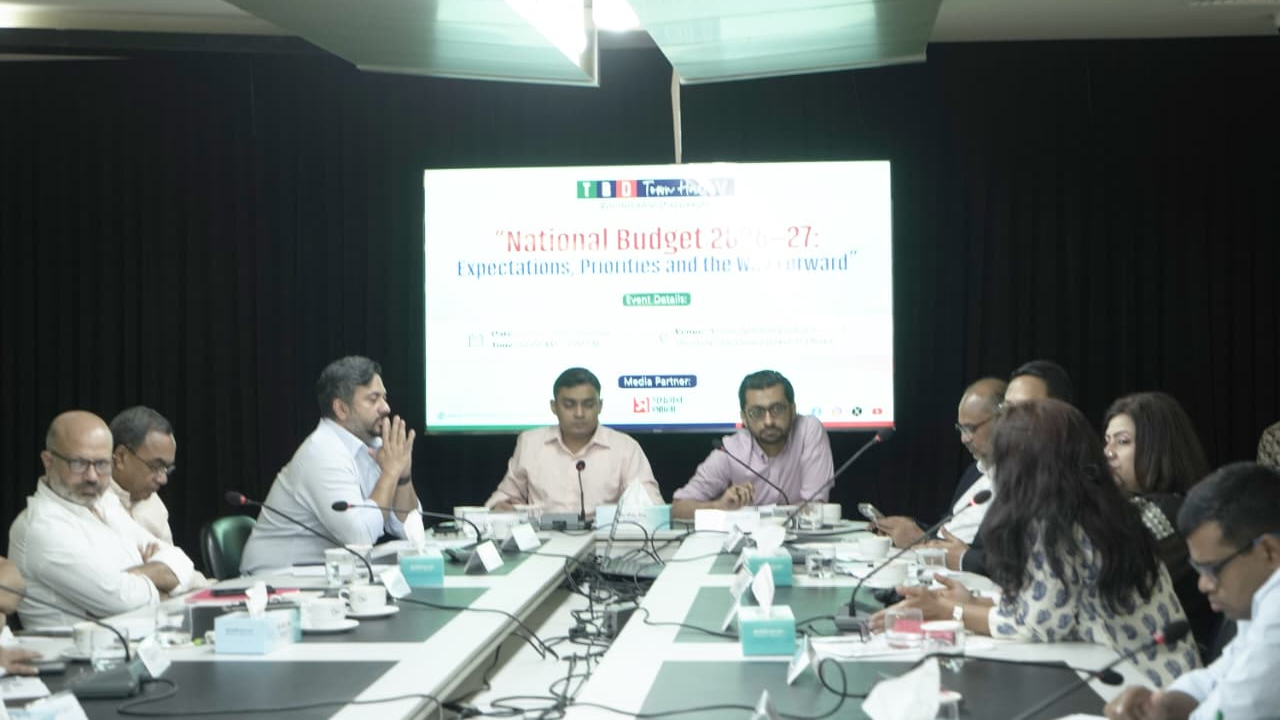
The fifth edition of The Bangladesh Dialogue (TBD) Town Hall, titled “National Budget 2026–27: Expectations, Priorities and Way Forward,” was held today at the Azimur Rahman Conference Hall of The Daily Star Centre in Dhaka.
Organized by The Bangladesh Dialogue, the roundtable brought together policymakers, political leaders, economists, bankers, business leaders, development practitioners, and other key stakeholders to discuss expectations, priorities, and policy recommendations for the upcoming national budget.
Among the distinguished participants were Mr. Rashed Al Mahmud Titumir, Adviser on Economic and Planning Affairs to the Honorable Prime Minister; Mr. Israfil Khosru, Member of the International Affairs Committee of the Bangladesh Nationalist Party (BNP); Mr. Rubayat Mannan Rafi, Chairman of The Bangladesh Dialogue; Mr. Syed Mahbubur Rahman, Managing Director and CEO of Mutual Trust Bank; Mr. Kamal Quadir, CEO of bKash; Mr. Ahmed Zafrul Hasan, Chief Digital Officer of Commercial Bank of Ceylon; Dr. Shafiqur Rahman, Executive Director of BRAIN; Mr. Zia Hasan, Economist; Shanaullah Shakib , Senior Reporter Prothom Alo, Mr. S.M. Saif Kader Rubab, Director of The Bangladesh Dialogue; Ms. Sayma Shawkat, Director of Gears Group and BACCO; Ms. Shirin Sultana Lira, Senior Programme Manager Embassy of Switzerland in Bangladesh ; Abdullah Al Faisla , Joint Chief Coordinator Mr. Tahmid Hasan, PhD Researcher; and Ms. Sabiha Zakir and Ms. Gula Jannat Disha, Directors of The Bangladesh Dialogue.
The discussion focused on the key economic challenges facing Bangladesh, budgetary priorities, private sector development, financial sector reforms, digital transformation, investment climate, and policy measures necessary to ensure sustainable and inclusive economic growth.
Rashed Al Mahmud Titumir, Adviser to the Prime Minister on Economic and Planning Affairs, said in his remarks that the upcoming budget will focus on expanding the number of taxpayers and broadening the tax net rather than increasing tax rates. To reduce dependence on Statutory Regulatory Orders (SROs) and eliminate harassment in the corporate sector, a risk-based audit system is being introduced, and the entire revenue administration is being digitized. These reform initiatives are being undertaken to achieve Prime Minister Tarique Rahman’s vision of transforming Bangladesh into a US$1 trillion “Democratic Human Welfare State” by 2034.
The Adviser assured investors that the upcoming budget would reflect the five key priorities sought by investors. First, policy continuity will be ensured by keeping the tax structure unchanged for at least five years to facilitate business planning. Second, reliable access to energy, including electricity and gas, will be guaranteed for industries. Third, banking sector reforms will ensure proper access to financing. In addition, the government will create a level playing field and strengthen market competitiveness for all businesses.
Discussing reforms in the industrial and energy sectors, he stated that Bangladesh is bringing back a comprehensive industrial policy after years of stagnation. Rather than focusing solely on importing solar panels or electricity, the government is emphasizing self-reliant industrialization, including the domestic production of electric buses and railway locomotives. To reduce the high costs associated with energy imports caused by oligarchic market structures, facilities for accommodating larger vessels and establishing strategic reserves are being developed. As a result, the prices of LNG and LPG are expected to decline automatically, benefiting ordinary citizens.
He further noted that opportunities are being created for local entrepreneurs to invest in idle factories under BGMC, BTMC, the Steel Corporation, and the Chemical Corporation in order to capitalize on the surplus production of crops, fruits, and dairy products in northern Bangladesh. Alongside pharmaceuticals, leather, electronics, toys, and ICT, the government is also prioritizing the creative economy.
To achieve its economic targets, the government has adopted a three-phase master plan comprising Recovery, Restoration, and Reconstruction. Innovative financial instruments, including sector-specific bonds such as those linked to aviation, are being introduced to deepen the capital market. Major development initiatives, including the Teesta Master Plan and the Padma Barrage Project, are also under consideration.
Israfil Khosru, Member of the International Affairs Committee of the Bangladesh Nationalist Party (BNP), stated that the economic system driven by group interests over the past seventeen years has undermined the country’s institutional integrity and structures. According to him, the current government has inherited a fragile economy. He emphasized that starting a business in Bangladesh remains excessively complicated, with a young entrepreneur needing to obtain as many as nineteen licenses to launch a business. The upcoming budget, he argued, should provide clear directives to eliminate these complexities.
Khosru further stated that bringing the informal sector into the formal economy is essential to achieving the target of creating ten million jobs within the next eighteen months. He also stressed the need for formal recognition of individuals working in the creative economy, including freelancers, content creators, and artists.
Syed Mahbubur Rahman, Managing Director and CEO of Mutual Trust Bank, remarked that governance in the banking sector began to deteriorate following the takeover of Islami Bank in 2017. He observed that among the country’s 57 banks, no more than 15–20 could currently be considered genuinely sound institutions. According to him, the banking sector’s overall capital position has fallen into negative territory. He also expressed concern that Bangladesh Bank is becoming increasingly centered on commercial banking activities.
Rahman further noted that the government is borrowing heavily from the banking sector to manage fiscal pressures. This has led to a crowding-out effect, limiting credit flows to the private sector. At the same time, declining public confidence in banks has resulted in more than BDT 3 trillion moving outside the formal banking system, further exacerbating liquidity challenges.
Kamal Quadir, Chief Executive Officer of the mobile financial services provider bKash, emphasized the need for long-term and targeted measures to broaden the tax base. He noted that although expanding the tax net is a recurring theme in every budget, the burden often falls on those who already pay taxes regularly. Given that a democratically elected government is now in place, he argued that a four-to-five-year strategic plan should be adopted.
He also highlighted the importance of greater government support for innovation. According to him, before bKash entered the market, no one had developed a similar service, and the company subsequently created an entirely new channel for tax collection and economic activity. He added that digital entrepreneurs do not seek government support in the form of physical assets; rather, they require clear, credible, and predictable policy frameworks.
Quadir further noted that until 2024, under National Board of Revenue (NBR) regulations, bKash was eligible for a 2.5 percent tax rebate provided its annual cash expenditure remained within BDT 3.6 million. However, this incentive was later withdrawn for reasons that remain unclear.
Rubayat Mannan Rafi, Chairman of The Bangladesh Dialogue, stated that the national budget should primarily focus on three key priorities: economic stability, employment generation, and social safety nets. He acknowledged that the government has made significant progress in maintaining economic stability. However, he emphasized that Bangladesh’s tax-to-GDP ratio remains low and should be increased through the expansion of the tax base and improved tax collection mechanisms.
The roundtable discussion, organized by The Bangladesh Dialogue, was chaired by Rubayat Mannan Rafi and moderated by SM Saif Kader Rubab, Director of The Bangladesh Dialogue