
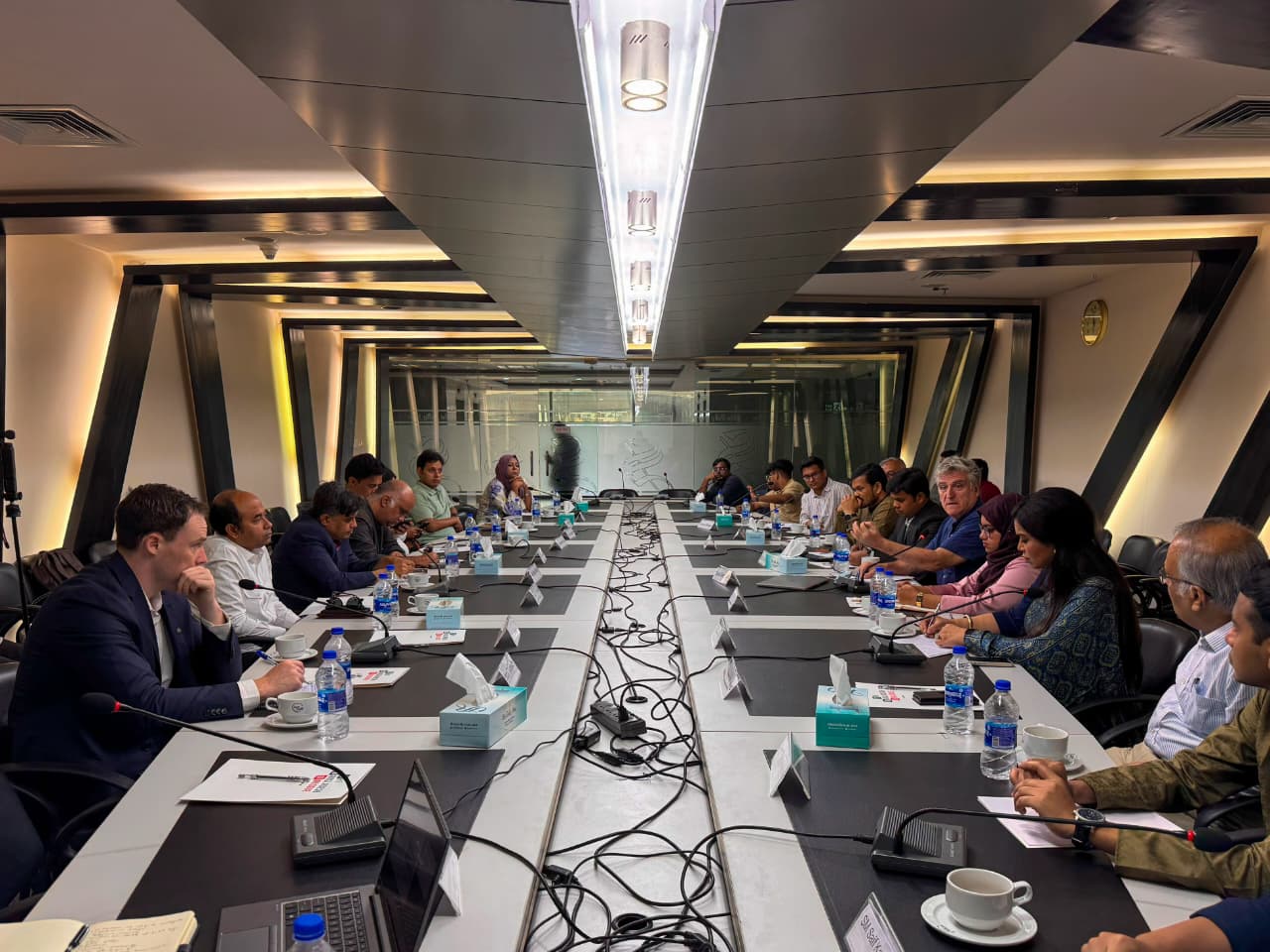
“For Sustained Peace and Democracy: Future of Reform in Bangladesh”
In collaboration with the Asia Pacific Centre for the Responsibility to Protect (APCR2P), University of Queensland, Australia
Dhaka, Bangladesh | 28 July 2026
Introduction
The Bangladesh Dialogue (TBD) convened Town Hall VI on 28 July 2026 under the theme “For Sustained Peace and Democracy: Future of Reform in Bangladesh,” organized in collaboration with the Asia Pacific Centre for the Responsibility to Protect (APCR2P) at the University of Queensland, Australia, with research support from the Australian Department of Foreign Affairs and Trade (DFAT). The round table brought together journalists, legal experts, academics, a retired military officer, diaspora representatives, human rights activist, and diplomatic officials to discuss the future of institutional reform, security-sector accountability, and democratic governance in Bangladesh. The session was moderated by Dr. Mubashar Hasan, Adjunct Research Fellow at the Humanitarian and Development Research Initiative (HADRI), Western Sydney University, and Kazi Rakib Hossain, Chief Operations Officer of The Bangladesh Dialogue, and closed with remarks from Barrister SM Saif Kader Rubab, Executive Director of The Bangladesh Dialogue. The following is a record of the speeches delivered, presented in the order in which they were given.
Aaqib Md. Shatil
— Special Correspondent, Netra News (Concept Presenter of the Roundtable)
Aaqib Md. Shatil opened the discussion by presenting a policy report he co-authored on the risk of atrocity crimes in Bangladesh following the fall of the Sheikh Hasina regime. He identified public security forces, including both law enforcement and intelligence agencies, as the most pressing risk factor for state-sponsored violence, noting that these risks are worsened by media incitement, the presence of Islamist networks, a polarized political climate, and the displacement pressure of Rohingya refugees. He recommended the immediate withdrawal of military-grade weapons, such as 7.62mm rifles, from regular policing, arguing that the use of advanced rifles for crowd control is “complete nonsense” and must be replaced with standard policing equipment. He also called for mandatory human rights training to be integrated into daily policing activities, transparent reporting mechanisms that allow citizens to report violations and know what happens after a report is filed, and, most significantly, televised public hearings in which the Inspector General of Police would be required to testify before a parliamentary committee on the steps being taken to prevent future atrocities.
Redwan Ahmed
— Journalist, Forbes 30 Under 30 Asia; Visiting Scholar, University of Southern California
Redwan Ahmed, a freelance journalist based in Dhaka, focused his remarks on youth representation, technological policing, and the regulation of social media by law enforcement. He argued that the roundtable itself did not adequately represent Bangladesh’s youth, noting that the average age of participants was higher than the demographic he represents, and called for a more inclusive decision-making process involving a wider range of voices. To address the power imbalance between citizens and the state, he recommended the mandatory use of body cameras for police officers, sharing a personal experience of feeling “completely helpless” during a police checkpoint interaction. He noted that the “mushrooming” of social media news outlets has made police sceptical of press credentials, as they are easily forged, and pointed to serious allegations of misconduct such as the planting of narcotics on individuals during searches. He also called for a formal government policy on social media use by law enforcement, criticizing the practice of traffic police publicly exposing minors and other individuals online, and argued that agencies should be barred from publishing private conversations or sensitive information without a court order.
Nazmul Ahsan
— Executive Editor, Netra News
Nazmul Ahsan focused on the structural culpability of the police force and the overreach of military and intelligence agencies into civilian governance. He argued that while the Rapid Action Battalion (RAB) is frequently singled out for extra-judicial killings often described through euphemisms like “gunfights” or “crossfire,” research and reporting indicate that police were actually responsible for the highest number of killings during the uprising, and suggested a serious investigation has been lacking because it could implicate multiple political parties, including the Awami League, BNP, and Jamaat. He described a “massive incentive structure” encouraging military interference in democratic processes, pointing to the DGFI as an extension of military power within the democratic framework, the Border Guard Bangladesh (BGB) as “extremely embedded” in domestic law enforcement beyond its border mandate, and the BTRC’s role in blocking critical news sources during the uprising. He concluded with a warning that as long as the military and its personnel remain deeply incentivised to stay integrated into civilian sectors such as export processing, private enterprise, real estate, and universities, Bangladesh will struggle to establish any “meaningful form of democracy.”
Zina Tasreen
— Journalist, The Daily Star
Zina Tasreen’s contribution focused on moving from policy recommendations to the practical implementation of security reforms. She emphasized that while reports and research are necessary, the priority must now be the “implementation thing” — ensuring proposed reforms are actually put into practice by the state. She called for a “step change” in how law enforcement operates in urban environments, specifically advocating for limiting the powers of police and enforcement agencies to prevent overreach, and argued that there needs to be a “form of push” from government and civil society to compel enforcement agencies to begin genuine implementation of accountability measures. She also noted that the state needs to be “more strict” in certain areas, acknowledging that strictness is often avoided in reform dialogues but is frequently a necessity for security reasons, and stressed that such measures are essential to ensuring security personnel actually follow the recommendations and protocols established by reform commissions.
Colonel (Retd.) Md. Sohel Rana
— Former Army Officer
Colonel (Retd.) Md. Sohel Rana shared insights on the role of the armed forces in Bangladesh’s future democracy, focusing on the need for a professional, modernised military shielded from political influence and centred on its core security mandate rather than civilian administration. He noted a perceived waste of resources where the government invests heavily in training specialists, such as pilots, only for them to retire early or be diverted into leading civilian institutions like the BTRC or Civil Aviation, and agreed that civilian institutions should instead be run by their own experts. He proposed a shift from a purely defensive military posture to a “limited offensive deterrence posture,” which he clarified does not require an increased budget but rather a redesign of the existing posture, along with a comprehensive “Vision 2024” national security strategy aligned with modern regional realities. He advocated for a smaller but more effective force that focuses on its own training and scope rather than performing duties for agencies like the NSI or BTRC, and recommended joint operational exercises to integrate military, paramilitary, and law enforcement into unified response mechanisms. On institutional integrity, he stressed the need to safeguard promotions, postings, and command appointments from political interference, and recommended separate internal audit committees to scrutinise the conduct of the forces.
Golam Intekhar Mahmud
— Editor and Publisher, Dhaka Stream
Golam Intekhar Mahmud focused on how social media has become a primary force shaping the reality of peace, democracy, and the future of Bangladesh. He noted that people in Bangladesh spend an average of 2.5 hours daily on social media, rising to six hours among the middle class, and that roughly 43% of Dhaka Stream’s readers and nearly half of all news readers in Bangladesh access content through social platforms. He explained that journalists are forced to follow the “grammar” of social media algorithms, often using emotive and provocative language to ensure content goes viral, and identified social media as the starting point for mob justice and extremist movements, citing historical examples of disinformation-driven violence in Ramu, Nasirnagar, and Comilla. He raised concern over the use of platforms like TikTok and Facebook Live to recruit individuals for foreign conflicts such as the war in Ukraine, some of whom return and are re-recruited into local extremist organisations. He also observed that even civil society has become prone to reacting impulsively to unverified information, and criticised the state’s failure to address disinformation beyond protecting high-profile individuals, warning that without proper state oversight and literacy initiatives, social media will continue to threaten the country’s future.
Dr. Shafi Md. Mostofa
— Assistant Professor, Department of World Religion and Culture, University of Dhaka
Dr. Shafi Md. Mostofa provided an academic and structural analysis of Bangladesh’s political state, arguing that current reform efforts often focus on “symptoms” rather than the underlying “cancer” of the political system. He identified three pillars that allowed the Sheikh Hasina regime to survive for over a decade: a “divide and rule” policy that used the Liberation War to create a polarised, singular national narrative; the “securitisation” of exaggerated extremist threats, used both to build trust with Western powers and to suppress domestic opposition under the guise of counter-terrorism; and the cultivation of “sacred” institutions around a central leader, such that criticism of the leader herself was taboo before the regime’s fall but became universal afterward. He urged civil society to remain vigilant about whether the current interim setup still clings to any of these three pillars, questioning whether merit is genuinely being prioritised in institutional appointments and pointing to Nepal, under Balendra Shah, as a positive example of transparent recruitment. For the long term, he recommended that democratic values be integrated into the national curriculum starting from Class 1, and that the government make education more inclusive to counter a growing trend of parents in rural areas turning to madrasas out of frustration with the mainstream system.
Jyoti Rahman
— Economist
Jyoti Rahman provided a structural and economic analysis of the security state, focusing on the “political economy” of law enforcement and the transformation of individual officers into instruments of state violence. He argued that civil society discussions often overlook the political economy angle, suggesting that the state’s machinery creates an incentive structure in which those in power, whether the BNP, Jamaat, or the current interim setup, are unwilling to surrender the instruments of force once they possess them. He challenged the notion that individuals join the police intending to commit atrocities like “crossfire,” pointing instead to low salaries as a factor that leaves officers susceptible to corruption, and questioned how a young recruit eventually becomes a figure like the notorious “DB Harun.” He drew a distinction between preventing atrocities, which he argued can happen immediately through a government’s “conscious decision” not to engage in extra-judicial killings, and deep institutional reform, which is far more difficult because it requires changing the entire state apparatus. He placed significant responsibility on the Home Minister, observing that practices like “crossfire” originated because maintaining order through legal means was “difficult,” and critiqued civil society for historically failing to create sustainable pressure that would make reform a political necessity.
Sara Hossain
— Senior Advocate, Supreme Court of Bangladesh
Sara Hossain focused on the structural necessity for independent oversight and the professionalisation of justice mechanisms to address state-sponsored atrocities. She argued strongly for the establishment of separate, independent investigative commissions to handle crimes committed by state actors, describing the current system of “police investigating themselves” as insufficient after persisting for fifteen years. She emphasised that investigations must be a professional and technical process, cautioning against treating justice or reform as a political negotiation between parties. She proposed that citizen-led organisations be empowered to oversee the registration and activities of law enforcement and state agencies, expressing concern that too many agencies or individuals currently wield “police power.” Referencing the Rana Plaza tragedy, she illustrated how institutional corruption and the prioritisation of political benefit over professional safety standards can lead to catastrophic consequences. She concluded by identifying the Law Minister and the Home Minister as the critical starting point for reform, arguing that these offices must lead the shift away from a system based on subjective perceptions toward one that is transparent and focused on victims.
David Bergman
— Journalist, Researcher and Columnist
David Bergman provided a comparative analysis of how different security forces conducted themselves during the July uprising, focusing on the breakdown of institutional discipline. He highlighted a stark contrast between the police, who “went shootings” in an undisciplined manner, and the army, which demonstrated significantly more restraint. Citing a closed-door meeting with the Army Chief, he noted that although the army fired roughly a thousand rounds of bullets during the final days of the uprising, it did not cause nearly as many fatalities as the police, attributing this to the military’s strict adherence to Standard Operational Procedures learned during institutional training. He pointed out a major legal breach by police, who under standard regulations are required to fire only in the presence of a magistrate, a rule he observed was not followed anywhere during the July killings. His primary recommendation was the urgent need for the state to instil discipline within its forces, arguing that ensuring security agencies follow proper procedures is essential to preventing future atrocities.
Shafiqul Alam
— Editor-in-Chief, Daily Waadaa; Former Press Secretary to the Interim Government
Shafiqul Alam provided a structural and historical analysis of law enforcement, focusing on the dangers of understaffing and the resulting over-reliance on paramilitary forces. He noted that during major protests in Dhaka, a city of millions, there were only around 66,000 police personnel available, and that police stations in the south-western and south-eastern parts of the country were easily overwhelmed for lack of manpower, contributing to the government’s inability to stop attacks on religious sites and villages. He explained that when the police force is too small to maintain order, the state resorts to deploying the Border Guard Bangladesh (BGB) and the military, a practice he described as “very coercive” and responsible for major atrocities, citing the killings of 28 February and 3 March and the Shapla Chattar protests as examples. He advocated for the removal of the BGB from domestic law enforcement entirely, and recommended doubling the number of police in Bangladesh so the state would not need to call on the military or BGB for internal security. He also called for an end to the politicisation of the police force, for officers to be made personally accountable and tried in lower courts rather than shielded by institutional immunity, and for the government and social media platforms to employ third-party fact-checkers, such as AFP Fact Check, to combat disinformation that incites violence.
Alauddin Mohammad
— Secretary, Diaspora Cell and Co-Lead, International Cell, National Citizen Party
Alauddin Mohammad offered a critical assessment of the current political transition, expressing concern that the collective aspirations for institutional reform following the July uprising are beginning to fade from public consciousness. He observed a worrying trend of the public and the state accepting “old types of practices” despite the push for a complete overhaul of the previous institutional setup, and argued that the collective aspirations of the young generation must remain central to the state’s focus. He emphasised that accountability must first come from politicians themselves, criticising the appointment of “political persons” to positions historically intended for neutral administrators, citing the appointment of a member of the BNP’s Election Operation Committee as an Additional Secretary for the Election Commission as an example that creates a “sense of mistrust.” He also raised alarm over “ghost cases” — filings against non-existent or wrongly identified people — appearing in the legal proceedings against the fallen Awami League regime, calling for a mandatory institutional review of these cases and a more transparent judicial system. He concluded that a “new settlement” is needed to prevent any single party from manipulating the system by placing partisan individuals in neutral positions, warning that failing to establish such neutrality will prevent the country from achieving the systemic change the uprising demanded.
Akbar Hossain
— Former Press Minister, Bangladesh High Commission in London
Akbar Hossain provided a political perspective on democracy, human rights, and the media in Bangladesh following the fall of the Sheikh Hasina regime, arguing that institutional reform is fundamentally a political issue. He identified the peaceful transfer of power through free, fair, and credible elections as the “cornerstone” of a functioning democracy, observing that Bangladesh has failed to hold consecutive credible elections over the last 35 years, with the transfers of power in 1991, 1996, and 2007 often marred by problems or requiring army intervention. He offered a specific legal recommendation to amend the Criminal Procedure Code to stop the practice of recording confessional statements before a magistrate, arguing that such statements are often obtained through intimidation or physical abuse in custody and are no longer necessary given modern forensic and digital investigation methods. He expressed regret over “lost opportunities” following the August uprising, believing that the immediate aftermath of the regime’s fall provided a unique window for drastic decisions regarding the DGFI and other security forces that was not fully utilised. On media, he observed a trend of individuals formerly aligned with the Awami League simply being replaced by those aligned with the BNP rather than the creation of a truly independent media, noting that recommendations from the former media commission head were not taken into account. He also shared his own experience of sustained social media harassment by political opponents, underscoring what he called the “interrelated” nature of media, democracy, and human rights, and concluded that the establishment of a genuine democratic process for the peaceful transfer of power remains the “bottom line” without which other reforms will not be sustainable.
Nabila Idris
— Former Member, Commission of Inquiry on Enforced Disappearances
Nabila Idris, a survivor of enforced disappearance, provided a critical analysis of how state atrocities are structural products of political signalling rather than isolated actions by security forces. She argued that security forces, whether police or military, do not commit atrocity crimes in isolation but follow specific “signals” from government, noting that even as the current interim government detains officials for previous crimes, it is simultaneously introducing legislative changes that signal a continuation of old patterns. She dismissed the renaming of the Rapid Action Battalion (RAB) as a move that fails to solve any core problems, and highlighted concerning new powers granted to security forces, such as the ability to arrest individuals without a warrant, noting that even some police officers have expressed fear to her about the consequences of being handed such powers by the Home Ministry. She critiqued the Human Rights Commission Act and anti-disappearance laws for establishing a system where accused forces investigate themselves, describing it as farcical. She explained that the government effectively offers officers a “limited period of immunity” — not from the crime itself, but from investigation while a given regime remains in power — creating a “gamble” for cadets who follow illegal orders hoping their regime will not fall, after which accountability is often applied arbitrarily. She maintained that security forces cannot solve the problem of state atrocities because they did not create it — politicians did — and argued that if a Law or Home Minister creates legislation that effectively legalises murder or blocks independent oversight, the ruling party must take responsibility. Her key recommendation was for members of the ruling party who understand these systemic failures to be more vocal and active in demanding genuine reform.
Kazi Jesin
— Journalist
Kazi Jesin offered a reflection on the gap between the high aspirations following the student uprising and the current reality of the state, focusing on public disillusionment, the continued reliance on a compromised police force, and the rise of online mobs. She argued that while aspirations for a “new Bangladesh” were exceptionally high after the uprising, the public now feels “wounded” because the initial momentum for reform was not fully utilised, highlighting the contradiction of a state that continues to rely on the same police force that violently suppressed student protesters. Responding to earlier comments about police understaffing, she observed that the police were highly effective when used by the state for “misdeeds,” questioning why the same force was unable to protect shrines or prevent mob justice, and attributed this to a lack of honesty and a pervasive fear within the force rather than simply a lack of manpower. She called for drastic new recruitment initiatives and investigations into those who were in charge during the suppression. On online harassment, she shared that she has received rape threats on social media from accounts she can identify as belonging to political activists, citing the assassination of Indian journalist Gauri Lankesh as a warning of where such threats can lead, and expressed concern that even an independent judiciary or functioning secretariat cannot easily prosecute thousands of anonymous social media accounts. She argued that reform must not become a political weapon used by parties to gain leverage over one another, criticising “selective criticism” of political appointments — noting that the appointment of nineteen Jamaat-e-Islami activists as Deputy and Assistant Attorney Generals went largely unremarked upon until their resignations — and concluded that system change is insufficient without internal change within individuals, since institutional reform alone will not produce a truly democratic society if party leaders do not instruct their activists to be humane and respect differing opinions.
Harry Thompson
— First Secretary, Australian High Commission in Bangladesh
Harry Thompson provided a brief but significant contribution focused on international support for the research presented and the broader goals of Australian engagement in the region. He introduced himself as the First Secretary of the Australian High Commission, representing the diplomatic mission’s interest in the town hall’s themes of reform and accountability, and clarified that the policy report presented by Aaqib Md. Shatil was developed in partnership with the University of Queensland and funded by the Australian Department of Foreign Affairs and Trade (DFAT). He noted that Bangladesh is a “target country” for Australian initiatives aimed at supporting professional and accountable security forces, and reaffirmed Australia’s continuing commitment to supporting the development of security mechanisms in Bangladesh that adhere to professional standards and maintain transparency.
Kamal Ahmed
— Consulting Editor, The Daily Star; Former Head, Media Reform Commission
Kamal Ahmed argued that the core obstacle to reform in Bangladesh is the lack of a functioning democracy and the unchecked power of “political masters.” He asserted that security forces and law enforcement agencies are currently tools of the political leadership, carrying out orders without question, and that it is impossible to make these forces accountable without first making politicians accountable. He pointed to the absence of any ethical code of conduct for Members of Parliament, the transformation of MPs into “executors of local development” who control funds meant for local government, and the way police often ignore standard protocols to follow “signals” from an MP’s office or ministry. He critiqued the history of building “independent” institutions such as the National Human Rights Council and the Anti-Corruption Commission, arguing that despite civil society lobbying, they were ultimately “captured” by whichever political party held power. As a former commission head himself, he offered a blunt assessment of the current reform process, describing the outcome of the Police Commission as the “worst” because its report was “out of line” and essentially allowed the police to investigate themselves, and warned that the interim government is losing its window for deep reform as it increasingly prioritises “political settlement” over implementation, with proposals such as rebalancing power between the Prime Minister and President now appearing “remote.” His key recommendations were to press for MP accountability through a mandatory code of conduct for all elected officials, new accountability mechanisms between elections, and a refocusing of the MP’s role on legislation and policy rather than direct execution of development projects.
Aslam Beg Sayem
— Secretary, The Bangladesh Dialogue
Aslam Beg Sayem, an economics major, provided a concluding synthesis of the town hall’s themes, focused on the economic drivers of corruption, the necessity of democratic continuity, and the dangers of political dehumanisation. He expanded on the “incentive structure” of law enforcement by detailing the corrupt recruitment process, noting that candidates for lower-level positions such as constables and Sub-Inspectors often pay bribes ranging from 1 to 2 million BDT for jobs that pay only a fraction of that monthly, creating a direct economic incentive for officers to engage in extra-judicial acts or act as “mercenaries” to recover their investment; he recommended making the entire recruitment process transparent and strictly merit-based. He identified the total absence of democratic continuity and peaceful transfers of power over the last fifteen years as the root cause of the country’s current irregularities, and highlighted a critical gap in the legal framework: the lack of effective whistleblower protections for ordinary citizens and journalists, since existing laws are mostly designed for public officers. Comparing the conduct of different forces during the July uprising, he noted that while the military followed training-based Standard Operating Procedures to avoid mass casualties, the police acted as an undisciplined force that consistently violated rules such as firing without a magistrate present, and urged a restoration of strict discipline within the forces. He issued a warning against the dehumanisation of political opponents, cautioning current political forces against repeating the previous regime’s targeting of groups like Jamaat to “strangle voices,” and expressed concern that while top political leaders have fled, many “overenthusiastic” police officers who committed crimes during the uprising remain in service and must still be held accountable. He concluded that while investigative commissions are doing their work, implementation of their recommendations depends entirely on political unity among parties both inside and outside parliament, noting that these insights would be compiled into a final report for Members of Parliament to guide future legislative reform.
Barrister SM Saif Kader Rubab
— Executive Director, The Bangladesh Dialogue (Closing Remarks)
In his concluding remarks, Barrister SM Saif Kader Rubab moved the discussion from the immediate trauma of the uprising toward a structured, national process of truth-telling, restitution, and long-term democratic values. He emphasised the need for formal acknowledgement of the atrocities committed over the last several years, describing them as “industrial level” dehumanising offences, and noted that there has been no proper socio-political or anthropological study by the government or established organisations on how these actions destroyed entire families. He observed that current documentation efforts are largely led by youth who, despite their passion, often lack the journalistic or academic training required, that Bangladesh lacks proper facilities for learning how to document such sensitive events, and that documentation efforts by political parties are often biased. He recommended a national, independent documentation process led by experts from various fields. He argued that because the crimes were committed by state mechanisms, the state itself must take responsibility for them regardless of which regime is in power, and that the state must remunerate victims and their families, noting that even parties like the BNP have a vested interest in this given that many of their members were also victims of disappearances and killings. He concluded by outlining a vision for Bangladesh’s future built on continuous dialogue between different sectors of society, civic education across the state to foster democratic participation, and the active promotion of a pluralistic society at every step of nation-building, ending with a call for government to avoid making the reform process a “one-party movement” and instead build a domestic format for accountability that reflects the needs of all Bangladeshi people.