
By Sabiha Zakir
Bangladesh was supposed to close the measles chapter. Instead Bangladesh turned into a national crisis over measles.
Since mid-March 2026, the country has been fighting an outbreak that has reached almost every district, filled paediatric wards past capacity, and killed more children in a single year than the disease has claimed in decades. By 16 September, the Directorate General of Health Services (DGHS) had recorded 175,198 suspected measles cases, 20,201 laboratory-confirmed infections, and 1,044 deaths linked to measles or measles-like illness, 100 of them laboratory-confirmed, the rest classified as suspected pending further testing. A year earlier, over the same stretch of the calendar, the country had logged 132 cases in total, and no deaths at all.
That gap, between a manageable disease and a national emergency, is a serious story.
Measles is one of the most contagious pathogens known to medicine, and also one of the most preventable. The World Health Organization recommends 95 percent coverage with both doses of the measles vaccine in every community to prevent the virus from spreading. Bangladesh had spent years working toward exactly that. The more useful question isn’t about parents skipping shots. It’s how a health system that had made real progress toward eliminating measles still ended up with enough unprotected children for the disease to spread this fast.
A virus with an impact that goes beyond a rash
Measles is caused by measles virus (MeV), an enveloped, negative-sense single-stranded RNA virus in the Paramyxoviridae family. Measles virus is deceptively simple. What makes it dangerous is not structural complexity but efficiency. Its basic reproduction number, R₀, is usually put at somewhere between 12 and 18, meaning a single infected person, in a fully susceptible population, can seed well over a dozen further infections. Few human pathogens spread that easily.
But transmissibility is only half of what makes measles a formidable disease. Unlike a virus that simply passes through the airway on its way to causing local damage, measles actively invades the immune system itself.
After entering the respiratory tract, the virus is picked up by dendritic cells and macrophages, the sentinel cells that normally intercept pathogens and alert the immune system. Measles turns this protective role against the host itself. It binds these cells through a receptor called CD150, also known as SLAM, which is expressed on activated immune cells, and rides them into the lymph nodes. There, it spreads through B and T lymphocytes, including the memory cells that carry a person’s accumulated immunity to everything they have previously encountered.
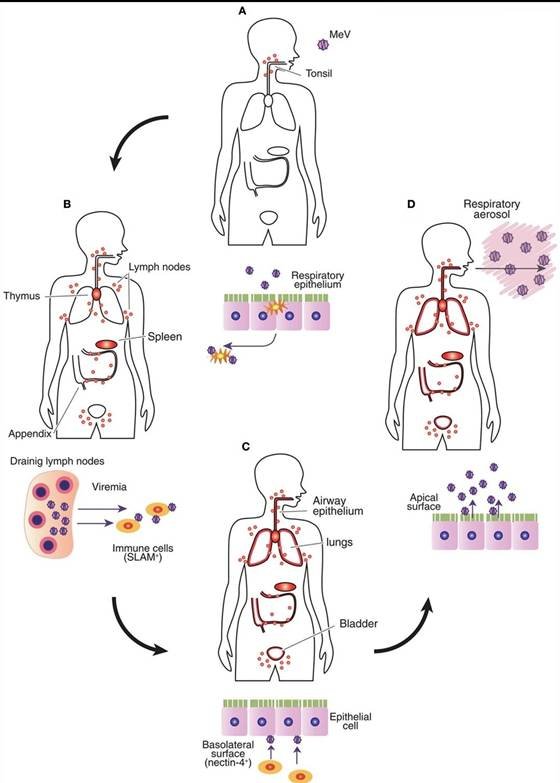
Figure 1. The measles infection pathway, from airway entry and immune-cell invasion to systemic spread and onward transmission.
This is where measles does something few other viruses do. As it infects and destroys memory lymphocytes, it can erase a meaningful slice of a child’s existing immune memory, a phenomenon researchers call immune amnesia, first demonstrated at scale in blood studies published in Science in 2019. A child can survive measles itself and still emerge from it more vulnerable to other infections for months afterward, having lost some of the immunological memory built up from earlier illnesses and earlier vaccines.
Only later does the virus complete its cycle, travelling back out to the epithelial cells lining the airway; this time through a different receptor, nectin-4, where it replicates toward the surface and is shed in respiratory droplets, ready to infect the next person.
In this way, measles uses the immune system to spread through the body, then returns to the respiratory tract to generate infectious virus for transmission to the next host.
That is the biological backdrop against which Bangladesh’s outbreak has to be read. A pathogen this contagious doesn’t need a wide crack in immunity to get through. A small one, left open long enough, works just as well.
Why are babies paying the highest price ?
This is where the Bangladesh outbreak requires a careful explanation.
Measles does not single out infants biologically. Anyone without immunity is at risk. But in an active outbreak, infants occupy a uniquely exposed position, for a reason that has nothing to do with parental neglect.
Bangladesh’s immunisation schedule, in line with WHO guidance for countries where measles still circulates, gives the first measles-rubella dose at nine months. An eight-month-old is not under-vaccinated. She is simply too young to have reached the age where protection begins, and in ordinary times, that gap is covered by the immunity of everyone around her. When population immunity is intact, the virus rarely reaches infants at all. When it is not, their vulnerability becomes the outbreak’s point of least resistance.
WHO’s outbreak investigation, published in April, found that children under five accounted for 79 percent of reported cases, children under two for 66 percent, and infants under nine months, too young for routine vaccination, made up 33 percent. A separate mortality review from Dhaka’s Infectious Diseases Hospital, covering deaths up to 23 August, found a sharper concentration: 86 percent of the 57 confirmed or suspected measles deaths it recorded were in children younger than 15 months, and 83 percent had received no measles vaccine at all. Pneumonia, measles’ most lethal complication, was documented in 88 percent of those deaths. The hospital was careful to note that, as a specialist referral centre, its figures are not nationally representative, but they describe, in stark terms, exactly who the virus is finding.
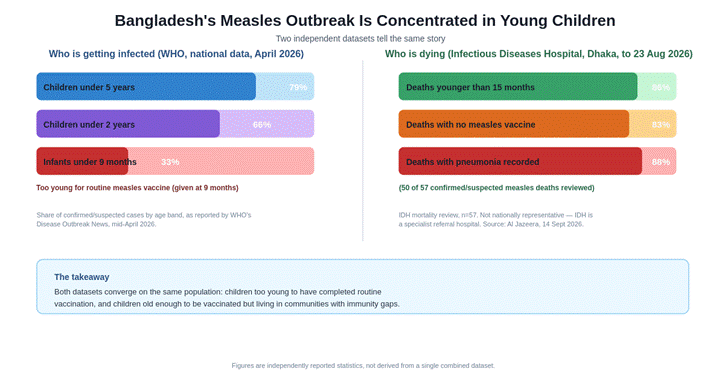
Figure 2. Age concentration of confirmed measles cases (WHO) and of reviewed deaths (Infectious Diseases Hospital, Dhaka).
The other half of the problem
The infant story explains only part of the outbreak. The rest involves children who were old enough to have been vaccinated, and were not.
Among confirmed cases reported by the DGHS in the outbreak’s early weeks, roughly 72 percent had received no dose at all, and another 16 percent had received only one of the two required doses. That is the more uncomfortable half of the picture, because it cannot be explained by a vaccination schedule working as designed. It reflects children who fell through it.
National coverage figures can conceal this kind of gap with ease. A country can report a respectable average immunisation rate while specific neighbourhoods, informal settlements, or hard-to-reach communities sit well below the 95 percent threshold that stops transmission. The virus does not notice Bangladesh’s national vaccination rate. It reaches one classroom, one slum, one settlement at a time, and if that population has enough unprotected children in it, an outbreak can ignite and sustain itself regardless of how the national number looks.
Where the immunity gap actually came from
Bangladesh had real grounds for confidence going into this decade: measles coverage was climbing, not slipping. First-dose measles-rubella coverage rose considerably through the 2000s and into the mid-2010s, and confirmed measles cases fell along with it. Then several things went wrong within a short span, and none of them had anything to do with parents refusing vaccines.
The country’s own 2023 Coverage Evaluation Survey recorded first-dose coverage slipping from 88.6 percent in 2019 to 86 percent by 2023, while second-dose coverage fell more sharply, from 89 percent to 80.7 percent. Routine immunisation had already taken a hit through the pandemic. There had not been a nationwide supplementary measles-rubella campaign since the one that ended in January 2021, five years without the kind of catch-up drive that normally mops up the children routine services miss.
Then, following the political transition of July 2024, procurement of the measles-rubella vaccine was delayed, according to Mushtuq Hussain, a former principal scientific officer at the Institute of Epidemiology, Disease Control and Research. That delay produced vaccine stockouts through 2024 and into 2025, right when the pool of susceptible children was already growing. Cases began climbing in January 2026 and surged sharply through March, and on 4 April the government formally notified WHO of a nationwide outbreak already present in 58 of its 64 districts. None of this required any single actor to make an obvious mistake. It was a chain of ordinary, explicable problems: a pandemic, a supplementary campaign postponed year after year, a change of government, a procurement delay. Together, they built quietly into a five-year accumulation of susceptible children large enough for a highly contagious virus to take hold.
Twenty million vaccinations, and still not enough
The emergency response has not been small. Since the campaign began in April, the country has vaccinated close to 20 million children, more than the original target of 18 million children aged six months to under five. And still, five months later, children continue to die.
That’s not really a contradiction. Vaccinating tens of millions of children mid-outbreak is a different job entirely from having kept population immunity high beforehand. One puts out a fire already burning. The other stops it from starting in the first place. There’s also a question of scale that the headline numbers don’t answer. A separate national campaign in June, distributing vitamin A to the same six-month-to-five-year age band, targeted roughly 24 million children, about six million more than the original measles campaign’s estimate. Epidemiologists, including Hussain, have since questioned whether the original population estimate simply undercounted the children who needed protection.
Twenty million vaccinations is, by any measure, an enormous logistical achievement. But the number that matters is not how many children were reached nationally, but whether coverage reached 95 percent in every community, including mobile and hard-to-reach populations that are easiest to miss and hardest to trace. Doctors at Dhaka’s Infectious Diseases Hospital report that most patients still being admitted are unvaccinated, while epidemiologists tracking the response say future rounds will need to focus on identifying specific pockets of susceptible children rather than simply pursuing another large national total.
Why measles kills
Measles itself is a systemic viral illness, but most of its deaths come through what it opens the door to afterward. Pneumonia, severe diarrhoea, dehydration, encephalitis and blindness are its major complications, and young or malnourished children carry by far the greatest risk. Vitamin A deficiency compounds all of it. WHO recommends vitamin A treatment for every child with suspected measles, because the infection itself can deplete vitamin A levels even in previously well-nourished children, and supplementation measurably reduces both complications and mortality.
Read against the biology, the sequence makes sense. Measles infects and depletes the immune cells a child would otherwise use to fight off a secondary infection, arrives in a body already carrying whatever nutritional deficits exist, and leaves pneumonia or dehydration to do the rest. That is a large part of why 88 percent of the deaths reviewed at Dhaka’s Infectious Diseases Hospital involved pneumonia rather than measles alone. The virus rarely needs to kill a child by itself.
A systems problem wearing a biological mask
It’s tempting to end a piece like this with one villain: a procurement delay, a missed campaign, a stockout. Each explanation is true. None of them, on its own, is enough.
What seems to have actually failed in Bangladesh is continuity. It’s the unglamorous, year-round grind of tracking down every child who missed a dose, running catch-up campaigns on schedule no matter what’s happening politically, and keeping vaccine supply chains stable through a change in government. Even the size of the gap is still being argued over: Hussain and others suspect the original population estimates simply missed how many children needed protection. Emergency vaccination can control an outbreak once it starts. It is not a substitute for the routine system that is supposed to prevent one from starting at all.
The science here has never been the hard part. The vaccine has existed since 1963. Its target, its transmission route, and its complications are all textbook material. What Bangladesh is relearning, at a cost of well over a thousand children’s lives, is that population immunity is not something a country achieves once and keeps. It has to be maintained, community by community, year after year, and the moment that maintenance lapses, a virus this contagious will find exactly where it lapsed.
References
1. Directorate General of Health Services (DGHS), Bangladesh. Daily measles situation updates, September 2026, as reported by The Business Standard and The Daily Star.
2. World Health Organization. “Measles – Bangladesh.” Disease Outbreak News, 2026-DON598, April 2026.
3. UNICEF. Bangladesh Humanitarian Situation Report No. 1: Measles Outbreak, 8 April 2026.
4. Al Jazeera. “Why Bangladesh has lost 1,000 lives to measles despite record vaccine drive.” 14 September 2026.
5. Al Jazeera. “Bangladesh measles deaths surpass 1,000 after vaccination drive falls short.” 9 September 2026.
6. The Business Standard. “Measles-related deaths rise to 1,044 in Bangladesh.” 16 September 2026.
7. Mina, M.J. et al. “Measles virus infection diminishes preexisting antibodies that offer protection from other pathogens.” Science, 2019.
8. Laksono, B.M. et al. “Measles Virus Host Invasion and Pathogenesis.” Viruses, 2016.
9. World Health Organization. “Measles vaccines: WHO position paper.” April 2017.
About Author:
Sabiha Zakir is a microbiology graduate currently pursuing an MSc in Biotechnology, with research interests in infectious disease, public health, and environmental health.