
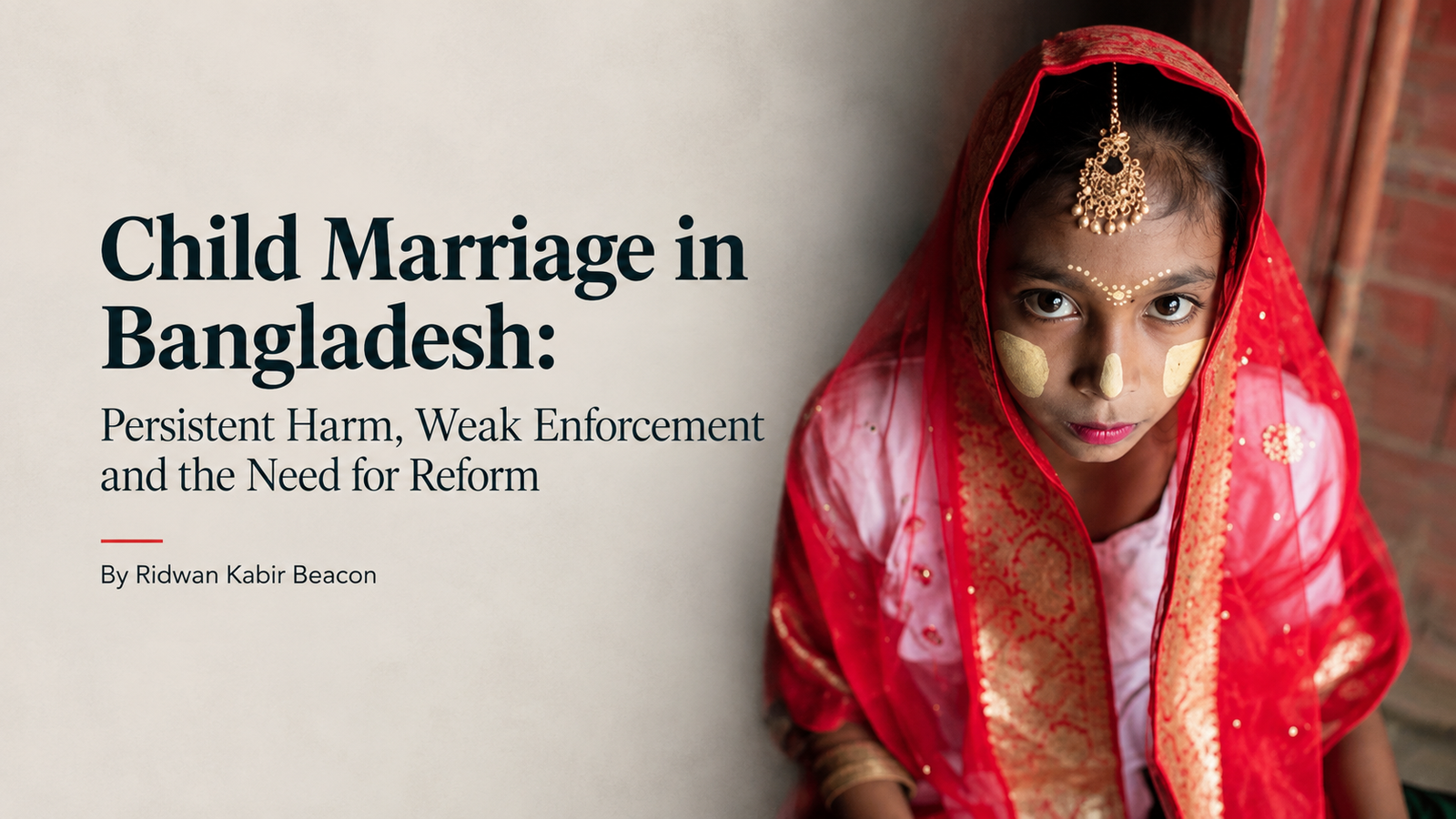
“I was a science student and got GPA 5 in my SSC exam. But before SSC, my family forced me to marry at 15. After that my husband did not want me to study. Still I managed to get into college, first in science, but since he did not let me attend, I had to shift to arts. I was supposed to sit for the HSC in 2025 but could not because I got pregnant and had to abort after 5 months. Now in 2026, I want to sit for HSC, but my in-laws are not allowing me.”
This story of an HSC candidate in 2026 shows how child marriage can disrupt almost every part of a girl’s life. She was married off at 15 despite having strong academic performance. Her husband stopped her from continuing her education. She had to change her academic group, became pregnant, underwent an abortion five months into the pregnancy, and is now being prevented by her in-laws from even sitting for the HSC examination.
This is not simply a story about one girl. Child marriage remains a serious problem in Bangladesh. According to the available data, 51% of women aged 20 to 24 were married before the age of 18, while 17% were married before the age of 15. Bangladesh therefore continues to have one of the highest rates of child marriage in Asia.
Now, what does the law say?
The principal legislative response is the Child Marriage Restraint Act 2017. The Act defines a child as a female below 18 years and a male below 21 years. It criminalises the contracting, solemnisation, registration and facilitation of child marriage, while also providing for preventive intervention by public authorities. The Act also establishes Child Marriage Prevention Committees and allows courts and administrative authorities to take action to stop an imminent child marriage.
At first sight, the law appears to provide a strong framework for preventing child marriage. But there is an important problem.
Section 19 of the Act allows marriage below the statutory minimum age in undefined “special circumstances”, with parental consent and judicial approval, where such marriage is considered to be in the child’s “best interests”.
This creates an obvious ambiguity.
A law intended to prevent child marriage should ideally be clear about when such a marriage is prohibited. But section 19 creates an exception without clearly defining what those “special circumstances” actually are. In practice, this creates the possibility that circumstances such as family pressure, pregnancy, poverty or other social difficulties could be used to justify a marriage that the law is otherwise intended to prevent.
The question, therefore, is not simply whether Bangladesh has a law against child marriage. We have one. The more important question is whether the law is clear enough, and whether it is being enforced effectively enough to protect the children it was created for.
Although there is limited reported case law directly interpreting the 2017 Act, Bangladeshi judicial authority supports a protection oriented approach.
In 2012, the High Court Division directed officials to explain their failure to prevent the reported marriage of a 12 year old girl. This showed that executive inaction in child marriage cases can be brought under judicial scrutiny.
More fundamentally, in Md Abu Bakar Siddique v SMA Bakar, the Appellate Division held that in matters concerning minors, the welfare of the child is the paramount consideration.
This principle is important when we think about child marriage.
A child marriage can affect a girl’s education, economic independence, physical and reproductive health and overall development. Therefore, any decision involving a minor must be approached primarily from the perspective of the child’s welfare rather than the convenience or wishes of the adults around her.
Similarly, in Bangladesh National Women Lawyers Association v Government of Bangladesh, the High Court relied on constitutional rights and international standards to protect women and girl children where domestic safeguards were insufficient.
These decisions indicate that if section 19 is applied by the courts, it should be interpreted narrowly and with the welfare of the child at the centre.
Now, what does the Constitution say?
Articles 17, 27 and 28 of the Constitution provide for education, equality before law and non discrimination on grounds of sex. Bangladesh is also bound by the Convention on the Elimination of All Forms of Discrimination against Women and the Convention on the Rights of the Child. These international instruments provide further support for protecting children from harmful practices and ensuring their development, education and dignity.
But the problem is not limited to the wording of the law.
The available data show that child marriage is particularly concentrated among communities facing greater structural disadvantage. In 2022, the prevalence was 53.3% in rural areas compared with 44.9% in urban areas. Among the poorest households, the rate was 64.1%, compared with 33.7% among the richest households. Rajshahi, Rangpur and Barishal also recorded particularly high rates.
This tells us something important.
Child marriage is not sustained only by social customs. Poverty, insecurity, limited access to education, family pressure and weak institutional oversight can all contribute to the continuation of the practice.
Then comes the biggest difficulty: enforcement.
A law can prohibit child marriage, but enforcing that prohibition becomes difficult when the basic information needed to enforce it is unreliable. Birth records can sometimes be inaccurate or deliberately altered, allowing false proof of age to be produced. Prevention Committees may also remain ineffective in practice. And even when a girl is being forced into marriage, she may have very limited ability to complain against her parents, future spouse or local intermediaries because she is dependent on them and may fear social stigma or other consequences.
Section 19 makes the situation even more complicated because its broad language can potentially be used to justify marriages that the general rule of the law is intended to prevent.
So, what should Bangladesh do?
Legal reform must go beyond simply declaring child marriage unlawful.
Section 19 should either be repealed or, at the very least, narrowed substantially so that poverty, pregnancy, family honour or similar social pressures cannot themselves become lawful grounds for child marriage. Any exception should be clearly defined and applied only in circumstances that genuinely protect the child’s welfare.
But changing the law alone will not solve the problem.
Girls who are already trapped in child marriages also need support. Educational reintegration, stipends, shelter, legal aid and reproductive health support can help girls regain some of the opportunities that were taken away from them.
The girl whose story we started with wanted to study. She had already demonstrated her academic ability by achieving a GPA 5 in her SSC examination. Yet marriage at 15 interrupted that path, and even years later, she is still struggling to continue her education.
That is why child marriage should not be understood only as an issue of age or marriage law. It is also an issue of education, health, economic independence, dignity and the ability of a child to make decisions about her own future.
The law may formally prohibit child marriage. But if a girl cannot prove her age, cannot access protection, cannot safely report a forced marriage and cannot return to education afterwards, then the protection remains incomplete.
The ultimate goal should therefore not simply be to punish child marriage after it happens. It should be to prevent it before it happens, protect the child when it is attempted, and support her when she has already been affected.
Because the real measure of a law is not only how strongly it is written. It is whether a girl like the one in this true story can actually live the life that the law promises to protect.
About Author:
Ridwan Kabir Beacon
Law Student, University of Dhaka.