
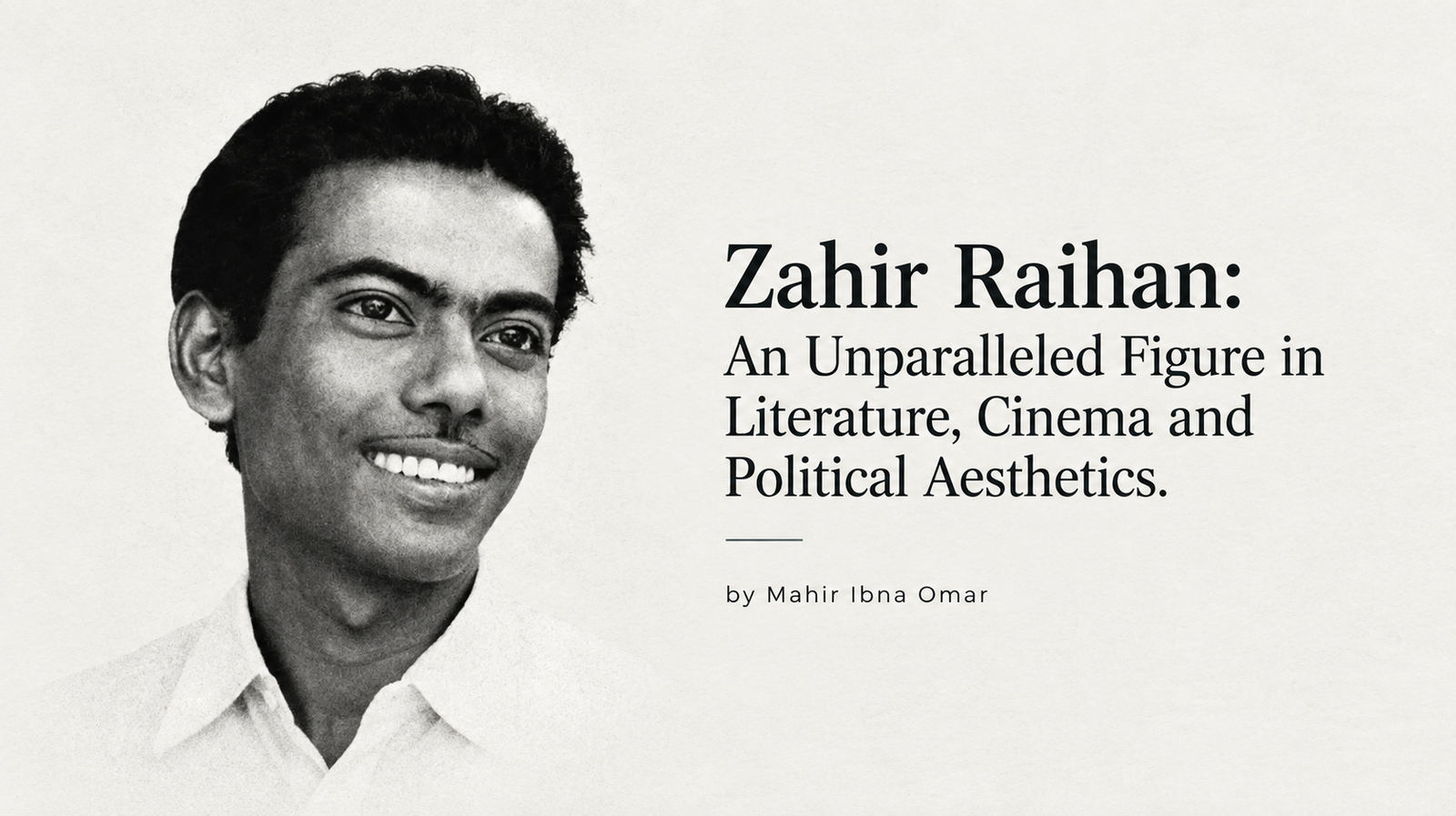
Abu Abdor Mohammad Zahirullah was born on 19 August 1935, in British India, in Majupur village of the present-day Sonagazi Upazila of Feni district. He was the third among eight siblings. His father, Mohammad Habibullah, was a teacher at the Calcutta Alia Madrasa, while his mother, Syeda Sufia Khatun, was a homemaker.
The transformation from his given name, Abu Abdor Mohammad Zahirullah, into the Zahir Raihan who became so deeply connected to our soul was itself quite remarkable. Passionate about the Bengali language, literature and underground politics, Zahirullah enrolled in the Department of Economics at the University of Dhaka in 1953 at his father’s insistence. He later re-enrolled in the Department of Bengali. It was during this period that he became directly involved in politics and became a full-fledged member of the Communist Party. In the newly created Pakistan, founded on the communal Two-Nation Theory, the Communist Party was banned, forcing its members to operate secretly. Comrade Moni Singh, one of the party’s leaders, therefore gave him the pseudonym ‘Raihan’. Later, Zahirullah shortened his name and added ‘Raihan’ to it, becoming Zahir Raihan. Our Zahir Raihan,, the Zahir Raihan of our soul.
Zahir Raihan was an extraordinary figure in the literary, cinematic and political landscape of Bengal and the Indian subcontinent. Particularly in the history of Bengali literature and cinema, he stands out as an artist whose creative vision was simultaneously literary, cinematic and political. He was a fiction writer, journalist, playwright, filmmaker, screenwriter, magazine editor and political-cultural activist. What made his artistic identity distinctive was that literature and cinema were never separate mediums for him. Rather, they were two powerful means of expressing the same social realities, political crises and human questions. Therefore, to assess Zahir Raihan merely as a talented creative artist would be to overlook the full extent of his historical significance. He must instead be understood as one of the important figures in the making of Bangladesh’s national and cultural identity.
Zahir Raihan’s artistic consciousness developed at a time when East Bengal was passing through profound political, economic and cultural inequalities. The foundation of his artistic consciousness was deeply rooted in his political activism. His literature and cinema cannot be fully understood outside this historical context. In his work, the crisis of the individual gradually becomes connected with larger social and political crises. After the Partition of 1947, East Bengal became part of Pakistan, but relations between East and West Pakistan increasingly became marked by disparities in political power, economic resources and cultural authority. The resistance that emerged over language, culture, economic rights and political autonomy had a profound impact on the literature and artistic practices of the time. Zahir Raihan was deeply influenced by this historical transformation.
He actively participated in the Language Movement of 1952, and this experience later shaped the political character of his literature and cinema. On 21 February 1952, at the very beginning of the Language Movement, he was among the first group of ten young protesters arrested for violating Section 144. He was also present at the historic gathering at Amtala that day. In June of the same year, he was arrested again and spent three months in prison. It was during this period of his student life that cinema began to take hold of his imagination. After being released from prison in 1952, he went to Calcutta to study cinema and enrolled at the Promtheś Barua Memorial Institute of Cinematography. However, due to financial difficulties, he had to leave the course after six months and return home. He subsequently resumed his studies at the University of Dhaka.
The Language Movement had a profound influence on Zahir Raihan’s literary career. He entered the film industry in late 1956, and his first directed film, “Kokhono Asheni”(Never Came), was released in 1961. His first novel, Shesh Bikeler Meye (The Girl of the Late Afternoon, 1960), followed by Trishna (1962), Hajar Bochhor Dhore (Thousands of Years, 1964), Arek Falgun (Another Spring, 1969), Ekushey February (1970), Ar Koto Din (How Much Longer, 1970), Mahamrityu, Ekusher Golpo and his other literary works all bear the unmistakable influence of the Language Movement. Observing this connection, Humayun Azad remarked that Zahir Raihan was perhaps the only Bangladeshi fiction writer whose emergence as a writer was rooted in the Language Movement. Had 21 February 1952 never happened, Zahir Raihan might perhaps never have become a fiction writer.
His political consciousness found a particularly direct expression in his novel Arek Falgun. Set against the backdrop of the Language Movement, the novel captures the spirit of resistance and sacrifice among young people in the face of state repression. Here, language is not merely a means of communication; it becomes a symbol of cultural identity and political rights. Thus, the Language Movement was not an isolated historical event for Zahir Raihan. Rather, it represented a fundamental moment in the formation of Bengali national identity. This understanding later strengthened the political and artistic foundations of his cinema.
Alongside literature, cinema became the most powerful medium of Zahir Raihan’s artistic expression. His importance in the history of Bengali cinema is particularly significant because he never regarded cinema merely as entertainment. In his films, narrative, visual composition, editing, sound, symbolism and political expression come together to form a conscious cinematic language. He did not reject the popular and entertaining possibilities of cinema; instead, he incorporated social and political meanings within them. As a result, his films could remain accessible to audiences while also being deeply politically conscious. The young filmmaker Zahir Raihan, working under the political conditions of Pakistan, was even described as the Michael Madhusudan Dutt of Bengali cinema.
A total of 31 films are associated with Zahir Raihan. He worked as an assistant director on 4 films, directed 8 full-length films, produced 12, wrote screenplays for 16 and wrote stories for 12 films. Alongside full-length films in Bengali, Urdu, English and Russian, he also produced documentaries, short films and other non-fiction works.
From the very beginning of his career, Zahir Raihan demonstrated remarkable skill in making women-centred films. Of the eight full-length narrative films he directed independently, Kokhono Asheni (1961), Kacher Deyal (The Glass Wall, 1963), Behula (1966), Anwara (1961), and Jibon Theke Neya (Taken from Life, 1970) are particularly concerned with women’s rights, suffering and struggles. During the 1960s, he also directed two Urdu-language films, Sangam (1964) and Bahana (1965). These were respectively the first colour film and the first CinemaScope film in the history of Pakistan and Bangladesh cinema.
His Kokhono Asheni is an important example of realism and psychological exploration in Bengali cinema. Rather than following the conventional structure of commercial cinema, the film focuses on human desire, loneliness and the complexities of relationships.
Yet the most celebrated expression of his cinematic genius is undoubtedly Jibon Theke Neya. Among all his films, this 1970 production remains one of the most discussed and historically significant. To view it merely as a political film would be to underestimate its artistic achievement. Its real strength lies in transforming political reality into the symbolic structure of family relationships. Through the power dynamics within a family, Zahir Raihan constructs a miniature representation of the political power structure of a state. Thus, a conflict within the family gradually becomes a metaphor for a larger political conflict. This transformation makes the film much more powerful than a straightforward piece of political propaganda.
One of the most significant aesthetic techniques of Jibon Theke Neya is symbolism. The authoritarian structure within the family reflects the authoritarian structure of the state. The household becomes, in effect, a miniature version of the state itself. Personal and political freedom, family and state, individual liberty and national independence consequently become interconnected. The political message of the film therefore does not depend merely on dialogue or slogans; the very structure of the film becomes political.
A landmark in Bengali cinema, Jibon Theke Neya is widely regarded as the first explicitly political film of its kind in Pakistan and Bangladesh cinema. The film opens with real footage of a Prabhat Pheri, accompanied by the iconic song “Amar Bhaier Rokte Rangano Ekushey February,” and ends with the cry of a newborn child named ‘Mukti’. That cry can be interpreted as an arrival announcement of a new nation, a new linguistic state, on the world map. The use of five celebrated songs in the film is also highly significant. Among them, “Amar Sonar Bangla” would later become the national anthem of Bangladesh. Released in April 1970, the film used metaphor to capture the Bengali people’s struggle for freedom at one of the most turbulent moments in their history. It was the last narrative feature film directed by Zahir Raihan to be released during his lifetime.
The Liberation War of 1971 pushed Zahir Raihan’s artistic consciousness into a more direct political role. During the war, he went to India and became actively involved in cultural and cinematic efforts supporting the Liberation War. His documentary Stop Genocide played an important role in presenting the atrocities and mass killings committed by the Pakistani forces to international audiences. Rather than portraying the war merely as a political conflict, he focused on the human reality of violence inflicted upon ordinary people. Consequently, Stop Genocide became an important cultural document in the history of international awareness about the Bangladesh Liberation War.
The significance of Stop Genocide lies not only in its political message but also in its cinematic technique. The documentary opens with a sketch and statement by Lenin, followed by footage of American bombing in Vietnam, the bodies of Vietnamese children and scenes of destruction caused by Nazi forces. This makes it clear that the film was not merely a representation of Bangladesh’s struggle; it was also conceived as a symbol of the consciousness of freedom-loving people across the world. Through newsreel footage, real images, narration and careful visual arrangement, Zahir Raihan created a cinematic language that confronted viewers with the reality of war. Here, cinematic beauty becomes secondary to the brutal truth of reality. In this sense, his documentary filmmaking was a form of political testimony. He used the camera not merely as an artistic instrument, but also as a witness to history.
His other wartime documentary, A State Is Born, was equally important in communicating the cause of Bangladesh’s independence and documenting the political and cultural reality of the Liberation War. Through Stop Genocide and A State Is Born, Zahir Raihan brought the Bangladesh Liberation War, the atrocities committed by the Pakistani military, the genocide and the suffering of the Bengali people before an international audience. Through these documentaries, he transformed cinema into an effective cultural weapon of the national liberation struggle. It is here that the relationship between art and politics in his cinematic vision becomes most evident.
Another important characteristic of Zahir Raihan’s cinematic language is his use of symbols and metaphors. Rather than relying solely on direct statements, he created political meanings through visual symbols, character relationships, locations and environments. As a result, his films often demand active participation from the viewer. The audience does not merely follow the story; they are also invited to interpret the deeper political and social meanings embedded within the images.
The relationship between his literature and cinema is also particularly significant. His literary experience enriched his approach to storytelling and character construction in cinema, while the visual nature of filmmaking influenced his literary imagination. There was therefore no rigid boundary between literature and cinema in his artistic consciousness. His literary descriptions often possess a strong visual quality, while his films contain a remarkable depth of literary narrative. In this sense, Zahir Raihan can be regarded as an important bridge between Bengali literature and cinema.
The final and most tragic chapter of Zahir Raihan’s artistic life was his disappearance. On 30 January 1972, he went in search of his elder brother, the writer and journalist Shahidullah Kaiser, and never returned. His disappearance, so soon after the independence of Bangladesh, remains one of the country’s most painful historical tragedies. Although there is no definitive official evidence establishing the circumstances of his death, his disappearance has remained a lasting source of grief and unanswered questions. It is also often discussed in relation to the broader violence against intellectuals and cultural figures in the aftermath of the Liberation War. However, there have also been alternative claims regarding his fate. Veteran journalist Nirmal Sen, for instance, claimed that Zahir Raihan was killed by members of the Mujib Bahini. At only 36 years and five months of age, the short but extraordinarily intense life of the revolutionary filmmaker Zahir Raihan came to an abrupt end; whether through disappearance or through violence at the hands of his killers.
Despite his short life, the breadth of Zahir Raihan’s literary and cinematic achievements is astonishing. His literature captured social inequality, exploitation, the struggles of the middle class and questions of human existence, while his films addressed Pakistani colonial domination, communalism, class inequality, nationalism and the desire for liberation. Therefore, to assess him simply as a talented writer or filmmaker would be to overlook his historical significance. He must be understood as one of the important figures in shaping Bangladesh’s national and cultural identity.
Zahir Raihan demonstrated that literature and cinema can simultaneously serve as mirrors of society and instruments for questioning it. He showed that nationalist consciousness can be expressed not only through political slogans but also through people’s everyday lives, culture, language, relationships and memories. He also demonstrated that an artist can be both aesthetically sophisticated and deeply political. Artistic beauty and social responsibility do not have to be opposites.
His unfinished life has given his work an additional historical significance. He left behind an extraordinary body of literature and cinema at a remarkably young age, suggesting the immense creative possibilities that remained unrealised. Had he lived longer, one can only imagine what further directions Bangladeshi literature and cinema might have taken through his work. Yet this incompleteness itself has become part of his historical legacy. He remains inseparably connected to the dreams of independence, the struggles that produced Bangladesh and the uncertainties that followed.
Zahir Raihan’s life was brief, but extraordinarily concentrated. What he created within just 36 years is remarkable in both Bengali literature and cinema. Even today, he is regarded as one of the most important and influential artist-thinkers in the cultural history of Bangladesh. His life and death are so deeply intertwined with the political history of Bangladesh that calling him merely an artist would be insufficient. He was, simultaneously, an artist and a fighter.
He remains very close to us, close to the heart. He is the Hajar Bochhor Dhore of our collective memory, the Arek Falgun that keeps coming again and again. He is still relevant. Indeed, during the July uprising of 2024, we repeatedly heard the words: “Ashche Falgun, Amra hobo digun” (In the coming Falgun, we will multiply.) That echo itself reminds us how deeply his imagination continues to live within our political and cultural consciousness.
At the intersection of art and politics, aesthetics and resistance, Zahir Raihan occupies an unparalleled place in Bangladesh’s cultural history. His work continues to remind us that an artist does not merely document his time; at times, an artist becomes a part of the struggle that defines that time. Zahir Raihan was precisely such an artist.
References
• Jahangir Mohammad: “Biplobi Zahir Raihan o Tar Rajnoitik Chalachchitra.” Kali O Kalam.
• “Zahir Raihan”: Banglapedia.
• Morshedul Alam: “Novels of Zahir Raihan: Theme and Art Style.”
• Mario Hirstein: Genocide, Gender and Nation in Zahir Raihan’s Stop Genocide (1971).”
• The Daily Star. “Let There Be Light: A Look into the Life and Works of Zahir Raihan.”
• Naznin Tithi: “Zahir Raihan and the Making of Jibon Thekey Neya.” The Daily Star, 18 August 2021.
• Zahir Raihan: Hajar Bochhor Dhore. Dhaka: Anupam Prakashani.
• Zahir Raihan: Arek Falgun. Dhaka: Anupam Prakashani.
About Author:
Mahir Ibna Omar
Executive, The Bangladesh Dialogue