
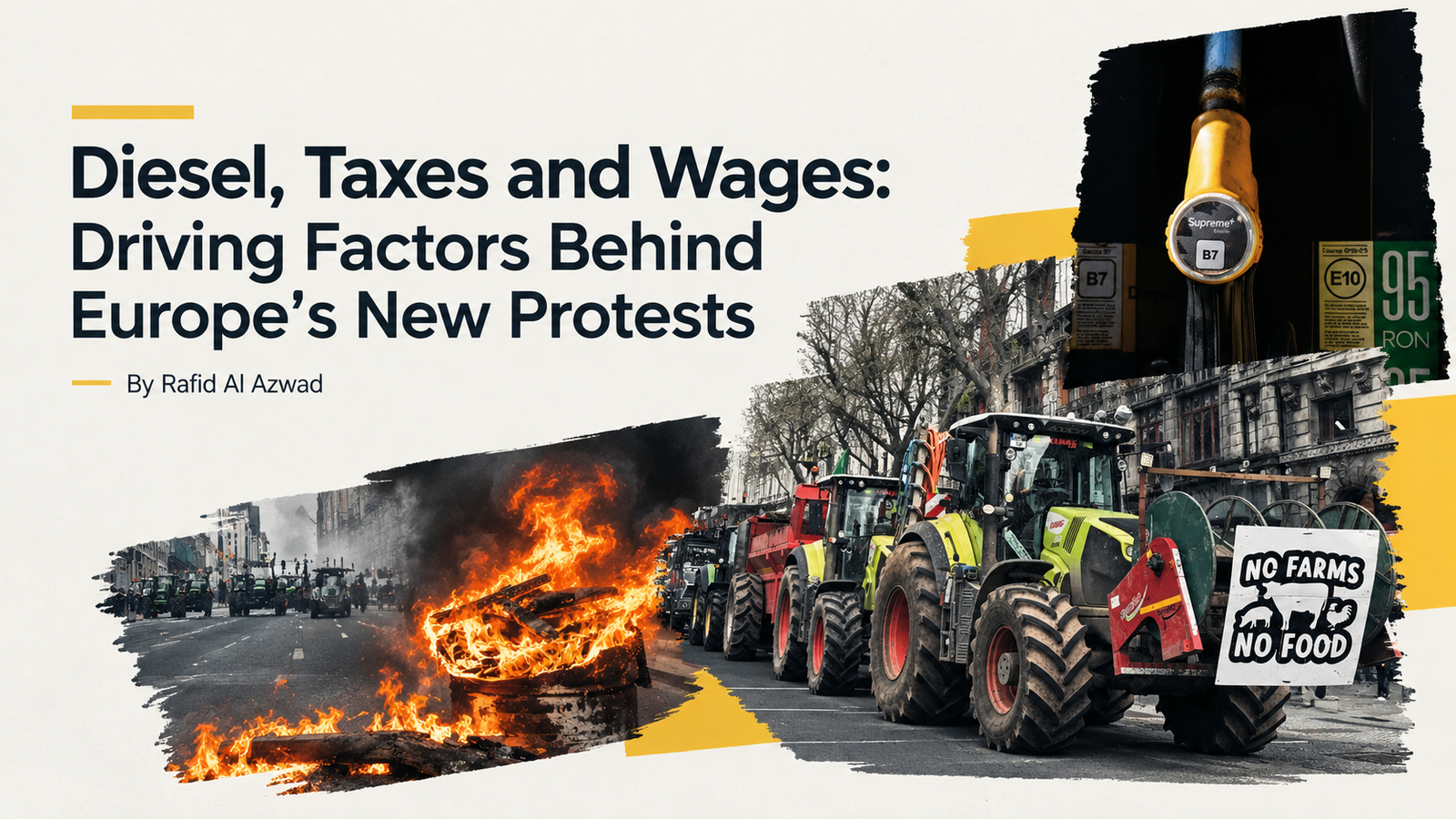
Fishermen in France, truckers in Portugal, rural campaigners in Ireland and workers in Greece are reacting to the same energy shock. Their grievances differ, but in three of the four countries the right is moving fastest to claim the anger.
In mid-September, about a hundred fishermen and their supporters blocked the fuel depot at Frontignan, near Sète, a day after police cleared a similar blockade at Fos-sur-Mer outside Marseille. On 25 September, hundreds of lorries crawled along a motorway in north-central Portugal while commuters sounded their horns on Lisbon’s 25 de Abril bridge. Two days later, a packed hall in Moate, County Westmeath, demanded that Ireland scrap its carbon tax. Earlier in the month, Greek farmers drove tractors into central Thessaloniki as their prime minister delivered his annual economic address.
It is tempting to read these scenes as one European uprising. However, they should be better understood as separate national disputes set off by a common shock, each shaped by its own politics, tax system and habits of protest. What they increasingly share is a political contest over who speaks for the people paying at the pump. In France, Ireland and Portugal, parties and activists of the right have pressed hardest, and earliest, to win it.
The shock began in the Gulf. Since the United States and Israel launched strikes on Iran in late February, shipping through the Strait of Hormuz, which carried roughly a fifth of the world’s oil before the war, has been severely restricted. In its September oil market report, the International Energy Agency put Brent crude at about $105 a barrel, 45% above pre-war levels, with Gulf oil exports at nearly half their pre-war volume.
For people on Europe’s roads, though, crude is only the starting point. What they buy is refined fuel, and refining has become the tightest link in the chain. The IEA reported that diesel refining margins in north-west Europe exceeded $100 a barrel in early September, so the finished product has risen far faster than the oil it is made from. Reuters also pointed to attacks on refineries linked to the war in Ukraine.
Tax then shapes what motorists actually pay. Excise duties, carbon levies and VAT make up a large share of the pump price across much of Europe, which is why the same barrel produces different prices in Lisbon, Dublin and Madrid. Portugal’s energy regulator, ERSE, attributed most of its gap with Spain to taxation. According to the IRU, the international road transport body, the EU’s weighted average diesel price reached €2.26 a litre on 17 September, 38% higher than at the end of February, even though crude remained below its peak from April. That matters politically. When a large share of the price is tax, the anger has a domestic target, and the demand to cut it is one the populist right has been quickest to champion.
Diesel is the fuel of work. It moves lorries, tractors, fishing boats and construction machinery, so when it rises, the cost of growing, catching, building and delivering rises uniformly. Eurostat’s flash estimate, published on 2 October, put euro area inflation at 3.8% in September, up from 3.2% in August. Energy prices were 18.8% higher than a year earlier, while core inflation, which excludes energy and food, stood at 2.5%.
That gap helps explain who is protesting. The squeeze is concentrated, and it falls hardest on those who burn fuel to earn a living and cannot quickly pass the cost on. The Portuguese quarrying and haulage firms behind the September convoy told the Portugal Resident that fuel accounts for around 70% of their operating costs, and that contracts signed before the latest rises leave them absorbing the difference. An Irish hauliers’ representative told RTÉ that many firms become unviable once diesel passes €1.90 a litre; some Irish forecourts were charging more than €2.10 in late September.
In France, the trigger was the price at the pump. Diesel, the country’s most widely used fuel, passed €2.37 a litre on 17 September, close to its record, according to government data. Fishermen led the first wave, blockading oil depots at Fos-sur-Mer and Frontignan and the ports of Nice and Grau-du-Roi. Their stated aims were a cut in the price of diesel and a meeting with the fisheries minister.
The government’s answer was targeted rather than general. On 16 September, Prime Minister Sébastien Lecornu extended sector-specific fuel aid to the end of the year, raising the subsidy for fishermen from 25 to 35 cents a litre, keeping 15 cents for farmers and 20 cents on non-road diesel for construction firms. The fishermen resumed their blockades the next day, and the CGT union demanded urgent talks on purchasing power and a price freeze.
French discontent has since spread well beyond fuel. On 29 September, public-sector workers struck and high school students blocked schools in protest at planned budget cuts, Reuters reported, as the government pursues a savings drive of around €54 billion. Calls for a revived “yellow vest” day of action on 17 October have circulated online. The echo is deliberate: the 2018 movement also began as a revolt against fuel taxes.
The National Rally moved quickly to claim the issue. On 18 September, arriving at an Élysée crisis meeting of party leaders, its president, Jordan Bardella, demanded “a cut in fuel taxes” to answer what he called the “suffering” of “working France”, and he has said he wants purchasing power to be the defining issue of next year’s presidential election. Not every claim has held up. Bardella said a European Parliament vote on 15 September would add 15 cents to the pump price; Libération reported that the Parliament says the vote was designed to limit that increase. The mainstream right is chasing the same voters: Bruno Retailleau of the Republicans has proposed scrapping the energy-saving certificates that help fund electric-car subsidies, which he says would cut pump prices by 15 to 17 cents.
The party starts from strength. Polls by Elabe, Ifop and Harris Interactive in late August put Marine Le Pen on between 33% and 38% in the first round, roughly double her nearest rival, and Reuters reported that surveys consistently show her best placed to win. A fuel crisis landing on a deeply unpopular government seven months before the vote is precisely the kind of issue on which the National Rally has built its appeal.
Portugal’s protest is narrower and more explicitly about tax. The 25 September convoy was organised by small firms in quarrying, earthworks and aggregates haulage, joined in Lisbon by a bridge users’ association. Reuters described hundreds of trucks taking part; organisers had hoped for more than 500. Eurostat data cited by Reuters showed Portuguese pump prices up 24% year on year in August.
The demands, relayed to the Lusa news agency, included suspending motorway tolls and the 23% VAT on fuel, reinstating pandemic-era remote working, and the resignation of the environment and energy minister, Maria da Graça Carvalho, after she suggested people drive more slowly to save fuel. Truckers also sought partial refunds of fuel tax.
Prime Minister Luís Montenegro has preferred a different tool. His government adjusts the tax on petroleum products weekly to offset the extra VAT the state collects as prices rise; the discount reached about 23 cents a litre in September and has been extended to the end of the year, alongside a 10-cent rebate on professional diesel. He has refused to cut VAT, as the Socialist Party and Chega propose, saying he will not pay for further discounts with more deficit or debt. The infrastructure minister agreed to meet the truckers.
Chega, the radical-right party, is among those pressing for that VAT cut, alongside the Socialists, and the mood plays to its strengths. A DN/Aximage poll in July put Chega on 26.4%, ahead of the governing Democratic Alliance on 23.2%, and the weekly CNN Portugal tracking poll in September showed the Socialists, Chega and the AD in a statistical tie. Not every survey agrees; some have recorded a dip for Chega. But a government that refuses further tax cuts while pump prices hit records, and a minister who tells drivers to slow down, hand an insurgent party an easy argument.
Ireland’s dispute has a longer arc. In April, convoys of tractors and lorries blockaded roads and fuel depots for about a week, led by farmers, hauliers and agricultural contractors. The government responded with excise cuts worth 32 cents a litre on diesel and 27 cents on petrol, and a €505 million support package.
Those blockades were also where the far right made its most visible bid. TheJournal.ie and The Irish Times reported that far-right figures became involved from the start. Kildare county councillor Tom McDonnell told protesters from a truck that “our country is at stake” and called for international protection centres to be closed to fund farmers. From Britain, the activist Tommy Robinson urged Irish people to “take their country back”. Both outlets stressed that the protests were not far-right in origin, and some protesters pushed back: when the anti-immigration campaigner Philip Dwyer tried to steer the conversation toward immigration, a farmer told him the protest was “about fuel”. Organisers removed far-right figures from their WhatsApp groups.
The current phase is aimed at the budget due on 6 October, and at the carbon tax in particular. At the Moate meeting on 27 September, organisers demanded that the tax be abolished across the board, including on home heating oil and food production, and warned of renewed action if the budget disappointed. The Irish Times put attendance at more than 1,000; the Irish Examiner described hundreds. Representatives of Sinn Féin, Aontú and Independent Ireland attended. Heating matters here: the average cost of 500 litres of kerosene rose from about €500 in February to €815 in September, according to figures cited by the Examiner.
The people leading the campaign carry some of that history. Among the organisers in Moate were James Geoghegan and Christopher Duffy, both spokesmen in April, when TheJournal.ie reported that Duffy had posted anti-immigrant content online and that Geoghegan had appeared on Dwyer’s livestreams. The parties gaining ground sit mainly on the conservative and rural right. Aontú reached 8% in the Sunday Independent/Ireland Thinks poll in September, its highest in that series, and rose two points to 5% in the Irish Times/Ipsos B&A poll; Independent Ireland polls between 4% and 7%. Researchers at Oslo’s C-REX centre judged in April that the far right had so far gained little, but warned that its potential would grow if the protests turned to home heating oil. The Moate meeting did exactly that.
Ministers have signalled that the excise cuts, due to start unwinding in November, will be extended into early spring. The Taoiseach, Michéal Martin, said people had a right to protest, but that jobs, the economy and the ports had to be protected.
Greece is the clearest case in which fuel is one grievance among several. On 5 September, unions and protest groups rallied in Thessaloniki as Kyriakos Mitsotakis gave his annual economic speech. The Associated Press reported thousands of protesters; police put the number above 25,000, according to Brussels Signal. The head of the GSEE union framed the issue as affordability, with wages low and prices soaring. AP noted that Greek workers have the lowest purchasing power in the EU, despite a budget surplus and growth of 2.1% last year. Farmers, meanwhile, spent much of the winter blockading highways over production costs, delayed EU subsidies and a farm-fund fraud scandal.
The government’s response has been broad. It promised tax cuts and wage and pension rises worth more than €2 billion over the next year, including zero income tax for farmers on earnings up to €20,000 and an excise refund on farm diesel at the pump from 1 November. On 30 September it raised its diesel subsidy from 10 to 15 cents a litre for the first half of October, a 20-cent cut once refiners’ discounts are included. Heating oil measures are due on 14 October.
Greece is the exception to the pattern, at least so far. There, the anger has been organised mainly by trade unions, and the competition for the farm vote is being waged by the centre-right government itself. Farmers and livestock breeders gave 48% of their vote to Mitsotakis’s New Democracy, according to Proto Thema, and the zero-tax pledge and diesel refund are aimed squarely at holding them before an election due by spring 2027.
Across the wider continent, research suggests energy shocks of this kind tend to help the radical right. A study published in August, “The Political Consequences of Energy Price Shocks: Evidence from Germany”, found that households whose electricity bills rose by more than the median after Russia’s invasion of Ukraine were 7.5 percentage points more likely to support the far-right AfD, with no comparable gain for any other party, Anadolu Agency reported. RTÉ noted this week that high energy costs are thought to be feeding far-right support across Europe, and that major gains for far- and hard-right parties are expected in France, Spain, Italy and Poland next year. Governments, meanwhile, are holding back: the IRU observed in September that national fuel measures across the EU are being tapered rather than deepened.
That reflects a bind every government shares. Relief costs money finance ministers say they lack: France is trying to pass a budget built on spending cuts, Ireland has pledged to keep spending growth at or below 6%, and Mitsotakis insists his package respects commitments to Brussels. Broad subsidies can also prop up demand while the European Central Bank fights inflation; it raised interest rates by a quarter point on 10 September. Cutting fuel taxes sits uneasily, too, with Europe’s commitment to move away from fossil fuels. In Ireland, carbon-tax revenue helps fund targeted welfare and agri-environment schemes, which is partly why the argument over scrapping it is so heated. Each of these constraints is an opening for the right, which can promise the tax cut that finance ministers refuse and present carbon levies and Brussels rules as the real problem.
The right does not have the field to itself. Sinn Féin wants the carbon tax lifted from home heating oil, Portugal’s Socialists back the same VAT cut as Chega, and France’s Communist leader, Fabien Roussel, has also said the government can cut fuel taxes. But the right has framed the issue most aggressively, tying the price at the pump to climate policy, to Brussels and, at its fringes, to immigration. France and Greece both vote by spring 2027, and those elections will be the first real test of whether that framing turns into votes.
What the protests reveal is not one European movement but the reach of one shock. A disrupted strait in the Gulf has become a fisherman’s fuel bill in Sète, a quarry owner’s loss-making contract near Coimbra, a kerosene delivery in the Irish midlands and a stretched pay packet in Thessaloniki. Each country filters that shock through its own taxes, fiscal limits and older grievances. Yet in France, Ireland and Portugal the political current runs in the same direction: the people paying most at the pump are being courted hardest by the right. Governments can soften the price for a while. They cannot set the price of a barrel of oil, and the longer the disruption lasts, the more of that anger their opponents will try to claim.
Sources
- Reuters via US News: France to extend targeted fuel aid (16 Sept 2026)
- The Local France: Another oil depot blocked as French fuel protests spread
- Reuters: Student protests and French public sector strike (29 Sept 2026)
- Reuters: Truckers, commuters protest in Portugal (25 Sept 2026)
- Portugal Resident: Hundreds of trucks to stage motorway go-slow
- Euronews: Portuguese PM outlines plan without changing VAT
- The Irish Times: Fuel protesters warn of further action
- RTÉ: Further fuel protests not ruled out, says hauliers group
- Irish Examiner: Ireland’s carbon tax explained
- AP: Greeks promised tax relief as protesters take to the streets
- Brussels Signal: Mitsotakis promises tax cuts and higher wages
- To Vima: Mitsotakis announces fuel subsidies (30 Sept 2026)
- IEA: Oil Market Report, September 2026
- IRU: Diesel prices surpass previous 2026 records
- Eurostat: Euro area flash inflation, September 2026
- Public Sénat: Flambée des prix du carburant, Bardella at the Élysée (18 Sept 2026)
- Libération fact-check on Bardella’s European Parliament claim
- Opinion polling for the 2027 French presidential election
- Observador: Sondagens (Portuguese polling)
- Lusa via AMAN: Government aims to extend fuel tax cut until year’s end
- TheJournal.ie: How Ireland’s far-right movement got involved in the fuel protests
- The Irish Times: How the fuel protests brought the country to a standstill
- RTÉ: Fuel protest group call on Government to abolish carbon tax
- The Irish Times: Poll reveals growing fragmentation of the Irish political landscape
- RTÉ: Sinn Féin most popular party among voters, opinion poll
- C-REX: The Irish Fuel Protests: A Driving Force for the Far-Right?
- Proto Thema: What Mitsotakis’ announcements at the Thessaloniki fair will bring
- Anadolu Agency: Study links German electricity bill increases to rising AfD support
- RTÉ: How is the EU dealing with energy price shocks? (3 Oct 2026)
About Author:
Rafid Al Azwad
Executive, TBD